
Victoria BC Real Estate Economic Outlook: What Buyers and Sellers Should Watch in 2026 and Beyond
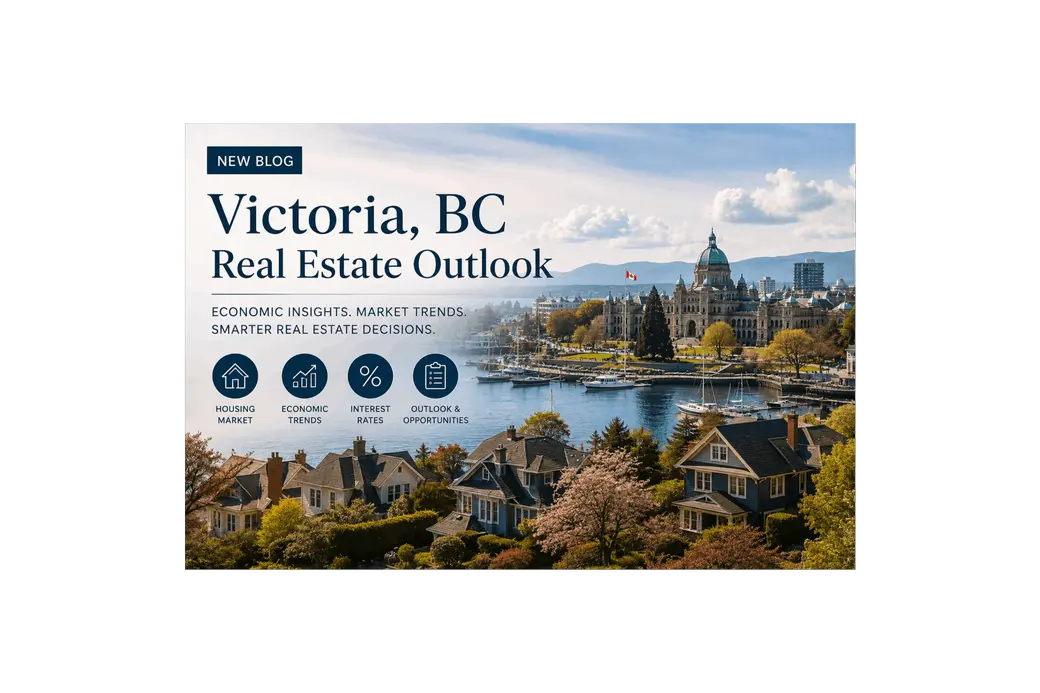
Victoria BC Real Estate Economic Outlook: What Buyers and Sellers Should Watch in 2026 and Beyond
The Victoria real estate market has entered a very different phase from the highly competitive conditions experienced during the pandemic years.
As we move through the second half of 2026, buyers have more properties to choose from, sellers are facing more competition, and interest rates and the broader economy continue to influence how quickly people are prepared to make a move.
So, what does the economic outlook tell us about where Victoria real estate may be heading?
Rather than trying to predict exactly what home prices will do, it is more useful to look at the economic forces that are likely to influence the market over the next 12 to 24 months.
Victoria's Housing Market Is More Balanced
One of the biggest changes in Victoria real estate has been the return of inventory.
At the end of July 2026, there were 3,847 active listings across the Victoria Real Estate Board region, approximately 3.9% more than a year earlier.
Sales, meanwhile, have remained relatively steady. There were 673 properties sold in July 2026, just 1% fewer than July 2025.
The difference can be felt in the buying experience.
Instead of buyers having to compete immediately for a limited number of properties, many now have more time to compare homes, consider neighbourhoods and negotiate the terms of an offer.
For sellers, that means pricing and presentation have become increasingly important.
Victoria Home Prices Have Softened
More inventory has also reduced some of the upward pressure on prices.
In July 2026, the MLS® Home Price Index benchmark value for a single-family home in the Victoria Core was approximately $1,311,000, down 2.8% from July 2025.
The benchmark condominium price was approximately $548,600, down 2.2% year-over-year.
This doesn't mean every property has declined by the same amount. Real estate remains extremely local, and results can vary considerably by neighbourhood, property type, condition and price range.
What it does demonstrate is that today's market is less forgiving of ambitious pricing than the low-inventory markets of previous years.
Interest Rates Remain One of the Biggest Factors
Mortgage affordability continues to play an enormous role in Canadian real estate.
The Bank of Canada held its policy interest rate at 2.25% in July 2026.
The Bank has also indicated that Canada's economy is beginning to improve, although uncertainty remains. Canadian GDP growth is projected at just 0.7% for 2026, before strengthening to approximately 1.8% in both 2027 and 2028.
Inflation is also expected to move back toward the Bank of Canada's 2% target in early 2027.
For real estate, the direction of borrowing costs matters because even relatively small changes in mortgage rates can materially change a buyer's purchasing power.
However, lower rates don't automatically mean rapidly rising home prices. Employment, consumer confidence, household debt, inventory and affordability all influence whether buyers actually decide to enter the market.
For readers who want to explore mortgage-rate forecasts and affordability scenarios in more detail, I recommend reviewing the research and forecasts available through Mortgage Sandbox.
British Columbia's Economy Is Expected to Grow Slowly
The broader BC economy is another piece of the puzzle.
The Province of British Columbia has projected real GDP growth of approximately 1.3% in 2026 and 1.8% in 2027, with stronger growth anticipated over the medium term.
This is important because housing markets ultimately depend on people's confidence in their income and employment.
Even when mortgage rates improve, households may hesitate to make a major purchase if they are concerned about their job or the overall economy.
A strengthening economy combined with more stable borrowing costs would therefore be supportive of housing demand heading into 2027.
Population Growth Is Another Factor to Watch
Victoria has long benefited from strong housing demand created by its lifestyle, limited geography and desirability as a destination for retirees, professionals and people relocating from other parts of Canada.
However, federal changes to immigration policy are expected to slow population growth nationally and in British Columbia in the near term.
Slower population growth could moderate housing demand compared with the unusually strong growth experienced in previous years.
At the same time, Greater Victoria remains geographically constrained. There is only so much land available for new housing, particularly for detached homes in established neighbourhoods.
That long-term supply constraint remains an important part of Victoria's housing story.
What Does This Mean for Victoria Buyers?
For buyers, the current environment may offer something that has been difficult to find in Victoria for years:
time and choice.
Higher inventory can allow buyers to compare properties more carefully, complete appropriate due diligence and potentially negotiate on price or terms.
Buyers shouldn't assume that every seller will negotiate, however. Well-priced homes in desirable neighbourhoods can still attract considerable interest.
The opportunity is less about trying to perfectly time the bottom of the market and more about recognizing when the right property, financing and personal circumstances align.
What Does This Mean for Victoria Sellers?
For sellers, today's market requires a more deliberate strategy.
When buyers have multiple alternatives, simply putting a property on MLS® and waiting is unlikely to produce the best result.
Price, property preparation, photography, marketing, timing and understanding competing inventory all become more important.
Sellers also need to separate what they want their property to be worth from what buyers are demonstrating they are currently willing to pay.
The first few weeks on the market can be particularly important. Starting significantly above market value and reducing the price later can sometimes result in a weaker negotiating position than pricing strategically from the beginning.
What Could Change the Outlook?
There are several factors worth watching through the remainder of 2026 and into 2027:
-
Mortgage rates: Lower borrowing costs could bring sidelined buyers back into the market.
-
Employment: Improving employment conditions would support consumer confidence.
-
Inventory: If listings remain elevated, buyers should continue to have more negotiating power.
-
Inflation: Persistent inflation could limit the Bank of Canada's ability to reduce interest rates.
-
Population growth: Changes in immigration and interprovincial migration will influence housing demand.
-
New construction: The amount and type of housing being completed will affect supply, particularly in the condominium market.
-
Global economic conditions: Trade uncertainty and geopolitical events can affect Canada's economy, inflation and ultimately borrowing costs.
Is Victoria Real Estate Heading for a Recovery?
There are reasons to be cautiously optimistic about the medium-term outlook.
The British Columbia Real Estate Association is currently forecasting a softer provincial market in 2026, followed by stronger activity in 2027. BCREA forecasts BC residential sales to decline approximately 2.1% in 2026 before increasing 7.7% in 2027.
That doesn't necessarily mean Victoria will follow exactly the same trajectory.
Victoria has its own supply constraints, demographics and housing patterns, and even within Greater Victoria conditions can vary considerably between neighbourhoods and property types.
What appears increasingly clear is that the market has moved away from the extreme conditions of the pandemic era and into a more balanced environment.
The Bottom Line
Trying to predict exactly what Victoria home prices will do six or twelve months from now isn't particularly useful.
Instead, buyers and sellers should pay attention to the factors that actually drive the market: interest rates, inventory, employment, population growth, affordability and local sales activity.
For buyers, increased inventory may provide opportunities that weren't available several years ago.
For sellers, success will increasingly depend on accurate pricing, strong preparation and a marketing strategy designed to make a property stand out from competing listings.
And for homeowners who aren't planning to move immediately, understanding these economic trends can still help when making decisions about refinancing, renovating, investing or planning a future move.
Real estate decisions shouldn't be based on headlines or attempts to perfectly time the market. They should be based on your own circumstances, your timeframe and what is happening in the specific Victoria neighbourhood and property type you are considering.
Thinking about buying or selling in Victoria BC? I am always happy to look at the numbers with you, explain what is happening in your particular area, and help you determine whether making a move makes sense for you.
Categories
Recent Posts









REVIEWS