
No Property Disclosure Statement in BC? Victoria Buyer Guide
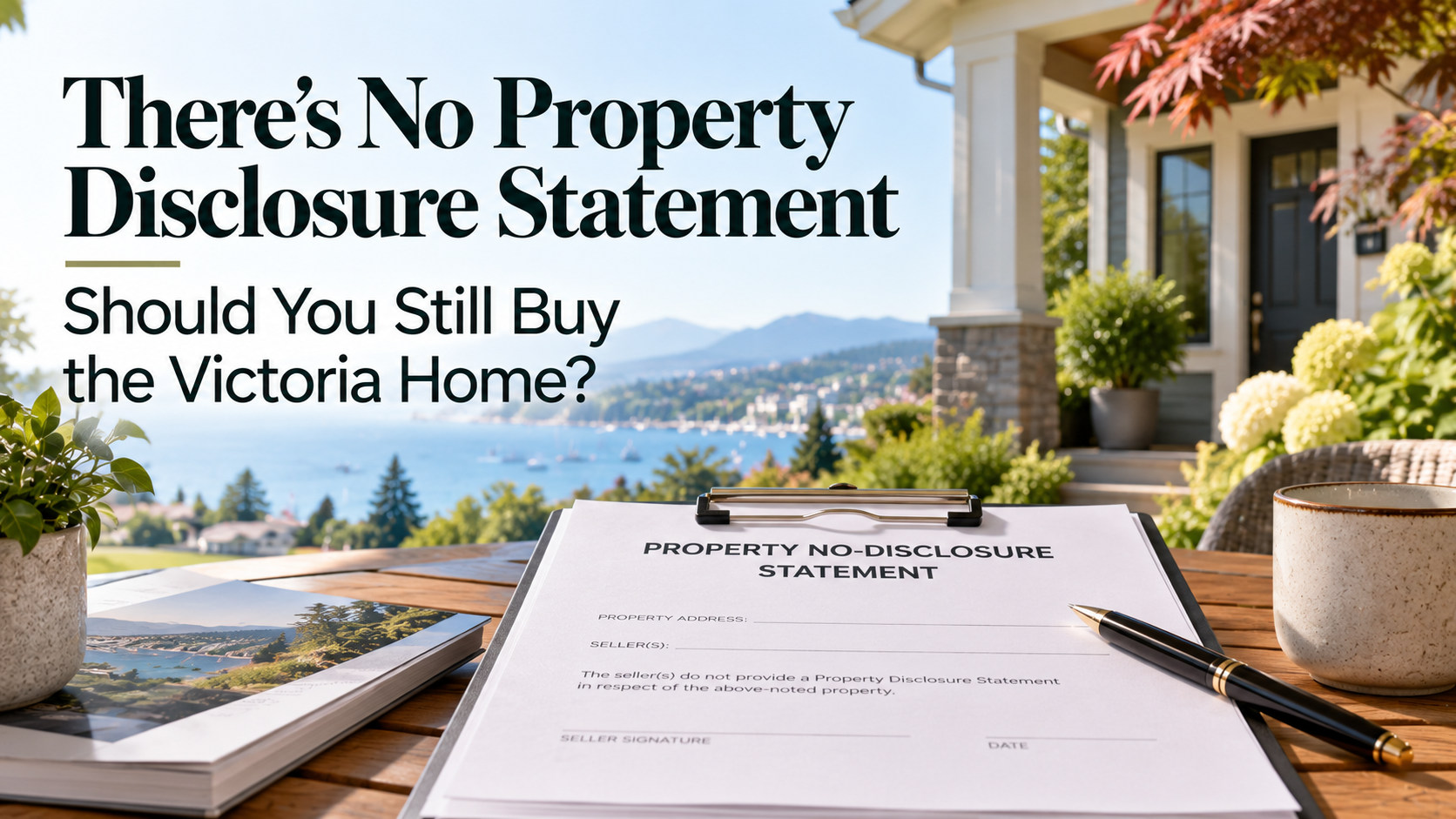
There's No Property Disclosure Statement — Should You Still Buy the Victoria Home?
You've found a Victoria home you really like.
The location works. The layout works. You've toured the property and you're starting to think seriously about writing an offer.
Then you review the listing documents and notice something you weren't expecting.
Instead of a completed Property Disclosure Statement, the seller has provided a Property No-Disclosure Statement.
For many buyers, the immediate reaction is:
"Why won't the seller tell us anything about the house? Is this a red flag?"
It's an important question — and one I wouldn't dismiss.
A Property No-Disclosure Statement doesn't give us the property information we would normally hope to receive from a completed Property Disclosure Statement. That means we need to understand what the document means and decide what additional due diligence should be completed before the buyer makes a final commitment.
What Is a Property Disclosure Statement?
In British Columbia, the Property Disclosure Statement — often called the PDS — is a commonly used form completed by the seller.
It asks the seller a series of questions about the property and provides buyers with information based on the seller's knowledge.
Depending on the type of property, the questions may address matters such as renovations, water problems, structural issues, services and other property characteristics.
But a PDS isn't a substitute for a buyer's own investigation.
I think of it as another source of information — and often a very useful one — that can help us identify questions requiring further investigation.
What Is a Property No-Disclosure Statement?
The Property No-Disclosure Statement, or PNDS, is different.
Rather than answering the detailed property questions contained in a regular PDS, the seller is indicating that they are not providing those representations about the property through a completed PDS.
There can be different circumstances surrounding why a seller does not provide a regular PDS. For example, there may be situations where a seller has limited firsthand knowledge of the property.
But as a buyer, I don't want to guess why.
I want to understand the circumstances as much as reasonably possible and then focus on the practical question:
What additional investigation should we complete before you decide whether to buy this property?
Is a Property No-Disclosure Statement a Red Flag?
I wouldn't reduce the decision to a simple "yes" or "no."
However, I would absolutely take the document seriously.
Current guidance from the BC Financial Services Authority advises buyers who receive a Property No-Disclosure Statement to conduct further due diligence.
That means this isn't a document I would simply file away and forget about.
Instead, it changes the way I approach the buyer's investigation.
If my buyer receives a Property No-Disclosure Statement, I'm not going to tell them that the house is automatically a bad purchase.
But I'm also not going to treat the absence of disclosure as unimportant.
We now have less information coming directly from the seller, so I want to identify the questions we can answer independently while the buyer still has the opportunity to investigate the property.
My job isn't to determine the seller's legal disclosure obligations. My job is to recognize that my buyer needs more information, coordinate appropriate due diligence and help make sure important questions aren't overlooked before subjects are removed.
1. Start With a Thorough Home Inspection
When seller-provided property information is limited, the home inspection becomes particularly important.
A qualified home inspector can examine the visible and accessible components of the property and identify areas that may require further investigation.
Depending on what the inspector observes, they may recommend that the buyer obtain additional advice from an electrician, plumber, engineer, roofing professional, environmental consultant or another qualified specialist.
A home inspection can't reveal every concealed condition in a house, but it can be an important starting point.
2. Investigate the Permit History
If the house has been renovated or altered, municipal permit records can provide another piece of the puzzle.
Perhaps the basement has been finished, a suite has been added, walls have been removed, electrical work has been completed or an addition has been built.
When appropriate, I want to compare what we see at the property with the information available through municipal records.
Permit history doesn't tell us everything about a home, but it can raise useful questions about when work was completed and whether permits were obtained where required.
3. Look More Closely at Major Building Systems
The age of the house can help us identify systems that deserve closer attention.
In many established Greater Victoria neighbourhoods, buyers are purchasing homes that may be several decades old.
Depending on the property, questions might include:
- What type of electrical wiring and panel are present?
- What type of plumbing supply lines are installed?
- How old is the roof?
- What is the condition of the perimeter drainage?
- How is the home heated?
- Are there signs of previous moisture intrusion?
- Have significant systems been replaced or upgraded?
Not every older system is automatically a problem. The purpose is to understand what is there, its condition and whether further professional assessment is warranted.
4. Consider Whether a Sewer Camera Inspection Makes Sense
The sewer lateral is largely out of sight, which means buyers can easily overlook it.
For some older Victoria and Saanich properties, a sewer camera inspection can provide useful information about the condition of the line and identify concerns such as deterioration, root intrusion, displacement or other issues.
Whether this investigation is appropriate depends on the property, but when seller disclosure is limited, I'm particularly interested in identifying components that can't be adequately assessed through a standard visual inspection.
5. Ask Questions About Underground Oil Tanks
Older homes in Greater Victoria may have previously used oil heat.
If there is evidence of a former oil-heating system or the age and history of the property make an underground tank a reasonable concern, additional investigation may be appropriate.
That might include reviewing available records and, where warranted, involving an appropriate oil-tank or environmental professional.
Again, my role isn't to determine whether contamination exists. It's to recognize the issue and help my buyer get it to the right professional.
6. Review the Title
The title search is another important part of the buyer's due diligence.
Depending on the property, title may contain charges such as easements, statutory rights of way, restrictive covenants or other registered interests.
These aren't necessarily negative. Many are completely normal.
But buyers should understand registrations that may affect their intended use of the property and obtain legal advice where appropriate.
7. Confirm the Property Can Be Insured
Insurance is another item I don't want buyers leaving until the last minute.
The insurer may ask questions about the age and condition of the home's roof, plumbing, electrical system, heating system and other characteristics.
Importantly, current BCFSA guidance recommends that buyers receiving a Property No-Disclosure Statement also check with their lender or mortgage broker about whether the document is sufficient for financing.
8. Look at the Property's Renovation History
A beautifully renovated home can still require careful investigation.
If substantial work has been completed, useful questions include:
- When was the work completed?
- Who completed it?
- Are invoices or renovation records available?
- Were permits required?
- Are permits available?
- Were plumbing, electrical or structural components changed?
I'm not trying to prove that every improvement ever made to the house is perfect.
I'm trying to help the buyer understand the property they're purchasing as well as reasonably possible before they become committed to it.
What About Material Latent Defects?
This is an important distinction.
Providing a Property No-Disclosure Statement doesn't necessarily eliminate a seller's legal disclosure obligations.
BC has specific rules and legal principles relating to material latent defects and disclosure. Real estate licensees also have professional obligations regarding certain material latent defects.
Because disclosure obligations can involve legal questions, buyers or sellers who need advice about their particular rights or obligations should obtain independent legal advice.
Does No PDS Mean You Should Walk Away?
Not automatically.
Imagine two properties.
House A: There is no completed PDS, but the buyer completes a thorough inspection, reviews permit and title information, investigates the major systems, confirms insurance and financing, and obtains specialist advice on the issues identified.
House B: There is no completed PDS, and the buyer decides that because the home looks well maintained, additional investigation isn't necessary.
Those are very different approaches to risk.
The absence of a completed PDS doesn't make the decision for you. It tells us that the due-diligence process deserves particular attention.
Why This Matters in Victoria's Established Neighbourhoods
This can be especially relevant when buying older homes throughout Gordon Head, Saanich, Cordova Bay, Cadboro Bay, Oak Bay, Fairfield, Fernwood, Esquimalt and Royal Oak.
Many homes in these neighbourhoods have evolved over decades.
There may have been additions, suites, electrical upgrades, plumbing changes, heating conversions, drainage work and multiple generations of renovations.
That's one reason I don't think of due diligence as a single home inspection.
Buying an older home is often an investigation made up of several pieces of information.
My job is to help identify which pieces matter for the particular property in front of us.
My No-Disclosure Checklist for Victoria Buyers
✓ Why is a regular Property Disclosure Statement not being provided?
✓ Have we discussed the PNDS with the buyer's mortgage professional?
✓ Have we completed an appropriate home inspection?
✓ Did the inspector recommend any specialist inspections?
✓ Have we investigated significant renovations and permit history?
✓ Have we reviewed the property's title?
✓ Should the sewer lateral be scoped?
✓ Is an underground oil-tank investigation appropriate?
✓ Are there electrical, plumbing, drainage or moisture concerns requiring further assessment?
✓ Has the buyer confirmed property insurance?
✓ Are there other property-specific questions we still need answered?
✓ Is the buyer satisfied with the information available before removing subjects?
Frequently Asked Questions
What is a Property No-Disclosure Statement in BC?
A Property No-Disclosure Statement indicates that the seller is not providing the representations about the property that would normally be contained in a completed Property Disclosure Statement. Buyers receiving a PNDS should conduct appropriate additional due diligence before deciding whether to proceed with the purchase.
Is a seller required to complete a Property Disclosure Statement in BC?
A Property Disclosure Statement is generally a voluntary form rather than a mandatory seller questionnaire. However, sellers and real estate licensees may still have disclosure obligations in certain circumstances. Buyers or sellers with questions about legal disclosure obligations should obtain appropriate professional advice.
Is a Property No-Disclosure Statement a red flag?
It should not be ignored. Current BCFSA guidance advises buyers receiving a Property No-Disclosure Statement to conduct further due diligence. The significance of the PNDS should be considered together with the property, the circumstances of the sale and the information that can be independently obtained.
Can I still have a home inspection if there is no Property Disclosure Statement?
Yes, subject to the terms of the purchase contract. A home inspection can be particularly important when seller-provided property information is limited, and the inspector may identify areas where additional specialist advice is appropriate.
Can a Property No-Disclosure Statement affect my mortgage?
It may be relevant to the lender's financing requirements. BCFSA advises buyers who receive a Property No-Disclosure Statement to check with their lender or mortgage broker about whether the document is sufficient for financing the property.
Does a Property No-Disclosure Statement mean the seller can hide defects?
No. Providing a Property No-Disclosure Statement does not necessarily eliminate legal disclosure obligations relating to defects. Disclosure obligations can involve specific legal and regulatory requirements, so buyers and sellers should obtain independent legal advice when questions arise.
Should I buy a Victoria home if the seller provides no PDS?
The absence of a completed PDS does not by itself determine whether a property is a suitable purchase. Buyers should understand why information is limited, complete appropriate property-specific due diligence, confirm financing and insurance, and make their decision based on the information available and their own tolerance for risk.
Helpful BC Home Buyer Resources
- BC Financial Services Authority — Searching for a Home
- BCFSA — FAQs About Real Estate Transactions
- BCFSA — Material Latent Defects
Buying an Older Home in Victoria?
A home can look wonderful and still leave important questions unanswered. I help my buyers identify the property-specific due diligence that matters, coordinate the appropriate professionals and gather the information they need before making a major purchasing decision.
Explore Victoria Real Estate with DawnDawn Stokkeland | REALTOR®
eXp Realty
Serving Victoria, Saanich, Gordon Head, Cordova Bay, Cadboro Bay, Oak Bay, Fairfield, Fernwood, Esquimalt, Royal Oak, Sidney and Greater Victoria.
Categories
Recent Posts






REVIEWS