
WETT Inspection in Victoria BC: What Home Buyers Should Know
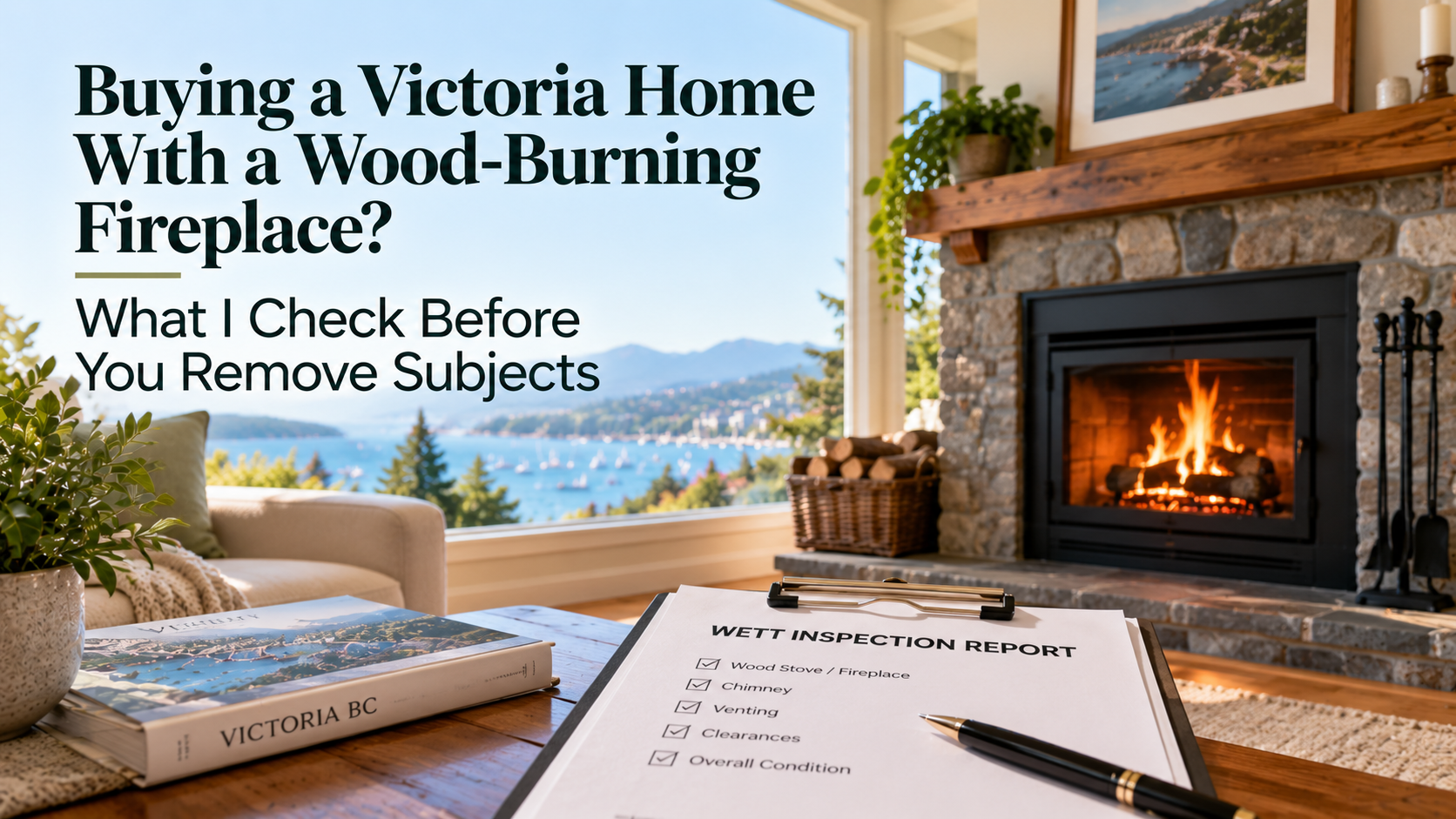
Buying a Victoria Home With a Wood-Burning Fireplace? What I Check Before You Remove Subjects
There's something pretty appealing about walking into a Victoria home on a cool day and seeing a beautiful wood-burning fireplace.
In an older Oak Bay or Fairfield character home, it might even be one of the features that makes you fall in love with the property.
But when I'm representing the buyer, I'm looking at that fireplace a little differently.
Before we assume you'll be able to light a fire on your first winter evening in the house, I want to know more about the fireplace, chimney, inspection history and insurance.
That's where you may hear the term WETT inspection.
And it's an area where buyers sometimes hear conflicting information: "It's WETT certified," "The previous owner had it inspected," or "The home inspector looked at it, so we're fine."
Those statements don't necessarily answer the questions I want answered before my buyer removes subjects.
First, What Exactly Is a WETT Inspection?
WETT stands for Wood Energy Technology Transfer.
A WETT inspection is an evaluation of a solid-fuel-burning system performed by an appropriately WETT-certified professional.
Depending on the system, that can include the wood-burning appliance or fireplace and its venting or chimney components.
WETT's inspection process looks at matters such as the appliance, clearances, visible system components and compliance with relevant requirements within the scope of the particular inspection.
A Fireplace Isn't Actually "WETT Certified"
This is probably the first misconception I would clear up for a buyer.
You may hear someone say:
"Don't worry — the fireplace is WETT certified."
That's not technically how WETT certification works.
WETT certifies individual professionals. It does not WETT-certify the fireplace, wood stove, chimney or installation.
The WETT-certified professional performs an inspection and provides an inspection report.
Why Does This Matter When You're Buying a Home?
There are two major reasons I pay attention to a wood-burning system during a purchase:
1. I want my buyer to understand the condition of the system.
2. I want my buyer to know whether it affects their ability to obtain satisfactory property insurance.
The second point is particularly important.
The BC Financial Services Authority provides specific real-estate contract clauses addressing wood stoves, fireplace inserts and chimneys because these systems can affect insurance coverage.
So this isn't something I want my buyer discovering a few days before completion when they're finalizing insurance.
A beautiful fireplace is exactly the kind of feature that can make a buyer emotionally connect with a home — and there's nothing wrong with that.
My job is to make sure we investigate the practical side of it too.
If you're planning to use the fireplace, I want you to understand the system, determine whether an appropriate inspection is needed and confirm any insurance requirements before you become committed to the purchase.
I'm not qualified to determine whether a fireplace or chimney is safe or code-compliant. My role is to recognize the question, bring in the appropriate professional and make sure the information gets gathered while we still have the opportunity to act on it.
1. I Find Out What Type of Wood-Burning System We're Dealing With
"Fireplace" can describe several different things.
The home might have a traditional masonry fireplace, a wood-burning fireplace insert, a freestanding wood stove or another solid-fuel-burning system.
The chimney and venting system also matter.
Before deciding what investigation is appropriate, I want to understand exactly what is installed in the property.
2. I Ask Whether There's an Existing WETT Inspection Report
If the seller has previously had the system inspected, I want to see the actual report rather than relying on a statement that the fireplace "passed WETT."
The report can give us useful information about what was inspected and what was observed at that time.
But an older report isn't automatically the end of the investigation.
A WETT inspection report records what the inspector observed at the time of that inspection. The inspector cannot account for changes, deterioration or alterations that may have occurred afterward.
That's why I also want to know:
- When was the inspection completed?
- Who completed it?
- What level of inspection was performed?
- Were any deficiencies or recommendations identified?
- Were repairs subsequently completed?
- Has the appliance, chimney or venting system changed since the inspection?
3. Understand That There Are Different Levels of WETT Inspection
WETT's SITE inspection process has three levels.
Level 1 — Visual Inspection:
A non-invasive inspection of readily accessible components. This is commonly used for real-estate transactions and insurance purposes.
Level 2 — Technical Inspection:
A more detailed inspection of accessible components. It may involve removing certain components, using ladders or accessing areas such as an attic or chimney.
Level 3 — Invasive Inspection:
Used when concealed areas need to be accessed and more invasive investigation is necessary.
A Level 1 Visual inspection is commonly used for real-estate and insurance purposes, but the appropriate level depends on the particular system and circumstances.
If concerns are identified, the WETT-certified professional may recommend a more detailed inspection.
4. A Regular Home Inspection and a WETT Inspection Aren't the Same Thing
Your home inspector may make observations about the fireplace, chimney or visible components during the general home inspection.
That's useful information.
But a general home inspection isn't automatically the same as having the wood-burning system evaluated by an appropriately WETT-certified professional.
If the fireplace is important to you, an insurer requires additional information, or the home inspector identifies a concern, I want to determine whether a specialist inspection should be part of our due diligence.
5. I Want the Buyer to Talk to Their Insurance Professional
This is a step I would not skip.
Insurance companies have their own underwriting requirements. A particular insurer may want information about the wood-burning appliance or request an inspection report before confirming coverage.
Requirements can vary, so I don't tell buyers that a fireplace is automatically insurable simply because someone previously used it or because an old inspection report exists.
I want the buyer's own insurance professional looking at the actual property and confirming what they require.
6. If There Are Deficiencies, Find Out What They Mean
Suppose the inspection identifies a concern.
That doesn't necessarily mean the entire fireplace has to be removed or that you should immediately walk away from the house.
The next step is understanding the deficiency.
Depending on the issue, an appropriately qualified professional may be able to explain what remediation is required and provide a property-specific estimate.
Then the buyer can evaluate the information in the context of the overall property and purchase price.
7. Don't Forget the Chimney
Buyers can naturally focus on the fireplace because that's the part they see in the living room.
But the fireplace or wood stove is only part of the system.
The chimney and venting components matter too.
Depending on the age, construction and condition of the system, further investigation or maintenance may be recommended.
If the chimney hasn't been used for a long period or there are signs of deterioration or performance issues, the appropriate professional can advise on the next steps.
What If the Seller Says They Never Use the Fireplace?
That's useful information, but it doesn't necessarily answer the buyer's question.
If you intend to use the fireplace after purchasing the home, I want to understand whether the system should be inspected before you rely on it.
A fireplace that has sat unused for years may actually give me more reason to ask questions about its current condition.
Should a Fireplace Problem Stop You From Buying the House?
Not necessarily.
Imagine two otherwise similar Victoria homes.
House A: The wood-burning fireplace has been appropriately inspected, the buyer understands the findings, insurance has been confirmed and any recommended work has been investigated.
House B: The listing says "wood-burning fireplace," but nobody knows when it was last inspected, the buyer hasn't spoken to their insurer and the assumption is simply that it must be fine because the seller has used it.
The fireplace itself isn't necessarily the difference.
The difference is how much information the buyer has before making the decision.
Why This Is Relevant in Victoria's Established Neighbourhoods
Wood-burning fireplaces, fireplace inserts and wood stoves can be found throughout Greater Victoria, but the issue comes up particularly naturally when looking at older detached homes and character properties.
Buyers searching in Oak Bay, Fairfield, Fernwood, Esquimalt, Gordon Head, Saanich, Cadboro Bay and Cordova Bay may encounter homes where a fireplace has been part of the property for decades.
The home may also have changed considerably around it.
Heating systems get upgraded. Chimneys are repaired. Inserts are added. Renovations take place. Owners stop using fireplaces and later owners begin using them again.
That's why I prefer to investigate the system that's actually in the house today rather than make assumptions based on its history.
My Wood-Burning Fireplace Checklist for Victoria Buyers
✓ What type of wood-burning fireplace, insert or stove is installed?
✓ Is there an existing WETT inspection report?
✓ When was the inspection completed?
✓ Who completed the inspection and what WETT qualification did they hold?
✓ What level of inspection was performed?
✓ Were any deficiencies or recommendations identified?
✓ Were recommended repairs completed?
✓ Has the system changed since the previous inspection?
✓ Does the home inspector have any additional concerns?
✓ Does the buyer's insurer require a WETT inspection or other documentation?
✓ Has satisfactory property insurance been confirmed?
✓ Is further assessment, cleaning, repair or a property-specific quote appropriate before removing subjects?
Frequently Asked Questions
What is a WETT inspection?
A WETT inspection is an evaluation of a solid-fuel-burning system performed by an appropriately WETT-certified professional. Depending on the level of inspection, the professional evaluates relevant visible or accessible components and provides an inspection report documenting the findings.
Is a fireplace WETT certified?
No. WETT certifies individuals, not fireplaces, wood stoves, chimneys or installations. A WETT-certified professional can inspect the system and provide an inspection report.
Do I need a WETT inspection when buying a home in Victoria BC?
A WETT inspection may be appropriate for a real-estate purchase involving a wood-burning system, and an insurer may request one before confirming coverage. The appropriate inspection depends on the property, the system and the buyer's insurance requirements.
Is a regular home inspection the same as a WETT inspection?
No. A home inspector may make observations about a fireplace or chimney during a general home inspection, but that is not automatically the same as a WETT inspection performed by an appropriately WETT-certified professional.
Can a wood-burning fireplace affect home insurance?
It can. Insurance companies have their own underwriting requirements for wood-burning appliances and systems. Buyers should provide information about the specific property to their insurance professional and confirm whether an inspection or other documentation is required before relying on coverage being available.
Does an old WETT inspection report mean I don't need another inspection?
Not necessarily. An inspection report records the condition and accessible components observed at the time of that inspection. Buyers should consider the age of the report, whether the system has changed and the requirements of their insurer, and obtain advice from the appropriate WETT-certified professional where necessary.
What happens if a WETT inspection identifies a problem?
The appropriate next step depends on the deficiency identified. A qualified professional can explain recommended repairs or further investigation and, where appropriate, provide an estimate so the buyer can understand the issue before making a final purchasing decision.
Helpful Buyer Resources
- Wood Energy Technology Transfer — About WETT Inspections
- WETT — Levels of SITE Inspections
- BC Financial Services Authority — Buying a Home
Considering an Older Home in Victoria?
Older Victoria homes can have wonderful character — and sometimes a few extra layers of due diligence. I help my buyers identify the questions that matter, bring in the appropriate professionals and gather the information they need before making a major purchasing decision.
Explore Victoria Real Estate with DawnDawn Stokkeland | REALTOR®
eXp Realty
Serving Victoria, Saanich, Gordon Head, Cordova Bay, Cadboro Bay, Oak Bay, Fairfield, Fernwood, Esquimalt, Royal Oak, Sidney and Greater Victoria.
Categories
Recent Posts








REVIEWS