
Buying a Home in Victoria BC? Check the Drainage System
```html
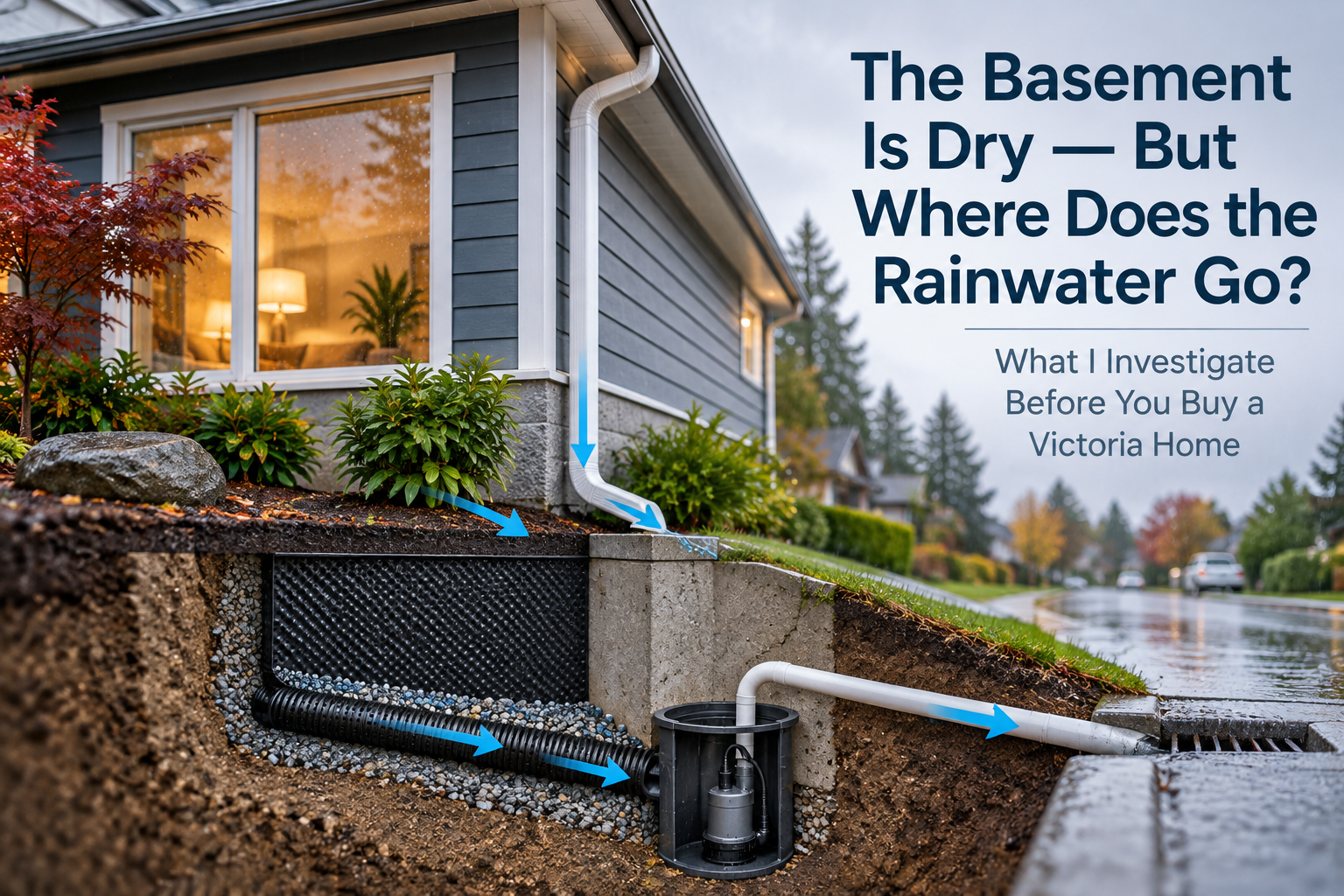
The Basement Is Dry — But Where Does the Rainwater Go?
A dry basement on the day you view a house is certainly reassuring. But it doesn't necessarily tell you how well the property manages water when Victoria gets several days of heavy winter rain.
When I'm helping someone buy a detached home in Greater Victoria, I don't only look for evidence that water has already entered the house.
I also want to understand where the water is supposed to go.
That means looking at the roof, gutters, downspouts, grading, perimeter drains, sump systems and storm connections as parts of one larger drainage system.
The goal isn't to turn a REALTOR® into a drainage engineer. It's to recognize the questions that deserve answers before you buy the property.
Start at the Roof
Rainwater management starts before the water ever reaches the foundation.
The roof collects a surprisingly large volume of water during a storm. Gutters then collect that runoff and direct it toward the downspouts.
That's why I look at something as simple as where the downspouts actually end.
Do they discharge beside the foundation? Do they connect into a rainwater leader or storm drainage system? Has someone disconnected or altered them? Does water appear to be directed toward the house rather than away from it?
Saanich advises homeowners to keep eavestroughs and downspouts clear and, during flooding conditions, to make sure downspouts discharge water approximately 1.2 metres (4 feet) away from basement walls without directing it onto a neighbouring property.
Then Look at the Ground Around the House
Landscaping isn't only cosmetic.
When I walk around a property, I'm paying attention to the way the land relates to the house.
Does the ground generally encourage surface water to move away from the foundation, or are there low areas beside the house where water could collect?
Have patios, garden beds, retaining walls or other landscaping features changed how water naturally moves across the property?
I also pay attention to neighbouring land. A property doesn't exist in isolation. Water can move downhill, across lots and around retaining walls.
None of these observations by themselves diagnose a drainage problem. They simply help us decide whether more investigation is warranted.
What Are Perimeter Drains Actually Doing?
Foundation drains — often called perimeter drains or drain tile — are installed around the foundation to collect groundwater and help move it away from the house.
The Capital Regional District identifies foundation drains as one of the underground systems that help protect homes from wet basements and flooding.
Like other underground piping, however, drainage systems can deteriorate over time.
That makes the history of the system useful information when we're considering an older home.
I may want to know:
- Do we know approximately when the perimeter drains were installed?
- Have they ever been replaced or repaired?
- Are there invoices, permits or other records?
- Have they been professionally inspected or flushed?
- Has the seller ever experienced water entry or drainage problems?
- Where does the drainage system ultimately discharge?
The last question is particularly important.
A drainage pipe going underground tells us where the water enters the system. It doesn't necessarily tell us where the water ends up.
When one part of that path isn't understood, that's where I start asking more questions.
What If the House Has a Sump Pump?
Seeing a sump pump doesn't automatically mean there is something wrong with a property.
But I do want to understand why it's there.
Where does the water entering the sump come from? Where does the pump discharge? How old is the pump? Is there a backup system? Has it ever failed? Is the system relied upon to keep the lower level dry?
If a finished basement depends on a pump operating during major rainfall, that's information I would want my buyer to understand.
Saanich also specifically states that groundwater sump pumps, foundation drains and roof downspouts should be connected to the stormwater drainage system rather than the sanitary sewer system.
Stormwater and Sanitary Sewer Are Not the Same System
This is an easy distinction for homeowners to overlook.
Your sanitary sewer carries wastewater from toilets, sinks, showers and other plumbing fixtures.
The stormwater system manages rainwater and other runoff.
In Saanich, the municipal stormwater network includes catch basins, underground storm drains, ditches, watercourses, wetlands and outfalls that ultimately move or manage runoff.
Connecting rainwater or groundwater into the wrong system can contribute to unnecessary pressure on sanitary infrastructure.
So when I'm investigating an older house, I don't simply want to hear that “the drains work.” I want to understand, as reasonably as possible, what drains are present and where they go.
What If Nobody Knows Where the Drain Goes?
That happens.
Especially with older properties, sellers may not know exactly how underground drainage was configured decades ago.
That's when other information becomes useful.
Depending on the property, we may look at municipal mapping, permit history, previous invoices or reports, seller disclosures and professional inspection.
Saanich provides public engineering information through SaanichMap and its Engineering Department. Those resources can help identify municipal infrastructure and provide context for how an area is serviced.
You can learn more about Saanich's stormwater system here .
A Finished Basement Makes This More Important, Not Less
Imagine two houses.
One has an unfinished concrete basement. The other has beautiful flooring, drywall, built-in cabinetry and a renovated family room downstairs.
Which one makes understanding the drainage history more important?
In my view, the finished basement deserves particular attention because there is simply more to lose if water gets in.
Fresh paint and new flooring can make a lower level look fantastic. They don't tell us how the property performed during previous winters.
That's why seller disclosures, inspection observations, drainage history and any available records can all matter.
A home may be dry because its drainage system is working exactly as intended. The point isn't to assume there is a hidden problem. It's to understand the system well enough to recognize when another question should be asked.
Can I Check Whether Drainage Work Was Previously Done?
Sometimes.
Permit and municipal records can provide another useful piece of the puzzle, particularly if a seller says the perimeter drains or storm lateral were replaced.
In Oak Bay, for example, replacement of perimeter drains requires a building permit, and replacing a storm-drain lateral on private property involves municipal permitting requirements.
That means permit history may help substantiate when certain drainage work was completed.
It isn't necessarily the only evidence I would consider, but it's another reason I like to look beyond the physical appearance of the house.
Planning a Major Renovation? Drainage Can Become a Bigger Issue
Buyers often tell me what they hope to do with a property before they purchase it.
Maybe they want to add a garden suite, build an addition, substantially renovate the house or eventually replace it.
Those plans can make existing underground services more important.
Saanich advises that new homes, accessory buildings and major renovations may require water, sewer and drain services to be installed or upgraded to current municipal standards.
As of September 2026, Saanich lists the base municipal fee for installing a 100 mm storm-drain connection at $8,000, with additional charges possible depending on factors such as rock, road classification or depth.
That doesn't mean every renovation requires a new $8,000 connection. It means servicing is something worth investigating before buying a property based on what you hope to build later.
Why This Matters in Greater Victoria
Rain isn't exactly unusual here.
More importantly, the Capital Regional District says Greater Victoria is expected to experience more intense winter rainfall events as the climate changes. Proper stormwater management is therefore increasingly important for reducing peak flows and flooding.
That doesn't mean every older Victoria home has a drainage problem.
It means understanding how a property manages water is becoming an increasingly sensible part of long-term home ownership.
This can be especially relevant when I'm helping buyers look at older homes in Oak Bay, Fairfield, Fernwood and Esquimalt, but I also consider drainage when appropriate in Gordon Head, Cadboro Bay, Cordova Bay, Royal Oak, Sidney and throughout Saanich.
When I walk through a house with buyers, I'm obviously looking at the things they can see. But I'm also thinking about the systems they can't see.
Drainage is a perfect example.
I'm not going to diagnose a perimeter-drain system or tell you that a property has a drainage problem. That's where qualified inspectors and other professionals come in.
What I can do is notice the clues, research the available information and help you ask better questions.
If we're buying a house with a beautifully finished basement, I don't only want to know that it's dry today. I want us to understand, as well as reasonably possible, how that house handles water when Victoria's winter rain arrives.
Frequently Asked Questions About Home Drainage in Victoria BC
Should I inspect perimeter drains before buying a home in Victoria?
It can be worthwhile when the age of the home, seller disclosures, visible conditions or other information suggests the drainage system deserves closer investigation. The Capital Regional District recommends periodic inspection and maintenance of underground sewer and stormwater piping.
What are perimeter drains?
Perimeter or foundation drains are installed around the base of a home's foundation to collect groundwater and move it away from the house, helping reduce the risk of wet basements and flooding.
Where should my downspouts drain?
The correct arrangement depends on the property and municipal requirements. In Saanich, roof downspouts, foundation drains and groundwater sump pumps should drain to the stormwater drainage system rather than the sanitary sewer. Homeowners should also avoid directing surface discharge toward neighbouring properties.
Is a sump pump in a basement a red flag?
Not automatically. A sump pump can simply be part of a property's drainage design. Buyers should understand why it is present, what water it manages, where it discharges and whether the home's lower level relies on it to remain dry.
How can I find out whether perimeter drains were replaced?
Seller disclosures, invoices, contractor documentation, municipal permit records and professional inspection can all help. The available records vary by municipality and by the age of the work, so the absence of one type of record does not by itself establish whether work was or was not completed.
Does a dry basement mean there are no drainage problems?
No single observation can establish that. A dry basement is encouraging, but buyers should consider the broader picture when appropriate, including drainage history, grading, downspouts, foundation drains, sump systems, seller disclosures and professional inspection.
Buying a Home in Greater Victoria?
A showing tells you how a home looks today. Good due diligence helps you understand how the property actually works. I help my buyers investigate the details, identify the questions that matter and bring in the right professionals when more expertise is needed.
Start Your Victoria Home SearchDawn helps buyers and sellers throughout Greater Victoria make informed real estate decisions through careful research, local market knowledge and a calm, strategic approach. Her focus is on helping clients understand not only the home they are considering, but the property systems, records and details that can affect ownership and future plans.
```
Categories
Recent Posts










REVIEWS