
Could Commuter Rail Return to Langford? What Homeowners Should Know
```html
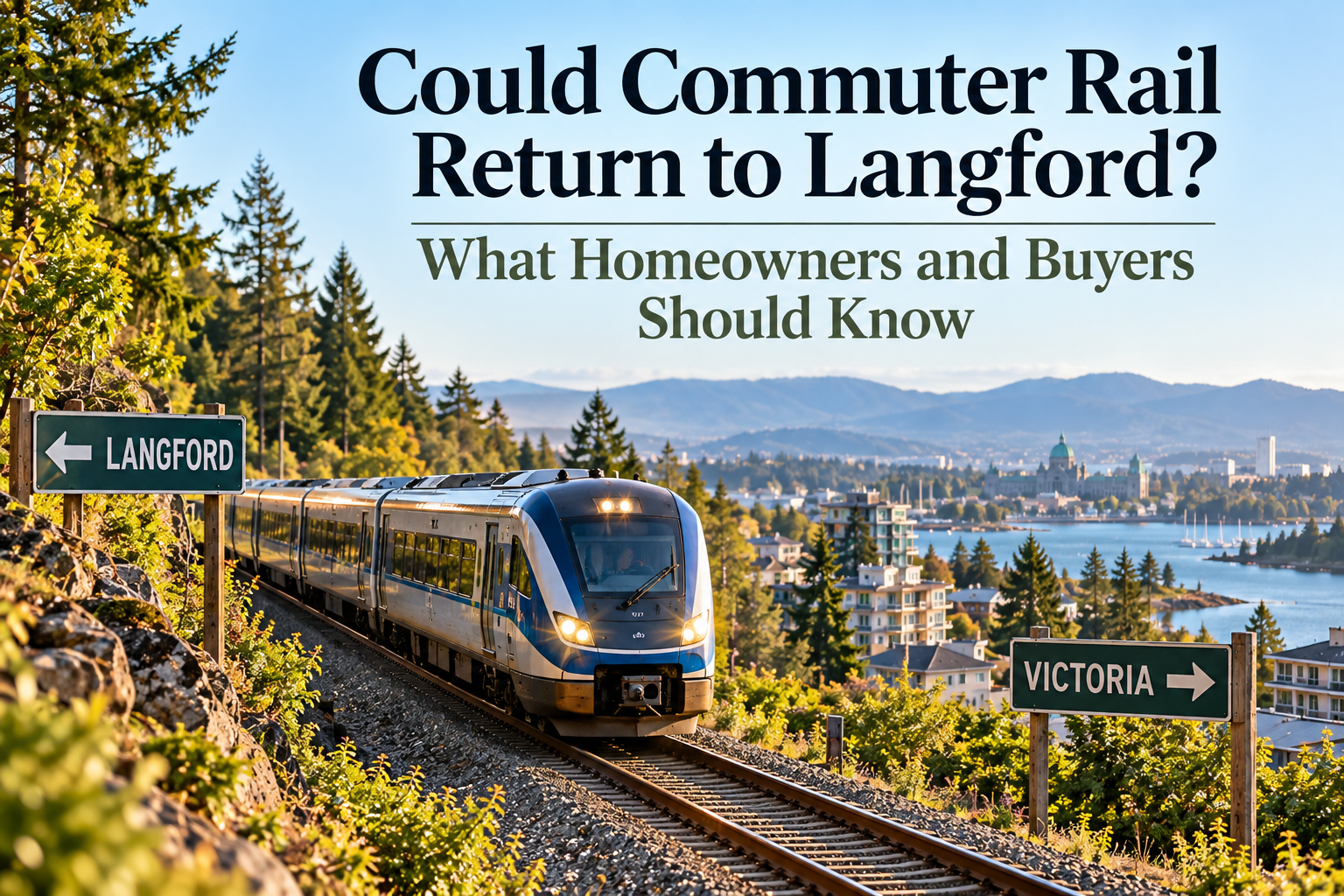
Could Commuter Rail Return to Langford? What Homeowners and Buyers Should Know
For years, Greater Victoria residents have talked about whether the old E&N rail corridor could someday become part of the solution to growing traffic congestion between the West Shore and Victoria.
For homeowners in Langford, that conversation has suddenly become much more interesting.
In September 2026, the federal government announced new funding for feasibility and technical work examining the potential restoration of passenger rail service between Victoria West and Langford.
The federal government is contributing $500,000 through PacifiCan, while the Capital Regional District is contributing approximately $523,100. The Province of British Columbia has also previously committed funding toward Island Corridor planning and engagement, including support for technical planning work.
But for anyone who owns a home in Langford—or is considering buying one—the project is worth watching.
What Is the E&N Rail Corridor?
The railway commonly referred to as the E&N was originally the Esquimalt & Nanaimo Railway.
Today, the broader Island rail corridor extends hundreds of kilometres along Vancouver Island and is managed by the Island Corridor Foundation.
Passenger rail service on Vancouver Island stopped in 2011, but much of the transportation corridor itself has remained preserved.
For Greater Victoria, one of the most interesting sections runs between Victoria West and the West Shore, including Langford.
As Langford and surrounding West Shore communities have grown, an obvious question has emerged:
What Has Actually Been Announced?
This is where it's important to separate a transportation proposal from a transportation project.
In September 2026, PacifiCan announced $500,000 in federal funding for the Island Corridor Foundation to undertake feasibility and technical studies examining passenger rail opportunities connecting Victoria West and Langford.
The Capital Regional District is contributing approximately $523,100 toward the work.
The study is expected to examine issues such as corridor planning, land use, technical feasibility and consultation with communities and project partners.
The Province has also been involved in Island Corridor planning. In 2023, British Columbia committed $18 million toward planning and engagement concerning the corridor, including $300,000 associated with technical planning work.
Previous provincial engineering work has also examined what infrastructure improvements would be necessary to support more frequent passenger service between Victoria and Langford.
So there is meaningful planning underway.
However, there is currently no confirmed construction schedule, opening date, final station plan or operating schedule for Victoria–Langford passenger rail.
Why Is Langford at the Centre of the Conversation?
Langford has experienced substantial growth over the past several decades.
That growth has brought more housing, businesses, amenities and employment opportunities to the West Shore.
It has also created a familiar challenge for anyone who regularly travels between Langford and Victoria:
Traffic.
The Trans-Canada Highway remains one of the primary transportation routes connecting the West Shore with Victoria.
For residents who commute during peak hours, congestion can significantly affect travel time and lifestyle.
That's what makes the existing rail corridor particularly interesting.
Rather than creating an entirely new transportation corridor, planners are investigating whether an existing corridor could eventually become part of Greater Victoria's transportation network.
First Nations and Local Governments Are Also Involved
Another important development occurred in late 2025 with the creation of the Reconciliation Corridor Initiative.
The initiative brings together the Songhees Nation and Esquimalt Nation (Kosapsum) with local governments including Langford, Colwood, Victoria, Esquimalt and View Royal.
The partnership is exploring the future of the Island Corridor between Victoria and Langford while considering transportation, reconciliation, economic development and land-use planning.
That makes the discussion much broader than simply putting passenger trains back onto old railway tracks.
Indigenous interests, land, transportation infrastructure, municipal planning and future development all form part of the conversation.
What Could Passenger Rail Mean for Langford Homeowners?
This is where the discussion becomes particularly interesting from a real-estate perspective.
Transportation accessibility is one of many factors people consider when deciding where to live.
For some buyers considering Langford, the trade-off can be relatively straightforward: they may be able to purchase a newer or larger property than they could closer to Victoria, but depending on where they work, commuting becomes part of the equation.
A reliable passenger-rail connection could potentially change that equation for some households.
Imagine living in Langford and having another option for travelling toward Victoria without relying exclusively on a vehicle and the Trans-Canada Highway.
For certain buyers, that could make West Shore living more convenient.
But it's important to emphasize the word could.
Until a route, station locations, service frequency, travel times, operating model and funding are established, we cannot know what effect passenger rail might have on individual neighbourhoods or properties.
I would not advise a buyer to pay a premium for a home today because of an unconfirmed future rail service. But I would want a buyer considering a property near the corridor to understand the planning that's underway.
Could Homes Near a Future Station Become More Desirable?
Potentially—but there isn't enough information today to draw that conclusion about any particular property.
Transportation access can influence buyer preferences. If commuter rail were eventually established and provided convenient, reliable service, homes within reasonable walking or cycling distance of a station could appeal to some commuters.
But final station locations have not been established, and we don't yet know what the service would look like.
That's why I would treat potential future rail access as an interesting planning consideration rather than a property-value assumption.
There Could Also Be Trade-Offs
Being close to transportation infrastructure isn't automatically positive for every homeowner or buyer.
If an inactive rail corridor becomes active again, properties immediately beside it could experience changes.
Depending on how a future service was designed, buyers might eventually want to understand:
- How frequently trains would operate
- What hours the service would run
- Where stations would be located
- Whether railway crossings or warning signals would change
- Potential train and station noise
- Pedestrian and cycling activity
- Station parking and vehicle traffic
- Future development around station areas
One buyer may consider a nearby passenger-rail station an enormous convenience.
Another may prefer to live farther away from the corridor.
That's why location decisions are personal—and why understanding future planning matters.
Could Rail Encourage More Development Around Stations?
This is another issue homeowners should watch.
Across Canada, transportation planning and land-use planning are increasingly connected. If passenger rail eventually moves forward, municipalities could examine whether areas surrounding stations should accommodate additional housing, businesses or mixed-use development.
That doesn't mean redevelopment will occur around any particular Langford property.
But if I were helping a buyer purchase a home close to the existing rail corridor, I would want to understand both the rail proposal and the municipality's longer-term plans for the surrounding area.
That's part of looking beyond the house itself.
What Does This Mean If You're Buying in Langford Today?
I wouldn't make a home-buying decision based on the assumption that commuter rail is coming.
It isn't confirmed.
But I also wouldn't ignore the planning work that's happening.
If you're considering a property close to the existing rail corridor, I'd want to investigate:
- Where exactly is the rail corridor in relation to the property?
- How close is the home to the existing transportation corridor?
- What does Langford's current planning envision for the surrounding area?
- Are there redevelopment or transportation plans nearby?
- Could future transportation improvements benefit your lifestyle?
- Would increased activity along the corridor concern you?
These questions don't necessarily change whether you should buy the property.
They simply give you more information before making the decision.
What About Current Langford Homeowners?
If you already own a home in Langford, I wouldn't make assumptions about what passenger rail might do to your property value.
There are simply too many unknowns.
Instead, I would pay attention to the planning process.
As the feasibility work progresses, we may eventually learn more about possible station locations, service frequency, infrastructure requirements and surrounding land-use planning.
Those details will be much more meaningful to homeowners than the general announcement that passenger rail is being studied.
Langford Is Already Planning for a More Connected Future
Rail isn't happening in isolation.
Langford has been working on broader transportation and active-transportation planning as the city continues to grow.
Meanwhile, the Capital Regional District is developing its long-term Regional Transportation Plan to guide future transportation investment across Greater Victoria.
Whether passenger rail ultimately becomes part of that network remains to be determined.
But the broader issue is clear: how people move between the West Shore and the rest of Greater Victoria is becoming an increasingly important planning question.
I think this is something Langford homeowners and buyers should watch—but not speculate on.
There's a big difference between a government-funded feasibility study and a funded construction project. We aren't at the second stage.
What interests me as a REALTOR® is what this tells us about the future conversation around the West Shore.
Langford continues to grow, and transportation between the West Shore and Victoria is one of the region's important planning challenges. We now have federal, provincial, regional, municipal and First Nations involvement in exploring whether the existing rail corridor could become part of the solution.
If I'm helping someone buy a property near this corridor, I want them to know that.
Not because I can tell them what will happen—I can't. But because part of good real-estate due diligence is understanding what may be changing around the property you're buying.
Categories
Recent Posts









REVIEWS