
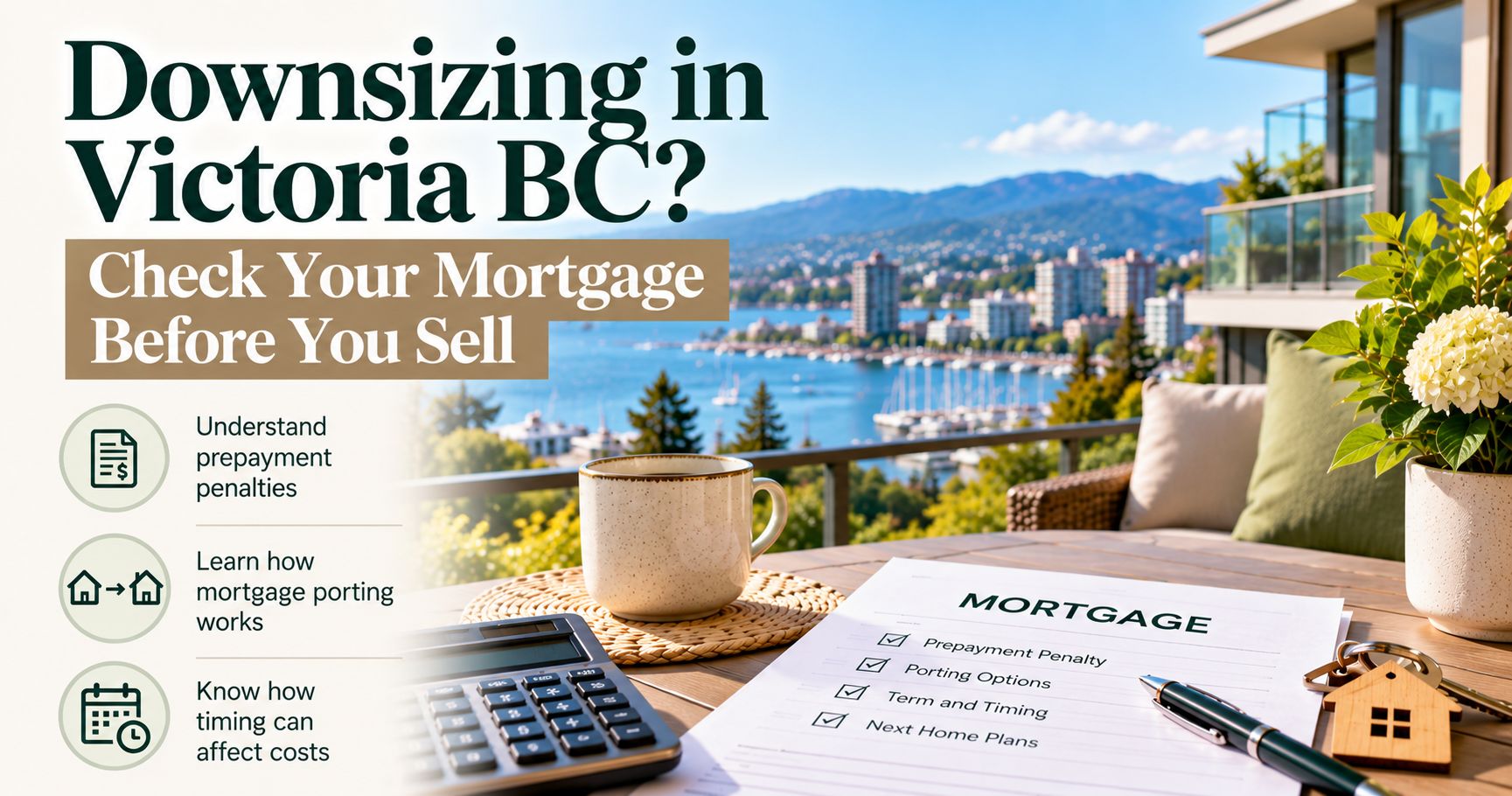
Downsizing in Victoria BC? Check Your Mortgage Before You Sell
Downsizing in Victoria BC? Check Your Mortgage Before You Sell
Downsizing can be an exciting next chapter. Perhaps the family home feels larger than you need, the garden is becoming more work, or you're simply ready for a home that better suits your lifestyle.
For many Greater Victoria homeowners, the plan seems straightforward: sell the larger home, purchase something smaller and enjoy having less to maintain.
But before you make that move, there's an important financial detail worth checking.
What happens to your existing mortgage when you sell?
If you still have a mortgage on your home, selling before the end of your mortgage term could trigger a prepayment penalty. Depending on your mortgage agreement, that penalty could amount to thousands of dollars.
You may also have the option of transferring your existing mortgage to your next property, a process known as mortgage portability.
However, portability isn't automatic, and buying a less expensive home can create additional complications.
Let's look at what Greater Victoria homeowners should understand before deciding when to sell.
Why Your Mortgage Matters When Downsizing
When homeowners begin thinking about downsizing, they naturally focus on the value of their current property and the price of their next home.
For example, someone selling a detached home in Gordon Head might be considering a townhome in Royal Oak, a condo in Sidney or a smaller property in Oak Bay.
The financial calculation often starts with the difference between the sale price and purchase price.
But that difference doesn't tell the whole story.
You'll also need to consider selling expenses, legal fees, moving costs, potential property transfer tax on your purchase and any mortgage-related costs.
If your mortgage term hasn't ended, the lender may charge a penalty when the mortgage is paid out.
That's why understanding your mortgage should be one of the first steps in planning your move.
What Is a Mortgage Prepayment Penalty?
A mortgage prepayment penalty is a charge that a lender may apply when you pay off a mortgage before the end of its term or make payments beyond the amount permitted by your mortgage agreement.
For homeowners selling a property, this often becomes relevant when the sale proceeds are used to pay off the existing mortgage.
The amount depends on your mortgage contract, the outstanding balance, the interest rate, the remaining term and the lender's calculation method.
Open vs. Closed Mortgages
An open mortgage generally allows you to pay off the mortgage without a prepayment penalty.
A closed mortgage usually has restrictions on how much you can repay early without a penalty.
Many Canadian homeowners have closed mortgages, so this is an important distinction.
How Are Mortgage Penalties Calculated?
For many closed fixed-rate mortgages, lenders commonly calculate a prepayment penalty using the higher of:
- Three months' interest on the outstanding mortgage balance.
- An interest rate differential, often called an IRD.
The IRD calculation generally considers the difference between specified interest rates over the remaining mortgage term.
However, lenders use different formulas, and some mortgage products have different penalty rules.
Variable-rate mortgages may also be treated differently from fixed-rate mortgages.
The only reliable way to know your actual penalty is to request a payout estimate from your lender.
Example: A Mortgage Penalty You Weren't Expecting
Imagine you have $300,000 remaining on your mortgage and two years left in your term.
You've decided to sell your home and move into a smaller property.
Your lender advises that paying off the mortgage early would result in an $8,000 penalty.
That amount is hypothetical, but it illustrates why mortgage penalties belong in your downsizing budget.
If you weren't expecting the charge, it could reduce the money available for your next home, moving expenses or savings.
Knowing about it before listing gives you time to explore your options.
What Does It Mean to Port Your Mortgage?
Mortgage portability means transferring your existing mortgage arrangements to a new property, subject to the lender's terms and approval.
This may allow you to keep an existing interest rate and certain mortgage terms instead of paying off the mortgage and arranging entirely new financing.
For homeowners with a favourable mortgage rate, portability can be worth investigating.
It may also help reduce or avoid some prepayment penalties.
But not all mortgages are portable.
And even when your mortgage has a portability feature, you generally need to satisfy the lender's requirements.
Portability Is Not Automatic
Your lender may require you to requalify based on your current income, debts, credit profile and other lending criteria.
The lender may also need to approve the new property.
There may be specific deadlines for completing the sale and purchase.
This is especially important if you're planning to sell first and take some time before purchasing your next home.
What If You're Buying a Less Expensive Home?
This is where downsizing can become a little more complicated.
You may be selling a larger home and purchasing a smaller one specifically to reduce your mortgage or eliminate debt.
But reducing the amount borrowed can sometimes trigger a partial prepayment penalty.
A Gordon Head to Royal Oak Example
Imagine a couple selling their longtime family home in Gordon Head and purchasing a townhome in Royal Oak.
They currently owe $300,000 on their mortgage.
After selling their home, they would like to reduce that mortgage to $200,000.
They assume they can simply transfer the mortgage to the townhome.
However, the lender may treat the $100,000 reduction as a partial prepayment.
Depending on the mortgage agreement and available prepayment privileges, a penalty could apply.
The lender might also have restrictions on how much of the mortgage can be transferred.
The couple should therefore compare the actual cost of porting a smaller mortgage with paying out the existing mortgage and arranging new financing.
The best option depends on their lender's terms, not simply the fact that they're downsizing.
Do Your Sale and Purchase Dates Matter?
Absolutely.
Mortgage portability often comes with timing requirements.
For example, a lender may require the purchase of your next home to be completed within a specified period before or after your current property sells.
Those deadlines vary by lender and mortgage agreement.
If your purchase falls outside the permitted window, you may lose the ability to port your mortgage or avoid the expected penalty.
This matters if you're considering selling your current home before finding your next property.
It also matters when negotiating completion dates on both transactions.
A lender may permit certain arrangements when the dates don't align, but those arrangements need to be confirmed in advance.
Should You Wait Until Your Mortgage Renews Before Selling?
Sometimes waiting can make financial sense.
If your mortgage term ends in a few months, you may be able to avoid a substantial prepayment penalty by arranging your sale around the maturity date.
However, waiting isn't always the best choice.
There are other factors to consider, including:
- Whether the right property is available now.
- Your current home's expected market value.
- How much you're spending to maintain your existing property.
- Your preferred moving timeline.
- The potential cost of delaying your plans.
- Changes in borrowing costs or personal circumstances.
The goal isn't necessarily to avoid every fee.
It's to understand the full financial picture so you can make a decision that works for you.
Three Mortgage Options Worth Comparing
| Option | Potential advantage | What to investigate |
|---|---|---|
| Pay out the mortgage | Allows you to start fresh or become mortgage-free. | Prepayment penalties, discharge fees and new financing costs, if applicable. |
| Port the mortgage | May preserve favourable terms and reduce some penalties. | Eligibility, requalification, balance reductions, fees and timing restrictions. |
| Wait until renewal | May avoid an early payout penalty. | Market conditions, carrying costs, lifestyle needs and the timing of your next purchase. |
What Other Costs Should You Include in Your Downsizing Budget?
Mortgage penalties are only one piece of the financial puzzle.
When helping clients consider downsizing in Greater Victoria, I encourage them to look at the full cost of selling and buying.
Depending on the properties and circumstances, that may include:
- Real estate commission and applicable GST.
- Legal or notary fees for the sale and purchase.
- Mortgage discharge, registration and financing fees.
- BC property transfer tax on the next purchase, unless an exemption applies.
- Moving and storage costs.
- Repairs, painting or preparation before listing.
- Strata fees and potential special levies if purchasing a condo or townhome.
- Property tax, utility and other closing adjustments.
- Possible bridge financing if you purchase before receiving your sale proceeds.
A home that costs less to purchase doesn't automatically mean the transition itself will be inexpensive.
But with good planning, you can understand those costs before committing to a move.
My Mortgage Checklist Before You List Your Home
Seven Questions to Ask Your Lender
- What is my current mortgage balance?
Ask for the most recent amount owing. - When does my mortgage term end?
Confirm the maturity date and whether the mortgage is open or closed. - What would my penalty be if I sold on my expected completion date?
Request a written estimate and ask how long it remains valid. - Is my mortgage portable?
Find out whether you can transfer your existing rate and terms to another property. - What happens if I reduce my mortgage balance?
Ask whether a partial prepayment penalty could apply. - What are the timing requirements?
Confirm how closely your sale and purchase dates need to align. - What other fees or approvals are required?
Ask about requalification, appraisal costs, discharge fees and any other conditions.
My recommendation: Ask your lender or mortgage broker to compare paying out the mortgage, porting it and waiting until renewal. Having those numbers in writing makes it much easier to plan your next move.
Why This Matters for Greater Victoria Homeowners
Many homeowners in Gordon Head, Broadmead, Cordova Bay, Cadboro Bay and Oak Bay have lived in their properties for years.
Some are mortgage-free, while others still have financing in place.
For those considering a move to a condo, rancher or townhome in Sidney, Royal Oak, Fairfield, Esquimalt or elsewhere in Greater Victoria, understanding the mortgage is an important early step.
It may influence when you list, how you structure your next purchase and how much money you'll have available after the move.
And even if you aren't ready to sell immediately, knowing your options can help you plan ahead.
Dawn's Take: Start With the Numbers, Not the Moving Boxes
When I meet with homeowners who are thinking about downsizing, we usually begin by talking about what they want their next chapter to look like.
Maybe they're tired of maintaining a large yard. Maybe they want one-level living, more freedom to travel or a home that's easier to look after.
Those are all good reasons to consider a move.
But before anyone makes a decision, I think it's important to understand the financial side.
We can look at what their current home may sell for, what suitable properties are available and what the overall transition might cost.
If there's still a mortgage, I encourage them to speak with their lender early.
I've always felt it's better to discover a potential expense while you're planning than after you've already committed to a sale.
Sometimes the numbers support moving sooner. Other times, waiting or adjusting the timing makes more sense.
My role is to help clients understand their options and move forward when the timing is right for them, without pressure.
Frequently Asked Questions About Downsizing and Mortgages in BC
Do I have to pay a mortgage penalty when I sell my home in BC?
Not always. If you have an open mortgage, you can generally pay it off without a prepayment penalty. If you have a closed mortgage and sell before the term ends, a penalty may apply. Your lender can provide the actual payout amount.
Can I transfer my mortgage to a smaller home in Victoria?
Possibly. Some mortgages are portable, meaning you may be able to transfer existing mortgage terms to your next property. Your lender must approve the arrangement, and you may need to requalify.
What happens if I want a smaller mortgage after downsizing?
Reducing your mortgage balance may trigger a partial prepayment penalty, depending on your mortgage agreement and available prepayment privileges. Ask your lender to calculate the cost before making a decision.
Is it better to sell my house before my mortgage renews?
It depends on your circumstances. Selling before renewal may involve a penalty, but waiting may also have costs or affect your moving plans. Compare the actual financial implications of both options.
Can I port my mortgage if I sell before buying another property?
Some lenders permit a gap between the sale and purchase, but strict timing requirements may apply. Confirm the permitted period and any conditions directly with your lender before setting completion dates.
Should I talk to my REALTOR or mortgage broker first about downsizing?
Both can help with different parts of the process. Your REALTOR can provide a market analysis, explain the selling process and help you explore suitable properties. Your lender or mortgage broker can explain your financing options, mortgage penalties and portability requirements.
Thinking About Downsizing in Victoria BC?
Whether you're just starting to think about a move or already looking at smaller homes, a little planning can make the process much easier.
Understanding your home's value, your mortgage obligations and the cost of your next property gives you a clearer picture of what's possible.
I'm happy to help you explore the options and work through the real estate side of the decision at your own pace.
Let's Talk About Your Next Move
Considering downsizing in Greater Victoria?
We can start with a simple 15–20 minute conversation about your current home, your plans and what you'd like your next home to offer.
No pressure. Just practical advice to help you plan.
Explore My Victoria Downsizing GuideHelpful Resources
- Financial Consumer Agency of Canada: Mortgage Prepayment Penalties
- Financial Consumer Agency of Canada: Choosing a Mortgage
- Financial Consumer Agency of Canada: Selling a Home
- BC Financial Services Authority: Mortgage Portability Guidance
Disclaimer: This article provides general educational information about mortgages and downsizing in British Columbia as of October 2026. Mortgage penalties, portability provisions, lending requirements and fees vary by lender and mortgage agreement. Consult your lender or licensed mortgage professional for advice specific to your circumstances. Any financial examples are hypothetical and are not quotes or estimates for a particular mortgage.
Categories
Recent Posts







REVIEWS