
Is the Fence Really on the Property Line? What Victoria BC Homebuyers Should Know.
Is the Fence Really on the Property Line? What Victoria BC Homebuyers Should Know
Imagine finding a home with a beautiful backyard, mature trees, a lovely garden and a fence that provides just the right amount of privacy.
Everything looks perfect. You can already picture summer barbecues, children playing on the lawn or your dogs enjoying the yard.
But here's a question most buyers don't think to ask: Is the fence actually on the property line?
It's easy to assume that the fence marks the legal boundary between two properties. After all, it's probably been there for years.
However, fences aren't always built exactly on property boundaries. In some cases, they may be several feet inside or outside the legal lot line.
If you're purchasing a home in Greater Victoria, understanding the difference between a fence line and a property line can help you avoid unexpected problems.
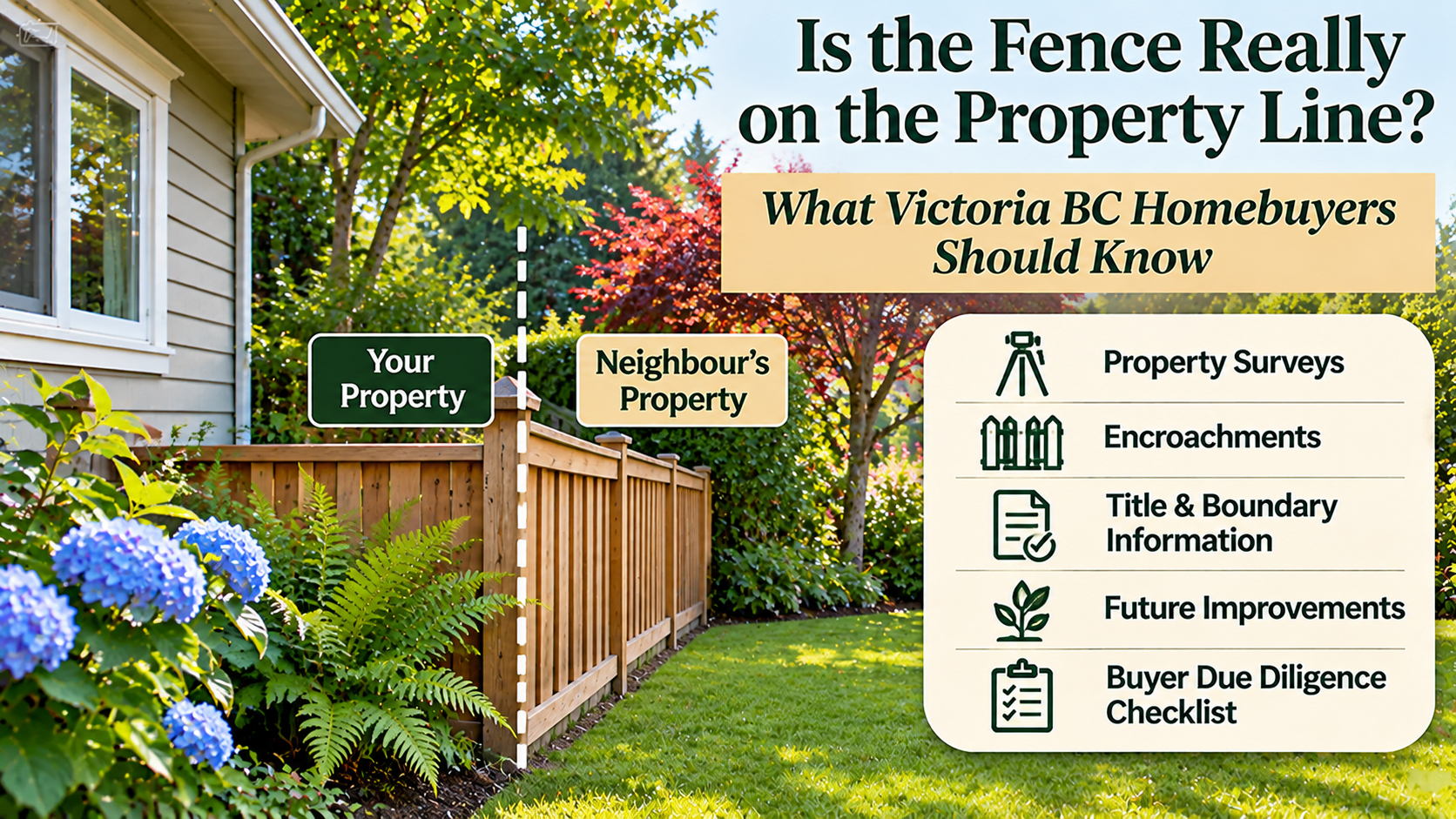
1. Why Isn't a Fence Always on the Property Line?
There are several reasons a fence might not follow the legal property boundary.
A previous homeowner may have installed it without obtaining a survey.
The fence may have been positioned to avoid a tree, rock, retaining wall or difficult terrain.
Neighbours may have agreed to place it somewhere convenient rather than exactly on the boundary.
Or the fence may simply have been built in the wrong location.
In established neighbourhoods such as Gordon Head, Oak Bay, Fairfield and Fernwood, fences and landscaping may have changed many times over the years.
A fence that has stood for decades may look like a permanent boundary, but its age alone doesn't prove where the legal property line is.
Interestingly, a longstanding fence can sometimes form part of the historical evidence considered when a boundary is being established. That is a matter for professional surveying and, where necessary, legal interpretation.
The safest approach is not to assume that the fence is correct or incorrect without proper investigation.
2. What Is the Difference Between a Property Line and a Fence Line?
A property line is the legal boundary defining the extent of a parcel of land.
A fence line is simply the physical location of a fence.
Sometimes they match. Sometimes they don't.
For example, a homeowner may have installed a fence a metre inside their property to avoid damaging a neighbour's landscaping.
In another situation, a fence may extend beyond the owner's property onto neighbouring land.
The difference may be relatively small, but it can become important when someone wants to replace the fence, construct an addition or install a new structure.
A legal boundary isn't established simply because a particular area has been fenced or maintained by one homeowner.
3. How Can Buyers Find the Legal Property Boundaries?
In British Columbia, the Land Title and Survey Authority of BC, commonly called the LTSA, maintains land title and survey records.
Registered survey plans show the legal dimensions and boundaries of parcels of land.
They may also identify survey monuments or posts used to establish boundaries.
However, a registered survey plan doesn't necessarily show where the current fence, garage or shed is located.
To establish the location of a boundary on the ground, a BC land surveyor may need to examine survey records, locate existing survey evidence and conduct field measurements.
Can You Use Online Property Maps?
Online parcel maps can be useful for preliminary research.
However, they shouldn't be treated as a precise survey of the property.
Digital property lines displayed over aerial photographs can appear slightly misaligned because of mapping and image-positioning limitations.
The LTSA specifically distinguishes ParcelMap BC's graphical representation of parcels from the authoritative legal survey records.
If you need to know whether a fence or building crosses a boundary, an online map isn't enough.
4. What Is a Building Location Certificate?
A building location certificate is a document prepared by a BC land surveyor showing the location of improvements relative to property boundaries.
It may identify the position of a house, garage or other improvements on the lot.
Depending on the scope of the survey, it can help reveal whether structures encroach across a property line.
These certificates are sometimes available from a seller who obtained one when purchasing, financing or making improvements to the property.
However, not every seller has one.
The Association of BC Land Surveyors explains that building location certificates reflect conditions at the time they were prepared.
That matters because a certificate prepared many years ago may not show a fence, shed or addition constructed afterward.
A buyer should ask whether the available certificate is sufficiently recent and appropriate for the questions they need answered.
5. What Is an Encroachment?
An encroachment occurs when a structure or improvement extends onto land outside the property where it is intended to be located.
Common examples can include:
- A fence built across the neighbouring property line.
- A garden shed extending onto adjacent land.
- A garage constructed partly over the boundary.
- A retaining wall located on a neighbouring property.
- Roof overhangs or other building components crossing a boundary.
Not every suspected encroachment is a serious problem, but it deserves investigation.
For example, a neighbour may have granted permission for a particular structure to remain.
In other circumstances, there may be no formal agreement, and the situation could lead to a dispute.
If an encroachment is identified, buyers should understand its nature and any legal or practical consequences before purchasing.
6. What Happens if a Neighbour's Fence Is on the Property You're Buying?
Suppose you're buying a property and discover that the neighbour's fence extends into the backyard by several feet.
Your first reaction might be that the fence should simply be moved.
But the situation may not be that straightforward.
The fence could have been installed by agreement between previous owners.
There may be questions about historical boundary evidence or registered property rights.
And even if a survey confirms an encroachment, resolving it may require cooperation between the property owners.
Possible solutions can include relocating the improvement, negotiating an agreement or obtaining legal advice about available remedies.
In some cases, an agreement or easement may allow an improvement to remain.
A buyer should not assume that they can automatically remove a neighbour's fence or structure without considering the legal circumstances.
If a boundary issue is identified, involving a BC land surveyor and a real estate lawyer before removing conditions may be appropriate.
7. Does a Property Survey Show Easements and Rights-of-Way?
Property boundaries are only one part of understanding a parcel of land.
A property may also be affected by registered easements, statutory rights-of-way or restrictive covenants.
For example, an easement might allow access across part of the property, while a statutory right-of-way could permit utility infrastructure to occupy a designated area.
These interests may affect where certain structures can be built or how part of the land can be used.
A title search and review of the relevant registered documents can help identify these interests.
A surveyor may also be able to show their location where the necessary records and survey information are available.
It's important to distinguish between reviewing the property's legal title and physically establishing boundaries on the ground.
Both can be relevant, but they answer different questions.
8. A Gordon Head Example: The Fence That Didn't Match the Property Line
A Hypothetical Buyer Scenario
Imagine a family purchasing a detached home in Gordon Head.
The property has a spacious backyard with mature landscaping, a wooden fence and a small garden shed.
The family loves the outdoor space. They have two dogs and are hoping to install a new fence and eventually build a larger patio.
During their due diligence, they notice that the shed sits very close to the fence.
They ask whether the seller has a recent survey certificate.
The seller provides an older building location certificate, but it was prepared before the shed and current fence were installed.
Because the exact boundary matters to their future plans, the buyers decide to consult a BC land surveyor.
The surveyor's work establishes that part of the fence is inside the neighbouring parcel.
The buyers then obtain legal advice about the implications and discuss possible solutions before deciding whether to proceed.
The issue doesn't necessarily mean they should abandon the purchase.
But understanding it before committing gives them the opportunity to make an informed decision.
9. Why Property Lines Matter When Planning Renovations
Even if the existing fence isn't a concern, property boundaries can become important when you're planning improvements.
You might want to:
- Replace or relocate a fence.
- Build a detached garage.
- Add a garden suite.
- Construct an addition.
- Install a retaining wall.
- Build a new deck.
- Change a driveway or parking area.
Many construction projects are subject to municipal zoning, setbacks, permit requirements and other restrictions.
If you're planning a structure close to a property boundary, accurate survey information may be essential.
For example, a proposed addition might meet the required setback when measured from the existing fence but fail to comply when measured from the actual property line.
This is why buyers with specific renovation plans should investigate the lot boundaries before purchasing.
10. Does the Seller Have to Provide a Survey?
Not every residential sale in British Columbia includes a current survey certificate.
Some sellers may have one from a previous transaction or renovation, while others may not.
Buyers can request available survey documents as part of their due diligence.
Whether the seller must provide a particular document depends on the contract and the circumstances of the transaction.
If the seller doesn't have a survey, buyers may decide to arrange one at their own expense, negotiate an arrangement or obtain legal advice.
The appropriate approach depends on how important the boundary information is to the purchase.
If a buyer has concerns about a possible encroachment, it's better to investigate before removing conditions rather than assume the issue can be resolved later.
11. Can Title Insurance Protect Against Boundary Problems?
Title insurance may provide protection against certain title-related risks, potentially including some encroachment issues.
However, coverage depends on the specific policy, its exclusions and the circumstances of the claim.
Title insurance is not a substitute for knowing where the property boundaries are.
It also doesn't automatically guarantee that a buyer will be able to build a proposed structure or resolve a neighbour dispute.
If title insurance is being considered, buyers should ask their lawyer or notary to explain the policy's coverage and limitations.
Where boundary location is important, a current survey may still be the appropriate step.
12. Could a Boundary Issue Affect Resale Value?
A confirmed encroachment or unresolved boundary dispute may affect how some buyers view a property.
It could raise questions about usable yard space, future improvements or the cost of resolving the issue.
However, not every fence discrepancy has the same significance.
The impact depends on the size and nature of the issue, whether it has been legally addressed and how it affects the property's use.
There is no standard dollar amount that should automatically be deducted from a property's value because a fence doesn't follow the boundary.
A property-specific assessment, supported by appropriate surveying and legal information, is more useful than making assumptions.
13. Property Boundary Checklist for Victoria Homebuyers
Before Removing Conditions, Consider:
- Fence location: Is there any reason to question whether the fence follows the legal boundary?
- Survey records: Is a registered survey plan available?
- Building location certificate: Does the seller have one, and how current is it?
- Outbuildings: Are sheds, garages or retaining walls close to the boundary?
- Encroachments: Are there known or suspected structures crossing property lines?
- Title documents: Are there registered easements, covenants or rights-of-way?
- Neighbour agreements: Are there any written agreements about fences, access or shared structures?
- Future plans: Could the location of the boundary affect proposed renovations?
- Municipal rules: What setbacks, permits or fence requirements may apply?
- Professional survey: Is a current survey necessary to answer important questions?
- Legal advice: Should a lawyer review a possible encroachment or boundary dispute?
- Insurance: Are there title insurance questions worth discussing with the buyer's legal professional?
14. What Should You Do if You Suspect a Boundary Problem?
If something about the fence, lot layout or neighbouring structures raises concerns, it's worth investigating rather than ignoring it.
A sensible approach may include:
- Ask the seller whether they have any survey documents or information about the boundary.
- Review the registered survey plan and relevant title documents.
- Identify any structures or improvements close to the suspected boundary.
- Consult a BC land surveyor if the physical boundary location needs to be established.
- Seek legal advice if an encroachment or dispute is identified.
- Consider how the findings affect your plans and willingness to purchase.
A general home inspector may notice a fence or structure that appears unusually close to a boundary, but a visual home inspection cannot reliably establish the legal property line.
That's the role of appropriate survey evidence and professional surveying advice.
Dawn's Take: Don't Assume the Fence Tells the Whole Story
When I'm showing buyers a home, I know how easy it is to picture how they'll use the backyard.
Perhaps they're thinking about their children playing outside, their dogs having room to run or building a new deck.
But I always think it's important to understand what they're actually purchasing.
A fence may have been in place for 30 years, but that doesn't necessarily mean it marks the exact property boundary.
If there's a shed, garage or retaining wall close to the fence, or my buyers are planning improvements, I'd want to know whether the boundary location needs further investigation.
That might mean reviewing survey documents, asking additional questions or involving a BC land surveyor.
It doesn't mean every property needs a new survey. It means understanding when the information is important.
I'd much rather help buyers investigate a potential issue before purchasing than have them discover an unexpected boundary problem when they're ready to make improvements.
Frequently Asked Questions About Fences and Property Lines in Victoria BC
Does a fence mark the legal property line in British Columbia?
Not necessarily. A fence may have been built inside or outside the legal boundary for convenience, landscaping or other reasons. Its location alone does not prove the boundary. A BC land surveyor can investigate and establish the boundary using appropriate survey evidence.
How can I find my property lines in Victoria BC?
Registered survey plans are available through the Land Title and Survey Authority of BC. However, determining the precise boundary location on the ground may require a BC land surveyor. Online parcel maps are useful for preliminary research but should not be relied upon for exact measurements.
What happens if my neighbour's fence is on my property?
The appropriate response depends on the circumstances. A survey may be needed to confirm the boundary, and legal advice may be appropriate if an encroachment is identified. Possible solutions can include relocating the fence or negotiating an agreement. Buyers should not assume they can simply remove it.
Does a seller have to provide a property survey in BC?
A current survey certificate is not automatically included with every residential sale. Buyers can request available survey documents, and contractual requirements may affect what must be provided. If the boundary location is important, buyers may consider arranging a survey before removing conditions.
Is an old building location certificate reliable?
An older certificate may be useful, but it reflects conditions when the survey was completed. Fences, buildings and other improvements may have changed since then. A BC land surveyor can advise whether the document is suitable for the buyer's intended purpose.
Does title insurance cover fence encroachments in BC?
Some title insurance policies may provide coverage for certain encroachment-related risks, but coverage and exclusions vary. Buyers should review the policy with their lawyer or notary. Title insurance does not establish the exact location of a property boundary.
Buying a Home in Greater Victoria?
Whether you're considering a family home in Gordon Head, a character property in Fairfield, an established home in Oak Bay or a property in Cordova Bay, understanding the land is an important part of buying with confidence.
I help buyers look beyond the obvious features of a property and identify the documents, questions and professional assessments that may be important before making a commitment.
You don't need to know everything about land surveying or property boundaries before buying a home.
But you should understand any significant concerns that could affect how you use the property.
Let's Talk About Your Home Search
Considering a Greater Victoria property with an older fence, unusual lot layout or structures close to the boundary?
I'm happy to help you identify the questions and property documents worth reviewing before you purchase.
No pressure. Just practical guidance to help you make an informed decision.
Connect With DawnHelpful Resources
- Land Title and Survey Authority of BC — Land Survey Plans
- LTSA — Ordering Land Title Documents and Plans
- Association of BC Land Surveyors — Frequently Asked Questions
- BCFSA — Legal Update: Easements and Encroachments
- BCFSA — Completing Your Home Purchase
Disclaimer: This article provides general real estate information as of November 2026. Property boundaries, encroachments, title interests and legal remedies depend on the individual circumstances. Buyers should obtain advice from a BC land surveyor, lawyer, notary or other qualified professional where appropriate. This article does not constitute legal or surveying advice.
Categories
Recent Posts



REVIEWS