
Buying a Home With a Sewer Pump in Victoria BC
Buying a Home With a Sewer Pump in Victoria BC: What Buyers Should Know
When you're viewing a home, you're probably paying attention to the layout, condition, neighbourhood and whether the property suits your lifestyle. The plumbing system usually isn't the first thing that comes to mind.
But what if you discover that the home has a private sewage pump?
You might wonder why it's needed, whether it requires regular maintenance and what happens if it stops working.
These are sensible questions, particularly if you're purchasing a property with a finished basement, a lower-level bathroom or a home built on sloping terrain.
A sewer pump isn't necessarily a reason to avoid a property. However, it's important to understand how the system works, who is responsible for maintaining it and what you should investigate before purchasing.
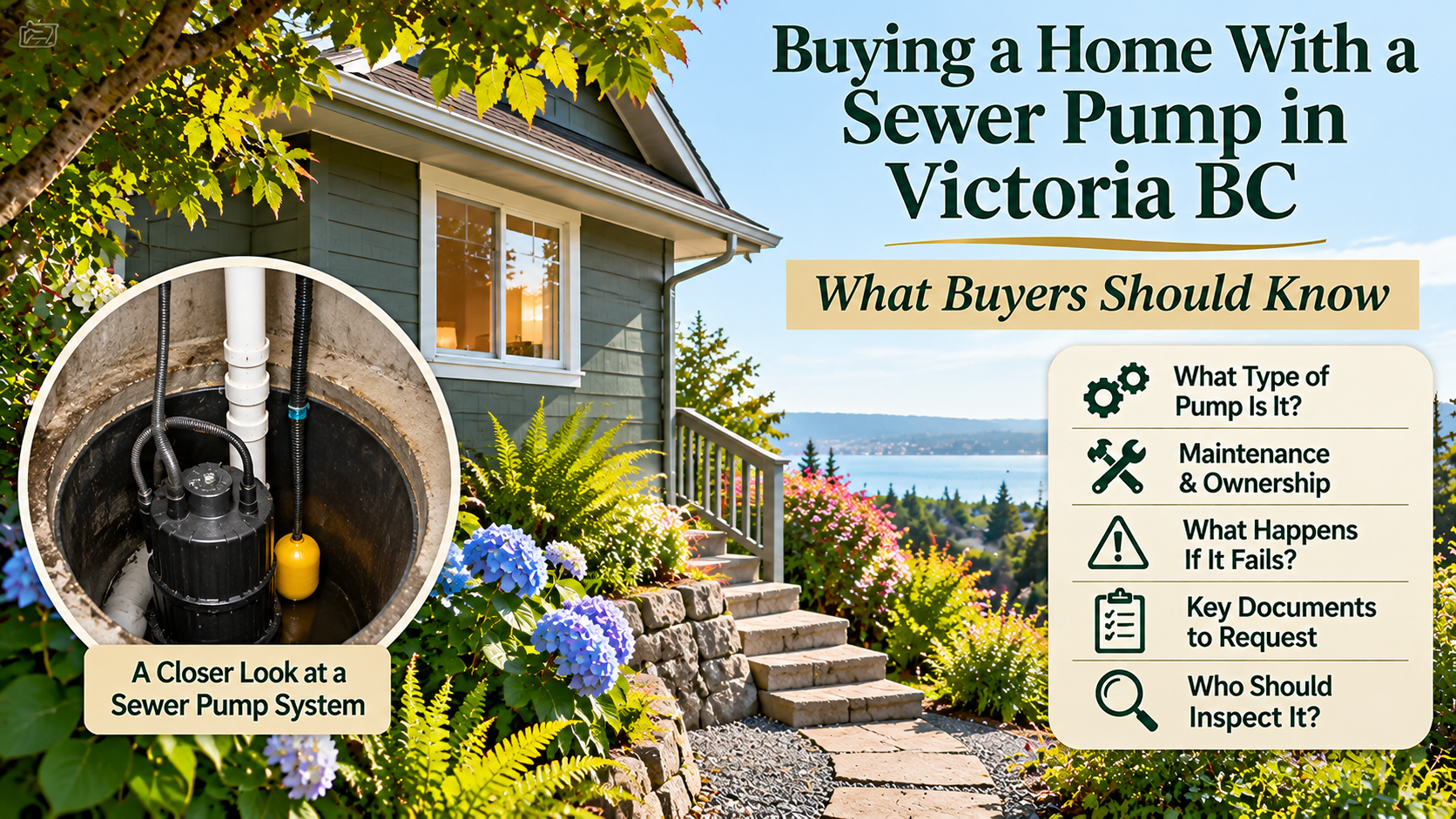
1. Why Would a House Need a Sewer Pump?
In many homes, wastewater flows through the plumbing system and into the municipal sewer by gravity.
But sometimes the plumbing fixtures are too low for wastewater to flow naturally to the sewer connection.
For example, a bathroom in a basement may be located below the level of the sewer line.
In other situations, the property's elevation or the location of the municipal sewer may make gravity drainage impractical.
A pump can move wastewater upward or across a distance so that it can reach the appropriate sewer connection.
This means a property can have municipal sewer service while still depending on private mechanical equipment.
Saanich's sanitary sewer system includes gravity mains and municipal pumping stations. However, municipal infrastructure should not be confused with privately installed pumping equipment serving an individual property.
2. What Type of Sewer Pump Does the Home Have?
There are several different types of wastewater pumping systems, and they don't all serve the same purpose.
Sewage Ejector Pump
A sewage ejector pump is commonly used when plumbing fixtures are located below the level of the main sewer line.
For example, a basement bathroom might drain into a sealed basin containing a sewage ejector pump.
When wastewater reaches a certain level, the pump activates and moves it into the home's drainage system.
The pump may serve only specific fixtures rather than the entire house.
Grinder Pump
A grinder pump is designed to break down sewage solids before pumping wastewater through a discharge pipe.
These systems may be used where wastewater needs to travel under pressure or where the sewer connection requires a particular pumping arrangement.
A grinder pump may serve a larger portion of the home's plumbing system, depending on the installation.
Private Wastewater Lift Station
Some properties use a larger pumping arrangement, sometimes referred to as a private lift station.
These systems may include one or more pumps, a collection chamber, level controls, alarms and additional electrical equipment.
The configuration depends on the property and the engineering requirements.
For buyers, the first step is to establish exactly which type of system is installed and what it serves.
3. Who Is Responsible for Maintaining the Pump?
This is one of the most important questions to ask.
If the equipment is privately owned, maintenance and repairs will generally be the responsibility of the property owner, subject to any applicable agreements or utility arrangements.
However, ownership shouldn't be assumed solely because the equipment is located near a house.
Some systems may serve more than one property, or there may be registered agreements relating to access, maintenance or shared expenses.
Buyers should investigate:
- Who owns the pump and associated equipment.
- Whether the system serves only one property.
- Whether any maintenance agreement exists.
- Whether the equipment is located on the property or elsewhere.
- Whether registered easements or rights-of-way affect access.
- Who pays for repairs and eventual replacement.
For an unusual installation, reviewing title documents and obtaining clarification from the municipality or appropriate utility may be worthwhile.
4. What Happens if the Sewer Pump Stops Working?
A sewage pump is mechanical equipment, and like other mechanical systems, it can fail.
Possible causes include:
- Electrical problems.
- A failed motor or pump component.
- Blocked or damaged piping.
- Float-switch or level-control problems.
- Improper materials entering the system.
- Loss of electrical power.
If a pump stops operating, wastewater may no longer be able to reach the sewer connection.
Continued use of affected plumbing fixtures could cause wastewater to accumulate or back up.
The consequences depend on the installation, the available storage capacity and whether alarms or backup equipment are present.
What About Power Outages?
Most residential sewage pumps depend on electricity.
If the power goes out and the system has no functioning backup power source, the pump may be unable to operate.
Buyers should ask whether the installation has a high-water alarm, backup power or other safeguards.
They should also understand what plumbing fixtures should not be used during a pump failure.
A qualified plumbing or pump-system professional can explain the specific system's limitations and recommended precautions.
5. How Much Maintenance Does a Sewer Pump Require?
Maintenance requirements vary depending on the equipment, how often it operates and the manufacturer's recommendations.
Some residential systems may operate for extended periods without major repairs, but that doesn't mean they are maintenance-free.
A qualified service provider may recommend periodic checks of:
- The pump and motor.
- Float switches or level sensors.
- High-water alarms.
- Check valves and discharge piping.
- Electrical controls.
- The condition of the collection basin.
- Any backup equipment.
Buyers should request the manufacturer's maintenance recommendations and any available service records.
It's also useful to know which local contractor has previously serviced the equipment.
6. How Old Is the Pump, and What Would Replacement Cost?
The age of the pump is worth investigating, but it shouldn't be used as the only indicator of condition.
Service life depends on the pump model, installation quality, usage, maintenance and operating conditions.
Replacement costs can vary considerably.
Replacing an accessible residential sewage ejector pump may be very different from replacing a buried grinder pump station that requires excavation, electrical work or modifications to the discharge piping.
For that reason, I wouldn't recommend relying on a generic online replacement estimate.
If the equipment is older, has an uncertain service history or shows signs of problems, buyers may wish to obtain a property-specific assessment and written estimate from a qualified contractor.
7. Can a Regular Home Inspector Assess the Sewer Pump?
A general home inspection may identify visible plumbing equipment and obvious concerns, but the scope of a standard inspection may not include a complete evaluation of a sewage pumping system.
The inspector may not dismantle the equipment, inspect the interior of a sealed basin or test every component.
If the home has a private sewer pump, buyers should ask the home inspector what is included in the inspection and whether a specialist assessment is recommended.
What About a Sewer Camera Inspection?
A sewer camera inspection can be useful for examining accessible sections of sewer piping.
However, it does not necessarily assess the condition of the pump motor, electrical controls, floats, alarms or other mechanical components.
Depending on the installation, some sections of piping may also be inaccessible to a conventional camera inspection.
A sewer camera inspection and a pump-system inspection serve different purposes.
If both are warranted, they should be considered separately.
8. Are Permits Required for Private Sewer Pumps in Saanich?
Permit requirements depend on the work being performed and the applicable municipality.
In Saanich, plumbing work and sanitary sewer connections are subject to municipal requirements.
Saanich's Building and Plumbing Bylaw includes provisions relating to sewer connections and pumping stations.
A private sewage pumping installation may involve plumbing permits, electrical permits, inspections or other approvals, depending on its design and scope.
Buyers should not assume that every system has identical permit requirements.
When reviewing a property, useful questions include:
- When was the system installed?
- Was it part of the original construction or added later?
- Are installation permits available?
- Were required inspections completed?
- Has the system been altered or replaced?
- Does the installation comply with applicable requirements?
The relevant municipality and permitting authorities should be consulted when documentation is missing or questions remain.
9. A Cordova Bay Example: The Beautiful Home With a Hidden Pump
A Hypothetical Buyer Scenario
Imagine a couple looking at a detached home in Cordova Bay.
The property has a lovely garden, ocean glimpses and a beautifully finished lower level with a guest bedroom and bathroom.
During their due diligence, they learn that the lower-level bathroom drains into a sewage ejector system.
The pump moves wastewater upward to the home's main drainage line.
The buyers have never owned a home with this type of equipment.
Rather than assuming it's a problem, they begin asking questions.
They request the installation documentation and ask when the pump was last serviced.
They also arrange for a qualified plumbing professional to assess the system.
The contractor explains which fixtures depend on the pump, how the alarm operates and what maintenance is recommended.
With that information, the buyers can make a more informed decision about the property and its ongoing responsibilities.
The pump itself may not be a deal-breaker. The important thing is understanding what they're purchasing.
10. What Should Buyers Request Before Removing Conditions?
Private Sewer Pump Due-Diligence Checklist
- System identification: Is it a sewage ejector, grinder pump or private lift station?
- Coverage: Which bathrooms, fixtures or buildings depend on the pump?
- Ownership: Who owns and maintains the equipment?
- Installation date: When was it installed?
- Make and model: Is the manufacturer's information available?
- Permits: Are relevant installation and inspection records available?
- Maintenance: Are service records available?
- Repairs: Has the system experienced failures, backups or major repairs?
- Alarms: Does it have a functioning high-water alarm?
- Power outages: What happens when electricity is unavailable?
- Professional inspection: Has a qualified specialist assessed the equipment?
- Replacement: Are there known concerns or anticipated expenses?
- Insurance: Has the buyer discussed applicable sewer-backup coverage and exclusions with their insurer?
- Shared arrangements: Are any easements, agreements or shared maintenance obligations involved?
11. Could a Private Sewer Pump Affect Resale Value?
A private sewer pump doesn't automatically make a property less desirable.
However, buyers may consider the additional maintenance responsibilities, potential repair costs and consequences of a system failure.
A newer, properly functioning system with clear documentation may be easier for buyers to evaluate than an older installation with no service history.
The impact on resale value will depend on the property, the type of equipment, its condition and how buyers compare it with other available homes.
There is no universal amount that should be deducted from a home's value simply because it has a sewage pump.
The goal is to understand the system and account for any property-specific concerns.
12. Is a Private Sewer Pump a Reason Not to Buy?
Not necessarily.
Many homes have mechanical systems that require maintenance, including heat pumps, boilers, sump pumps and sewage ejectors.
The existence of a pump is not, by itself, evidence that something is wrong.
What matters is whether the system is appropriate for the property, functioning as intended and reasonably understood by the buyer.
If the equipment is old, poorly maintained or difficult to access, those concerns deserve further investigation.
If it has been professionally installed and maintained, buyers may feel comfortable accepting the responsibilities that come with ownership.
As with any significant property component, the decision should be based on reliable information rather than assumptions.
Dawn's Take: It's About Understanding What You're Buying
When I'm helping buyers look at a home, I pay attention to the systems that aren't always obvious during a showing.
A private sewage pump is a good example.
The home may be beautifully maintained, and everything may appear to work perfectly. But if the property relies on a pump to move wastewater, I'd want my buyers to understand exactly how that system works.
I'd want to know what the pump serves, who maintains it, whether there have been problems and what would happen if it stopped operating.
I'd also want the right professional involved if there were questions about its condition.
That doesn't mean I'd discourage someone from buying the property.
It means I'd want them to make their decision with a clear understanding of the responsibilities and potential costs.
Buying a home is about more than what you can see. It's also about understanding the systems that keep everything working behind the scenes.
Frequently Asked Questions About Buying a Home With a Sewer Pump
Why would a house connected to municipal sewer need a pump?
A pump may be needed when plumbing fixtures or the property are too low for wastewater to reach the sewer connection by gravity. The pump moves wastewater to a suitable discharge point, even though the home is connected to municipal sewer.
Is a sewage ejector pump the same as a grinder pump?
No. A sewage ejector pump generally moves wastewater containing solids, often from lower-level plumbing fixtures. A grinder pump incorporates a mechanism that breaks down solids before pumping. The appropriate system depends on the installation.
What happens to a sewer pump during a power outage?
Most residential sewage pumps require electricity. Without functioning backup power, the pump may stop operating. Continued use of affected fixtures could cause wastewater to accumulate or back up. Buyers should ask about alarms, backup systems and emergency procedures.
Should I have a sewer pump inspected before buying a home?
A specialist inspection is worth considering, particularly when the pump's age, condition or maintenance history is uncertain. A qualified plumber or pump-system specialist can assess components that may fall outside a general home inspection.
Does a sewer camera inspection check the pump?
Not necessarily. A sewer camera inspection generally examines accessible piping. It may not evaluate the pump motor, float switches, alarms or electrical controls. Buyers should confirm the scope of each inspection.
Who pays to replace a private sewer pump in Victoria BC?
The owner of a privately maintained system is generally responsible for its repairs and replacement, subject to any applicable agreements or utility arrangements. Buyers should verify ownership, maintenance obligations and any shared responsibilities before purchasing.
Buying a Home in Greater Victoria?
Whether you're considering a family home in Gordon Head, a hillside property in Cordova Bay, an older home in Oak Bay or a renovated property in Esquimalt, understanding the home's important systems is part of making an informed purchase.
My approach is to help buyers identify the questions worth asking, understand the available information and involve qualified professionals when needed.
You don't need to know everything about plumbing or mechanical equipment before buying a home.
But you should understand the significant responsibilities you're taking on.
Let's Talk About Your Home Search
Considering a property in Greater Victoria with a private sewer pump or another unusual feature?
I'm happy to help you understand what information to request and what questions to ask before making a commitment.
No pressure. Just practical guidance to help you make an informed decision.
Connect With DawnHelpful Resources
- District of Saanich — Sanitary Sewer Information
- District of Saanich — Plumbing Permits
- District of Saanich — Sewer Backup and Emergency Assistance
- District of Saanich — Sanitary Sewer Guidelines
Disclaimer: This article provides general real estate information as of November 2026. Sewer pump design, ownership, maintenance obligations, permit requirements and inspection needs vary by property and municipality. Buyers should verify property-specific information with the appropriate local authority, qualified plumbing professionals, legal advisers and insurance providers where necessary.
Categories
Recent Posts









REVIEWS