
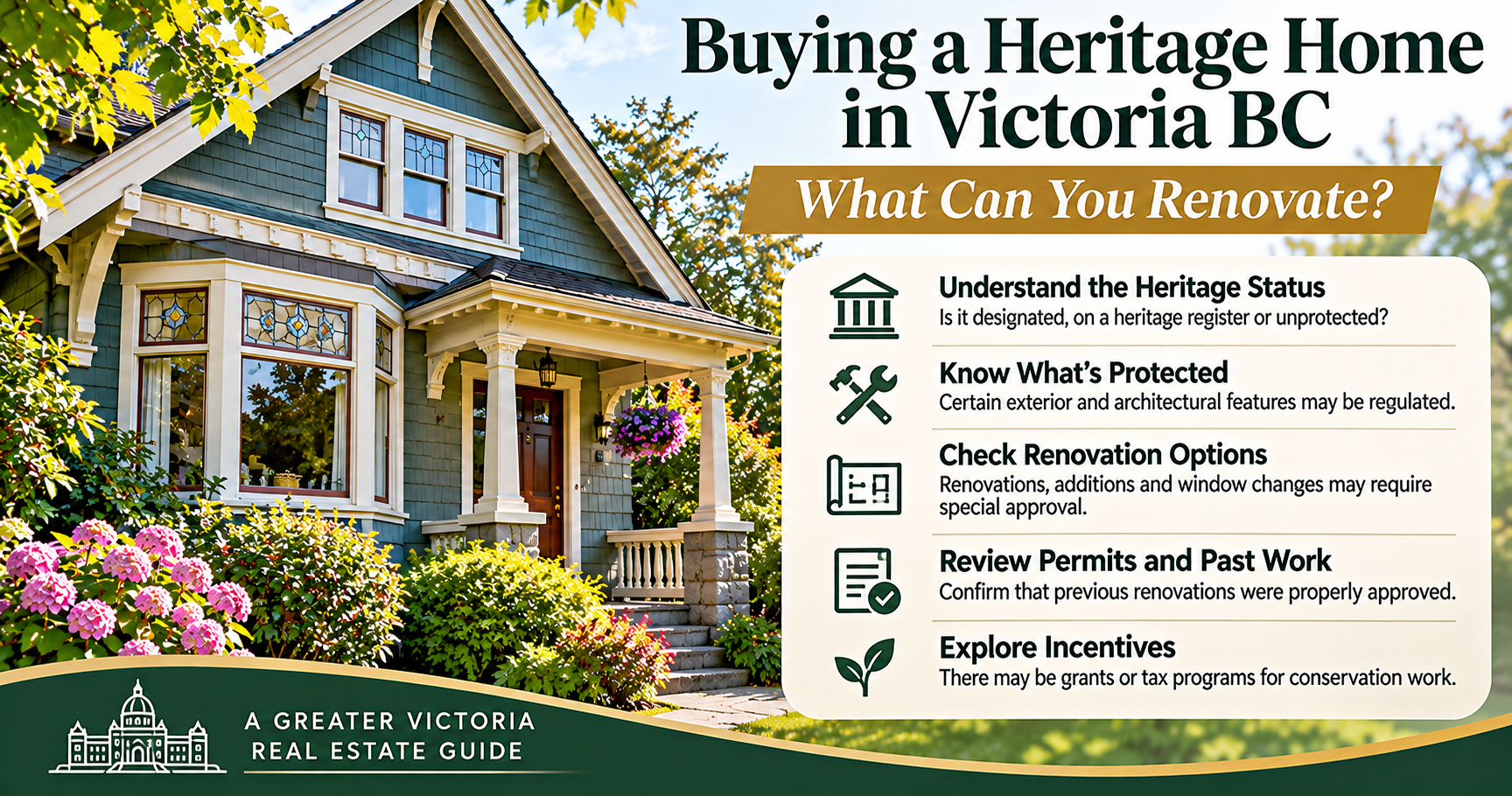
Buying a Heritage Home in Victoria BC: What Can You Renovate?
Buying a Heritage Home in Victoria BC: What Can You Renovate?
There's something special about Victoria's older character homes. The original woodwork, beautiful windows, covered verandas and architectural details give these properties a personality that's difficult to recreate in a newer home.
Neighbourhoods such as Fairfield, Fernwood and Oak Bay are especially appealing to buyers who appreciate traditional architecture and established streetscapes.
But if you're considering purchasing an older home, there's an important question worth asking before you make an offer:
Is the property protected by heritage regulations, and could those regulations affect the changes you want to make?
Not every older home has heritage protection. And even when a property does have heritage status, renovations aren't necessarily prohibited.
The key is understanding what protections apply to the specific property before committing to the purchase.
1. What Makes a Home a Heritage Property in Victoria BC?
Greater Victoria has many homes dating back to the early 1900s and even earlier.
Some have been formally recognized for their architectural, historical or cultural significance.
However, a home's age alone doesn't establish that it has legal heritage protection.
There are several different heritage classifications buyers should understand.
Older Character Home
A character home may have historical architectural features without being formally registered or designated as a heritage property.
For example, a 1915 home in Fernwood might retain its original front porch, wood siding and decorative trim but have no formal heritage designation.
Normal zoning, building permit and other municipal requirements would still apply to renovations.
Property on a Municipal Heritage Register
A municipal heritage register identifies properties considered to have heritage value or character.
Registration provides formal recognition, but registration alone does not create permanent legal heritage protection.
For example, the City of Victoria explains that a property listed only on its Heritage Register is not automatically subject to the same alteration restrictions as a formally designated property.
However, a registered property may also be located within a Heritage Conservation Area or subject to another protection mechanism.
Registration can also have implications for certain demolition and development review processes.
Buyers should therefore investigate all applicable protections rather than relying on the register listing alone.
Heritage-Designated Property
A heritage-designated property has formal legal protection, generally established through a municipal bylaw.
In Victoria, changes affecting protected features may require formal approval, and demolition of a designated building requires municipal consent.
The specific features protected depend on the designation and other applicable documents.
Some designations focus primarily on the exterior, while others may identify particular interior features, landscape elements or structures.
Heritage Conservation Areas and Agreements
A property may also be affected by a Heritage Conservation Area, heritage revitalization agreement or heritage covenant.
These can create additional requirements or restrictions.
This is why it's important to investigate the specific property, not simply ask whether the house is old.
2. Can You Renovate a Heritage-Designated Home?
Yes, renovations may be possible.
Heritage designation does not necessarily mean a home must remain exactly as it was when originally built.
However, certain changes may require additional approvals, and some proposals may not be permitted.
The City of Victoria explains that normal maintenance and repairs that do not visually change protected materials or appearance can generally proceed without heritage approval.
Changes affecting designated features may require municipal consent or a Heritage Alteration Permit, depending on the property and scope of work.
Buyers should distinguish between routine maintenance and changes that alter the home's protected character.
Replacing Windows
Windows are one of the most common renovation questions for buyers of older homes.
You might want to improve energy efficiency, reduce drafts or replace deteriorating frames.
But if original windows are protected heritage features, replacing them with modern units may require approval.
The municipality may expect a conservation approach that preserves important architectural details.
Before budgeting for replacement windows, ask which alterations would be acceptable.
Updating Kitchens and Bathrooms
Many heritage homes have kitchens and bathrooms that have been renovated over the years.
Interior updates may be possible without affecting protected heritage features.
However, buyers should not assume every interior alteration is unrestricted.
Structural work, plumbing, electrical changes and any specifically protected interior features may introduce additional requirements.
Building permits may still be necessary even when heritage approval isn't required.
Adding an Extension
Perhaps you love a character home in Fairfield but would eventually like a larger kitchen or an additional bedroom.
An extension may be possible, but the design could need to respect the property's heritage character.
Municipal staff may consider the scale, placement, materials and impact on protected architectural features.
Zoning requirements, setbacks, lot coverage and other development rules also apply.
A heritage designation does not automatically authorize an addition, and an addition permitted by zoning is not automatically acceptable from a heritage perspective.
Changing the Exterior
Replacing siding, changing exterior materials, altering a porch or removing decorative trim may affect protected features.
Before purchasing, identify which exterior elements are significant and whether proposed changes would require approval.
3. Heritage Register vs. Heritage Designation: What's the Difference?
| Heritage Register | Heritage Designation |
|---|---|
| Recognizes a property's heritage value. | Provides formal legal protection. |
| Does not itself create permanent heritage protection. | Can restrict alterations to protected features. |
| May trigger additional review or temporary protection measures. | Alterations or demolition may require municipal approval. |
| Other protections may still apply. | Specific requirements depend on the designation and applicable rules. |
The distinction matters because buyers sometimes assume that every property on a heritage register has the same restrictions.
That's not the case.
The best starting point is to ask the municipality to confirm the property's status and explain what approvals would be required for your intended renovations.
4. A Fairfield Heritage Home: A Practical Buying Example
Imagine Purchasing a 1912 Character Home
A couple finds a beautiful older home in Fairfield.
The house has original woodwork, large windows, a welcoming front porch and a mature garden.
They love the property, but they're also thinking ahead.
They would eventually like to replace some windows, renovate the kitchen and build a small rear extension.
Before making a firm commitment, they discover the property has heritage designation.
Does that mean they should walk away?
Not necessarily.
But it does mean they should investigate their plans before purchasing.
Their next steps might include:
- Obtaining the heritage designation bylaw and related documents.
- Identifying the protected architectural features.
- Reviewing previous building and heritage approvals.
- Discussing their proposed renovations with municipal heritage staff.
- Obtaining preliminary advice from a qualified designer or heritage professional.
- Estimating renovation costs and possible approval timelines.
They may discover that their plans are feasible with appropriate design changes.
Or they may learn that certain alterations would be difficult or unlikely to receive approval.
Either way, understanding the situation before purchasing allows them to make a more informed decision.
5. What About Heritage Homes in Oak Bay, Saanich and Other Neighbourhoods?
Heritage protection is not limited to the City of Victoria.
Different municipalities maintain their own heritage records, policies and approval processes.
Fairfield and Fernwood
These Victoria neighbourhoods contain many older character homes.
Buyers should investigate whether a particular property is registered, designated, within a Heritage Conservation Area or subject to other restrictions.
Oak Bay
Oak Bay has its own heritage program and municipal planning requirements.
Buyers considering an older home should confirm the property's status directly with the District of Oak Bay.
Certain properties may also be subject to design controls unrelated to heritage designation.
Saanich, Gordon Head, Cadboro Bay and Cordova Bay
Saanich includes properties from many different periods of development.
Although much of Gordon Head and Royal Oak is associated with later residential development, buyers may still encounter historically significant properties in Saanich.
Heritage status should be verified on a property-by-property basis.
Esquimalt and Sidney
Buyers considering older homes in Esquimalt or Sidney should consult the applicable municipal heritage and planning records.
Never assume that Victoria's specific approval process applies automatically in another municipality.
6. What Should Buyers Check Before Purchasing a Heritage Home?
A home inspection is important, but it cannot determine the full legal implications of heritage protection.
Buyers should investigate the property's legal status and any restrictions that could affect future plans.
Heritage Home Buyer's Checklist
- Confirm heritage status: Is the property registered, designated or subject to another heritage protection?
- Request the relevant documents: Obtain designation bylaws, agreements, covenants and other available records.
- Identify protected features: Determine whether protection applies to exterior materials, windows, interiors, landscaping or other elements.
- Review renovation history: Ask for building permits and previous heritage approvals.
- Check your renovation plans: Speak with municipal staff before assuming proposed changes will be permitted.
- Investigate property condition: Consider inspections of the roof, foundation, electrical system, plumbing and other relevant components.
- Budget carefully: Allow for potential specialized materials, conservation work and professional advice.
- Check insurance and financing: Confirm that your insurer and lender are comfortable with the specific property and its condition.
- Explore possible incentives: Ask whether the property and proposed work qualify for any current heritage conservation programs.
- Consider future resale: Understand how the property's character and restrictions may influence its appeal to future buyers.
7. Are Heritage Homes More Expensive to Maintain?
They can be, but not always.
Maintenance costs depend on the age, condition, construction and particular features of the property.
Older homes may require specialized work involving original wood windows, exterior detailing, masonry or other traditional materials.
If certain features are protected, replacement options may be more limited.
However, a well-maintained heritage home can also offer excellent craftsmanship and durable materials.
The important thing is to evaluate the actual condition of the home rather than assuming every heritage property will be expensive to maintain.
8. Are Grants Available for Heritage Home Renovations?
Some municipalities and heritage organizations offer incentives or grant programs for eligible conservation projects.
The City of Victoria, for example, identifies grant opportunities for improvements to heritage-designated houses.
However, funding availability, eligibility, covered work and application deadlines can vary.
Not every older or registered property qualifies.
Buyers should investigate available programs directly with the municipality or administering organization before relying on financial assistance.
9. Can Heritage Designation Affect Resale Value?
Heritage status can influence a property's appeal, but it doesn't automatically make a home more or less valuable.
Some buyers are attracted to distinctive architecture, original craftsmanship and established neighbourhood character.
Others may prefer a property with greater flexibility for redevelopment or extensive renovations.
The impact on market value depends on the home's condition, location, protection requirements, buyer demand and comparable sales.
When evaluating a heritage property, it's important to consider both the features that make it desirable and any limitations that may affect future buyers.
10. Should You Avoid Buying a Heritage-Designated Home?
Not necessarily.
For buyers who appreciate older architecture and want to preserve a home's character, a heritage property can be a wonderful choice.
The concern isn't heritage designation itself.
The concern is purchasing a property without understanding how its protections may affect your plans.
If you're hoping to substantially alter the exterior, demolish the home or undertake major redevelopment, heritage restrictions deserve particular attention.
But if you love the property's existing character and your future plans are compatible with its protections, heritage status may not be a significant obstacle.
Dawn's Take: Love the Character, but Understand the Restrictions
I love the character of older homes in Victoria. Original hardwood floors, detailed trim, beautiful windows and welcoming front porches can make a property feel very special.
But when buyers are considering a home with heritage status, I encourage them to think about their future plans as well as what they love about the property today.
If you're hoping to replace windows, renovate extensively or add more living space, it's important to understand what approvals may be required before purchasing.
An older home isn't automatically heritage-designated, and even when a property has formal protection, that doesn't necessarily mean renovations are impossible.
The key is understanding the specific restrictions and requirements before making a commitment.
I would rather help my clients investigate these questions early than have them discover unexpected limitations after they've purchased the home.
A beautiful character home can be a wonderful place to live. The goal is to make sure it also works for the way you want to live in the future.
Frequently Asked Questions About Heritage Homes in Victoria BC
Can you renovate a heritage-designated home in Victoria BC?
Yes, renovations may be possible, but changes affecting protected heritage features can require municipal approval. The requirements depend on the property's designation, applicable bylaws and the proposed work. Buyers should confirm the rules with the municipality before proceeding.
What is the difference between a heritage register and heritage designation?
A heritage register identifies properties with recognized heritage value but does not itself create permanent legal protection. Heritage designation provides formal legal protection and may restrict alterations or demolition. Other protections, including heritage conservation areas and agreements, may also apply.
Can you replace windows in a heritage home?
Window replacement may be possible, but original windows or exterior features may be protected. The municipality may require approval or a conservation approach that preserves important architectural details. Buyers should investigate the property's specific restrictions before budgeting for replacements.
Can you build an addition on a heritage-designated house?
An addition may be possible, but it must comply with applicable zoning, building and heritage requirements. Municipal approval may be needed, particularly if the proposed addition affects protected features or the property's heritage character.
Does an old house automatically have heritage designation?
No. A property's age alone does not establish heritage designation. Some older homes have no formal heritage protection, while others may be registered, designated or subject to heritage agreements or conservation area requirements.
Are there grants for renovating heritage homes in Victoria BC?
Some heritage conservation grants and incentives may be available for eligible properties and projects. Programs, funding and eligibility requirements vary. Buyers should confirm current opportunities with the municipality or organization administering the program.
Thinking About Buying a Character Home in Greater Victoria?
Whether you're considering a heritage property in Fairfield, a character home in Fernwood or an older home in Oak Bay, it's worth understanding the property's condition, history and potential restrictions before making an offer.
I can help you identify important due-diligence questions, review available property information and coordinate the next steps with the appropriate professionals.
My approach is simple: clear information, thoughtful guidance and no pressure.
Let's Talk About Your Next Home
Considering a character or heritage home in Greater Victoria?
We can start with a 15–20 minute conversation about the property, your renovation plans and what you should investigate before purchasing.
No pressure. Just practical guidance to help you make an informed decision.
Connect With DawnOfficial Resources
- City of Victoria — Heritage Conservation
- BC Government — Conserving Buildings and Properties
- BC Government — Local Government Heritage Planning
- District of Oak Bay — Zoning and Land Use
- District of Saanich
Disclaimer: This article provides general educational information as of November 2026. Heritage protection, renovation approval requirements and municipal policies vary by property and jurisdiction and may change. Buyers should confirm the specific legal status, permitted alterations and required approvals with the relevant municipality and obtain legal or professional advice where appropriate.
Categories
Recent Posts



REVIEWS