
Buying a Home Near a Creek in Victoria BC: What Buyers Should Check Before Purchasing.
Buying a Home Near a Creek in Victoria BC: What Buyers Should Check Before Purchasing
There's something special about a home surrounded by nature. A creek running through the property, mature trees, ferns and a peaceful garden can make a home feel like a private retreat.
In Greater Victoria, we're fortunate to have established neighbourhoods where homes sit alongside streams, ravines and natural green spaces.
But if you're considering buying a property near a creek, there's something important to understand: the natural features that make the property attractive may also affect what you're allowed to build or change.
That doesn't mean you should avoid these properties. It simply means there are some additional questions worth investigating before purchasing.
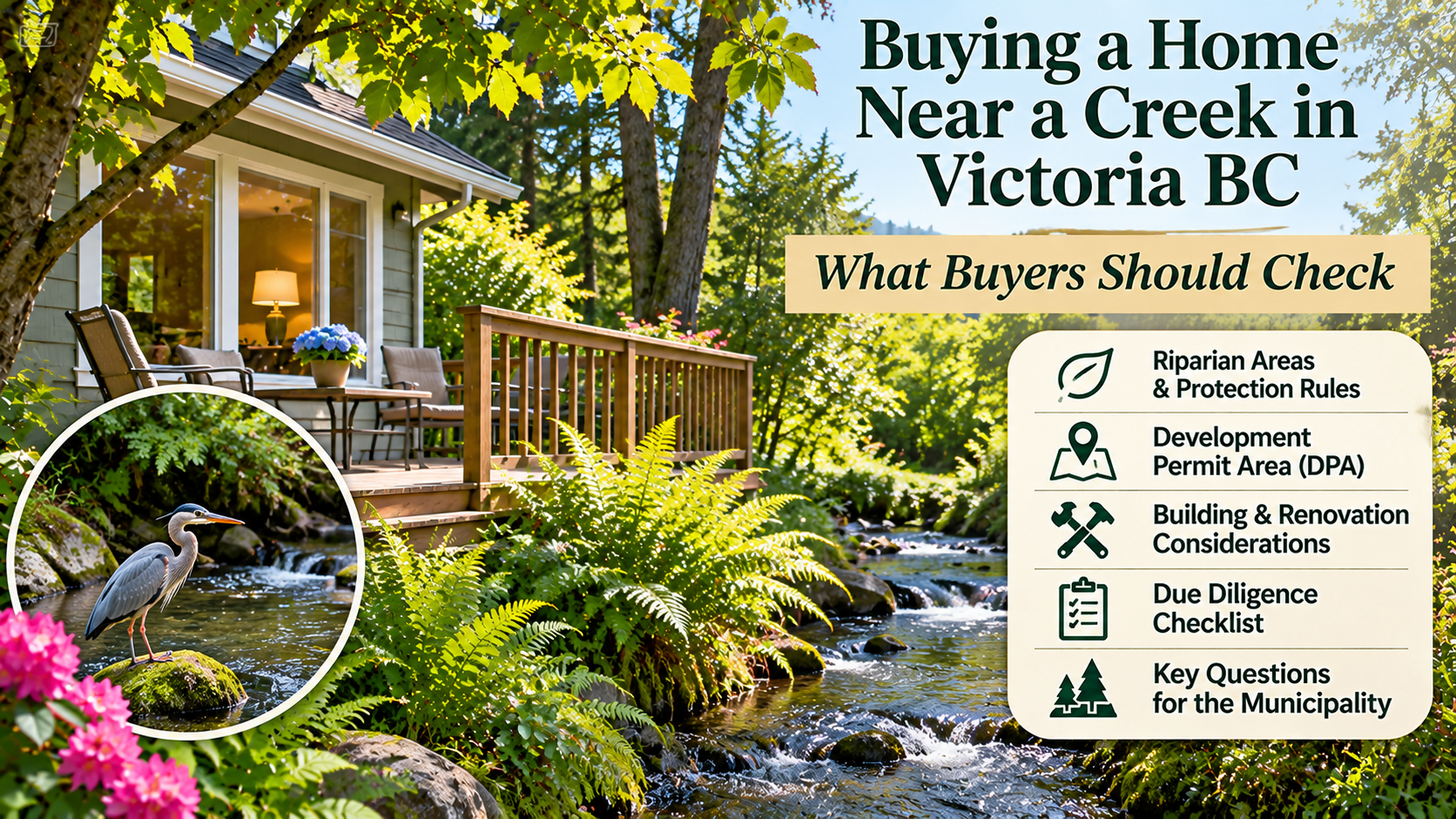
1. Why Does Buying Near a Creek Require Additional Due Diligence?
When purchasing a home, buyers naturally focus on the condition of the house, its location and whether it meets their needs.
But the land itself deserves just as much attention.
A creek or seasonal watercourse may be part of an environmentally sensitive area. Depending on the property, regulations may protect nearby vegetation, wildlife habitat, streambanks and other natural features.
These protections can affect activities such as building additions, constructing decks, changing landscaping or disturbing the ground.
For example, you might purchase a property with a large backyard and assume there's room for a garden suite.
But if part of the yard falls within a protected streamside area, the available building space may be more limited than it initially appears.
That's why it's important to understand the property's restrictions before making plans.
2. What Is a Riparian Area?
A riparian area is the land beside a stream, creek, river, lake or other watercourse.
These areas play an important environmental role.
Vegetation along waterways helps stabilize streambanks, provides shade, filters runoff and supports fish and wildlife habitat.
In British Columbia, riparian areas may be protected under provincial legislation, federal fisheries legislation and local government bylaws.
One important provincial regulation is the Riparian Areas Protection Regulation (RAPR).
The regulation establishes requirements for certain development activities near streams that provide fish habitat.
Importantly, the regulation's definition of a stream is broader than many people expect.
It can include watercourses that don't contain water throughout the year, as well as certain connected ditches, springs and wetlands.
So a small seasonal creek should not automatically be dismissed as insignificant.
3. What Is the 30-Metre Riparian Assessment Area?
Under BC's Riparian Areas Protection Regulation, the standard riparian assessment area generally extends 30 metres from the stream boundary on each side.
Different measurement rules can apply to streams within ravines.
This is an important distinction: the 30-metre assessment area is not automatically a universal 30-metre no-building setback.
Where the regulation applies, a Qualified Environmental Professional may need to assess the property and determine the appropriate Streamside Protection and Enhancement Area, commonly called a SPEA.
The SPEA identifies an area requiring protection to maintain important riparian functions.
The applicable restrictions depend on the assessment, local government requirements and the proposed development.
If you're considering an addition or another significant improvement near a creek, it's important to confirm the requirements rather than assume a particular distance is permitted.
4. What Is a Streamside Development Permit Area in Saanich?
The District of Saanich has a Streamside Development Permit Area, often abbreviated as SDPA.
Its purpose is to protect streamside environments from inappropriate development and support the restoration of natural areas.
Saanich identifies land within 30 metres of a stream as part of its Streamside Development Permit Area.
If a property contains or is near a creek, stream or wetland, it may fall within this designation.
Within the SDPA, land alteration, subdivision or construction generally requires a Streamside Development Permit unless a valid exemption applies.
Certain activities, such as maintaining an existing home or landscape, may qualify for exemptions. However, the details matter, and an exemption should not be assumed.
What About Saanich's Former Environmental Development Permit Area?
Saanich's former Environmental Development Permit Area was rescinded in April 2018.
However, the Streamside Development Permit Area remains a separate planning tool.
Other requirements, including tree protection rules and applicable provincial legislation, may also affect the property.
For buyers, the practical step is to check the current municipal maps and confirm the specific rules affecting the address.
5. Can You Build an Addition or Deck Near a Creek?
Possibly, but it depends on the property and the proposed work.
Imagine buying an older home with plans to expand the kitchen or build a larger deck overlooking the garden.
If the proposed construction is close to a protected watercourse, you may need additional approvals.
The municipality may require information about the proposed work and its potential environmental impacts.
Depending on the circumstances, an assessment by a Qualified Environmental Professional may be necessary.
Before purchasing, buyers planning renovations should investigate:
- Whether the property is within a development permit area.
- Whether the proposed work falls within a riparian assessment area.
- Whether environmental assessments are required.
- Whether zoning and building setbacks permit the proposed construction.
- Whether protected trees or vegetation affect the plans.
- Whether additional approvals or professional reports may be necessary.
A large lot doesn't necessarily mean that all of its land is available for development.
6. Can You Change the Landscaping Along a Creek?
Landscaping is another area where buyers should be cautious.
You might want to clear brush, remove trees, install retaining walls, create a patio or extend your lawn toward the creek.
However, vegetation and soil near waterways can play an important role in protecting streambanks and aquatic habitat.
Activities that disturb these areas may require permits or other authorization.
Potentially regulated work can include:
- Removing trees or native vegetation.
- Excavating or changing the slope of the land.
- Constructing retaining walls.
- Filling low-lying areas.
- Altering a creek bank.
- Redirecting water flow.
- Building pathways, decks or other structures.
Routine maintenance may be treated differently from new construction or significant land alteration.
Before starting work, check with the municipality about what is permitted.
7. What If the Creek Only Flows During Winter?
This is a particularly useful question in Greater Victoria.
Some watercourses are seasonal. They may carry water during periods of heavy rainfall and appear dry during summer.
But the absence of visible water doesn't necessarily mean environmental protections don't apply.
Provincial regulations can recognize certain intermittent watercourses and connected drainage features.
If you notice a channel, culvert, wetland or seasonal flow near a property, don't assume it's simply an ordinary drainage ditch.
Ask the municipality whether the feature is mapped or regulated.
Where the status is uncertain, professional environmental advice may be appropriate.
8. Does Living Near a Creek Increase Flooding or Erosion Risks?
Not every property near a creek has a flooding or erosion problem.
However, proximity to a watercourse is a reason to investigate how water moves across and around the property.
Questions worth asking include:
- Has the creek overflowed during heavy rainfall?
- Has the property experienced water intrusion or flooding?
- Are there signs of erosion along the banks?
- Have retaining walls or drainage systems been installed?
- Has the creek changed course or been modified?
- Are there any previous engineering or environmental reports?
- Are flood-related insurance exclusions or limitations relevant?
A general home inspection may identify some visible concerns, but it cannot necessarily assess the stability of a streambank or predict future flooding.
If there are concerns about slope stability, erosion or flooding, a qualified engineer or other appropriate specialist may be needed.
9. A Cadboro Bay Example: The Beautiful Creekside Property
A Hypothetical Buyer Scenario
Imagine a family looking at a detached home in Cadboro Bay.
The property has a lovely garden, mature trees and a small creek near the back of the lot.
The family loves the setting. They're already imagining a larger deck, a garden studio and perhaps an addition in a few years.
During their due diligence, they discover that part of the property falls within a Streamside Development Permit Area.
This doesn't automatically mean their plans are impossible.
But it does mean they need more information.
They contact the municipality to understand the applicable restrictions and whether the improvements they're considering would require environmental review.
They also ask whether any previous assessments or development permits are available.
If necessary, they consult a Qualified Environmental Professional to better understand the potential constraints.
With that information, they can decide whether the property still meets their long-term needs.
The creek may remain one of their favourite features. The difference is that they now understand the responsibilities that come with it.
10. What Is a Qualified Environmental Professional?
A Qualified Environmental Professional, or QEP, is a professional who meets the applicable regulatory requirements and has the expertise needed to assess environmental conditions.
Depending on the work involved, this may include a registered professional biologist or another appropriately qualified professional.
For certain developments subject to BC's Riparian Areas Protection Regulation, a QEP conducts an assessment to identify the streamside area requiring protection and any necessary mitigation measures.
The assessment may influence where development can occur and what measures are required.
Not every property purchase requires a QEP assessment.
However, if you're planning significant improvements near a watercourse, or the property's restrictions are unclear, obtaining professional advice before committing can be valuable.
11. What About Existing Decks, Retaining Walls or Other Improvements?
Buyers should also consider improvements that are already on the property.
For example, a home might have an existing deck extending toward a creek or a retaining wall along the bank.
The fact that a structure exists doesn't necessarily establish that it was properly approved.
If a feature raises questions, buyers may wish to investigate:
- When the improvement was constructed.
- Whether building or development permits were required.
- Whether the relevant permits were obtained.
- Whether environmental assessments were completed.
- Whether the structure has known deficiencies.
- Whether future repair or replacement could trigger additional approvals.
Older structures may be subject to different circumstances than newly proposed work.
The municipality and appropriate professionals can help clarify what applies.
12. Could Creekside Restrictions Affect Resale Value?
A creek can be an attractive natural feature, particularly for buyers who appreciate privacy, mature landscaping and wildlife.
But restrictions affecting the usable land may also influence how buyers evaluate a property.
For example, a buyer hoping to build a garden suite may view the property differently from someone who simply wants to enjoy the existing home and natural setting.
There is no universal amount that a creek adds to or subtracts from a property's value.
The impact depends on the location, condition, environmental constraints, development potential and current buyer demand.
Understanding these factors is part of evaluating the property realistically.
13. Buyer Due-Diligence Checklist for Creekside Properties
Before Removing Conditions, Consider Checking:
- Watercourse identification: Is there a mapped creek, stream, wetland or seasonal watercourse?
- Municipal designation: Does the property fall within a Streamside Development Permit Area or another applicable development permit area?
- Provincial regulations: Could the Riparian Areas Protection Regulation apply to proposed development?
- Protected area: Has a Streamside Protection and Enhancement Area been identified?
- Existing permits: Are there records for previous additions, retaining walls, landscaping or other work?
- Future plans: Could restrictions affect a deck, addition, garden suite or other proposed improvement?
- Tree protection: Are there protected trees or vegetation?
- Flood history: Has the property experienced flooding or water intrusion?
- Erosion: Are there concerns about streambank or slope stability?
- Professional reports: Are environmental, geotechnical or engineering assessments available?
- Property title: Are there registered covenants, easements or other restrictions?
- Insurance: Has the buyer investigated relevant flood and water-damage coverage?
- Professional advice: Would a QEP, engineer, surveyor or other specialist be appropriate?
14. Questions to Ask the Municipality Before Purchasing
If you're interested in a property near a creek, the municipality is an important starting point.
Useful questions include:
- Is the property located within a Streamside Development Permit Area or another applicable environmental designation?
- Are there mapped streams, wetlands or other protected natural features affecting the lot?
- Are there previous environmental assessments or development permits associated with the property?
- What approvals might be required for an addition, deck, retaining wall or garden suite?
- Are there known restrictions affecting tree removal, landscaping or ground disturbance?
- Would the proposed work require a Qualified Environmental Professional?
- Are there other municipal or provincial requirements that should be investigated?
Remember that a preliminary municipal inquiry may not be a formal approval of future construction.
If a particular improvement is essential to your purchase decision, consider whether further professional review or written confirmation is needed before removing conditions.
Dawn's Take: Understand the Property Beyond the House
I can certainly understand why buyers are drawn to homes with creeks and natural green spaces. These properties can have a wonderful sense of privacy and connection to nature.
But when I'm helping someone purchase a property like this, I want them to understand more than just the house itself.
I'd want to know whether the creek affects what they can build, whether there are restrictions on landscaping and whether any existing improvements raise questions.
I'd also want to understand their long-term plans.
If they're hoping to build an addition or garden suite, that information becomes particularly important.
A creek isn't necessarily a problem. In fact, it may be one of the reasons they love the property.
But I believe buyers should understand both the benefits and the responsibilities before making a commitment.
My role is to help buyers ask the right questions, understand the information available and involve qualified professionals when needed.
Frequently Asked Questions About Buying a Home Near a Creek
Can I build an addition near a creek in Victoria BC?
Possibly, but the answer depends on the property's location, applicable development permit requirements, zoning and environmental regulations. A proposed addition within a regulated riparian area may require further assessment and approval. Buyers should confirm the requirements before purchasing if the addition is important to their plans.
What is a riparian setback in British Columbia?
A riparian setback is an area near a watercourse where development may be restricted to protect environmental functions. Under BC's Riparian Areas Protection Regulation, the standard riparian assessment area generally extends 30 metres from the stream boundary, with different rules for ravines. The actual protected area and development restrictions depend on the applicable assessment and regulations.
Does a seasonal creek count as a protected watercourse?
It can. Some intermittent watercourses and connected drainage features fall within provincial definitions. A creek doesn't necessarily need to flow throughout the year to be subject to environmental requirements. Buyers should confirm its status with the municipality or an appropriate professional.
Can I remove trees or change landscaping beside a creek?
Certain landscaping activities may require permits or other authorization, particularly where they involve removing vegetation, disturbing soil or altering a streambank. Routine maintenance may be treated differently from new development. Check applicable municipal and provincial requirements before starting work.
Does buying a home near a creek mean there is a flood risk?
Not necessarily. Flood and erosion risks depend on the property's elevation, drainage, stream characteristics and other site conditions. Buyers should investigate any known history and consider specialist advice where concerns exist.
Should I hire an environmental professional before buying a creekside property?
Not every purchase requires an environmental assessment. However, a Qualified Environmental Professional may be helpful when the property has unclear restrictions or the buyer is planning development near a protected watercourse. The municipality can help identify applicable requirements.
Buying a Home Near a Creek in Greater Victoria?
Whether you're considering a property in Cadboro Bay, Cordova Bay, Gordon Head, Oak Bay, Royal Oak or another Greater Victoria neighbourhood, it's important to understand how the land can be used.
Some properties have environmental features or restrictions that aren't immediately obvious during a showing.
I help buyers investigate the important details, understand what information to request and identify when professional advice may be needed.
You don't need to become an expert in environmental regulations before buying a home. But you should have a clear understanding of any significant limitations that could affect your plans.
Let's Talk About Your Home Search
Considering a home near a creek, stream or natural ravine in Greater Victoria?
I'm happy to help you understand which property records, municipal questions and professional assessments may be worth reviewing before you make a commitment.
No pressure. Just practical guidance to help you make an informed decision.
Connect With DawnHelpful Resources
- BC Government — Riparian Areas Protection Regulation Model
- BC Laws — Riparian Areas Protection Regulation
- District of Saanich — Streamside Development Permit Area
- District of Saanich — Environmental Development Permit Area Information
- BC Financial Services Authority — Items Affecting a Property
Disclaimer: This article provides general real estate information as of November 2026. Riparian regulations, development permit requirements, environmental restrictions and property-specific conditions vary. Provincial and local rules may change. Buyers should confirm current requirements with the applicable municipality and obtain independent professional advice where necessary. This article does not constitute legal, environmental or engineering advice.
Categories
Recent Posts





REVIEWS