
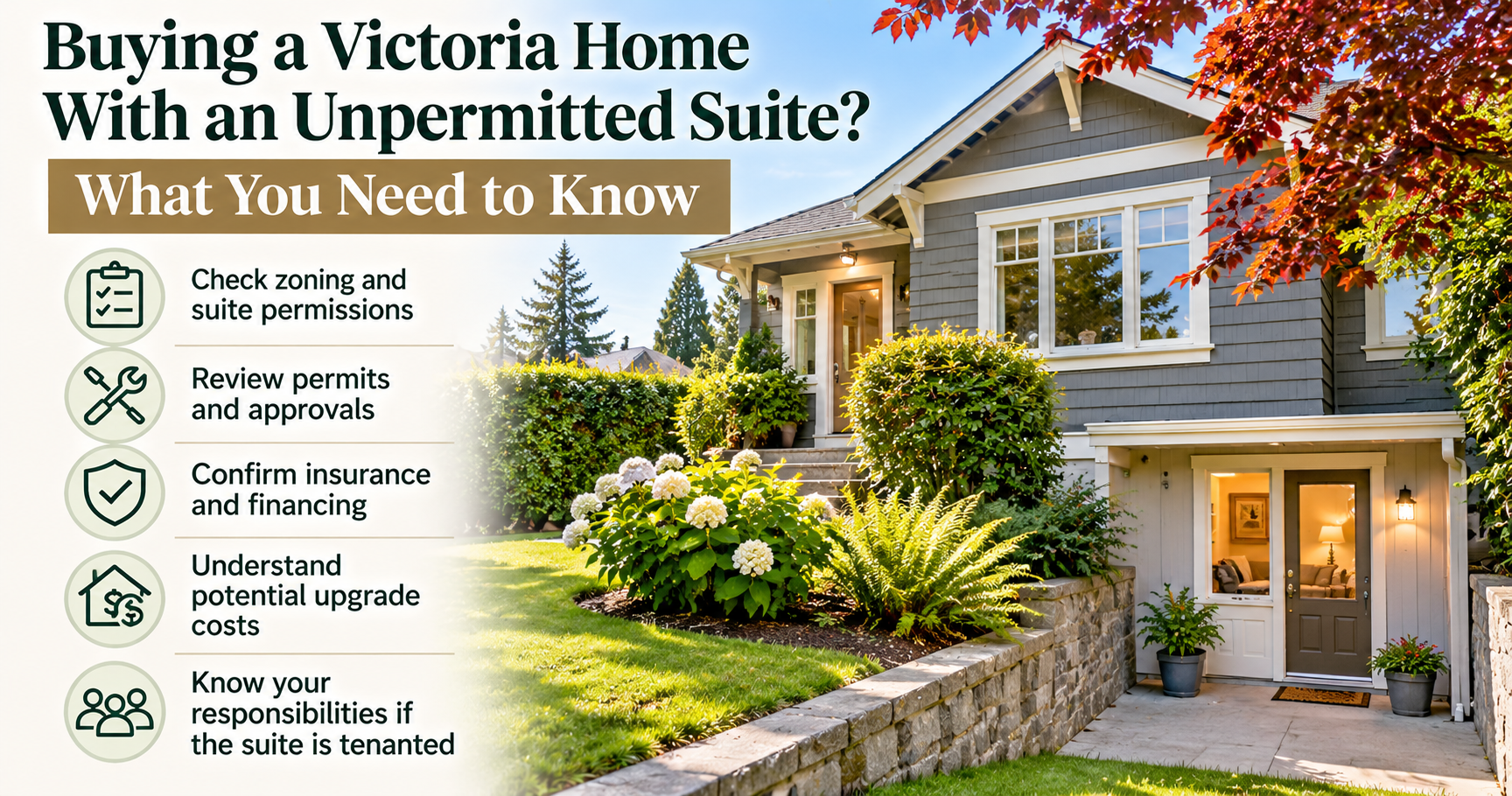
Buying a Victoria Home With an Unpermitted Suite? What You Need to Know.
Buying a Victoria Home With an Unpermitted Suite? What You Need to Know
A home with a secondary suite can be appealing, especially in Greater Victoria, where rental income may help offset mortgage payments or provide additional flexibility for a growing family.
Perhaps you're considering a house in Gordon Head with a basement suite, a character home in Fernwood with a separate rental unit, or a property in Esquimalt where the lower level has been converted into living accommodation.
The extra space and potential income can be attractive.
But before making an offer, there's an important question worth asking:
Was the suite properly permitted and approved?
A suite may have been rented for years, have its own entrance and kitchen, and look completely finished. That doesn't necessarily mean it has all the required municipal approvals.
Buying a property with an unpermitted suite isn't automatically a reason to walk away. However, it's important to understand the potential risks, costs and responsibilities before committing to the purchase.
What Is an Unpermitted Secondary Suite?
A secondary suite is a separate dwelling unit located within a larger residential building, subject to the applicable building-code and municipal definitions.
It commonly includes its own cooking facilities, bathroom, sleeping area and living space.
An unpermitted suite is generally one that was constructed, converted or used without some or all of the required permits and approvals.
You may also hear people describe these suites as unauthorized or illegal suites.
Those terms are sometimes used interchangeably, but the actual circumstances can differ.
For example, a suite might be permitted under current zoning but lack the required building permit or occupancy approval.
Another suite might have been constructed under older regulations, with records that need to be investigated.
The important point is to establish the property's actual approval status rather than relying on a label.
What's the Difference Between Zoning Permission and a Legal Suite?
This is one of the most important distinctions for buyers to understand.
1. Zoning Permission
Zoning determines whether a particular use is allowed on a property, subject to applicable regulations.
For example, the District of Saanich permits secondary suites as an accessory use in specified residential and agricultural zones, subject to its requirements.
However, zoning permission alone doesn't mean an existing suite has been approved for occupancy.
2. Building Permits and Inspections
Creating a secondary suite may require building, plumbing, electrical and other approvals.
The work must meet applicable building-code requirements, and inspections may be required.
These requirements address important safety considerations.
3. Final Approval or Occupancy Permit
The City of Victoria states that a legal secondary suite requires approved permits, completed inspections and a final Occupancy Permit.
Saanich also requires an Occupancy Permit for a legal secondary suite.
Simply being allowed to have a suite under zoning is not the same as having a legally approved suite.
Why Might a Home Have an Unpermitted Suite?
There are several possible explanations.
- The basement was converted into a rental suite without obtaining permits.
- Previous owners completed renovations without the required approvals.
- A suite was started under a permit, but the final inspections were never completed.
- The property has undergone changes since the original approvals were issued.
- The suite was previously decommissioned and later brought back into use without the necessary approvals.
- Older construction or incomplete documentation has created uncertainty about its status.
Not every situation involves the same level of risk.
That's why the first step is to investigate what was actually approved and what remains outstanding.
Does a Suite Being Advertised in an MLS Listing Mean It's Legal?
No.
A listing may describe a property as having a basement suite, in-law accommodation or a mortgage helper.
Those descriptions do not, by themselves, establish that the suite has the required municipal approvals.
Similarly, the fact that a suite has been rented for years doesn't prove that it is authorized.
Even a separate entrance, kitchen, hydro meter or mailing address should not be treated as confirmation of legal status.
Buyers should request supporting documentation and verify the information with the appropriate municipality.
Example: A Gordon Head Home With a Basement Suite
Imagine a couple considering a detached home in Gordon Head listed for $1.1 million.
The property has a nicely finished basement suite advertised as generating $1,800 per month in rental income.
The buyers are excited because that income could help with their mortgage payments.
During due diligence, however, they discover that Saanich has no record of a building permit for the suite conversion.
This doesn't automatically tell them whether the suite can be approved.
But it does raise important questions.
- Does the suite comply with current municipal requirements?
- Were the electrical and plumbing alterations properly completed?
- Would additional construction be required to obtain approval?
- What might those upgrades cost?
- Will the lender consider the projected rental income?
- Will the insurance company provide appropriate coverage?
Before proceeding, the buyers should investigate these questions and consider obtaining advice from qualified building professionals.
The goal isn't necessarily to eliminate every risk. It's to understand the risks before deciding whether the property is right for them.
What Building and Safety Issues Should Buyers Investigate?
Secondary suites must meet applicable building and safety requirements.
If a suite was constructed without permits, some of the work may not have been inspected.
Depending on the property, buyers may need to investigate:
Fire Separation
Requirements may apply to the construction separating the suite from the main dwelling.
These can involve walls, ceilings, doors and penetrations between units.
Smoke and Carbon Monoxide Alarms
Alarm requirements depend on the building configuration and applicable code.
A qualified professional can help determine whether the installation is appropriate.
Safe Exits
The suite must have appropriate means of exiting in an emergency.
Depending on the layout, this may involve doors, windows or other design considerations.
Ceiling Heights
Basement ceiling heights can be an issue in older homes.
Certain existing buildings may qualify for alternative compliance provisions under the BC Building Code, but eligibility and requirements must be confirmed.
Electrical and Plumbing Work
Additional kitchens, bathrooms and living areas may involve electrical and plumbing alterations.
Buyers should investigate whether the work was permitted, inspected and completed appropriately.
Heating and Ventilation
The suite's heating, ventilation and related building systems may also require review.
A general home inspection can identify visible concerns, but it cannot establish that every concealed component meets code.
Can an Unpermitted Suite Be Legalized?
Sometimes, yes.
But legalization is not automatic, and the process depends on the property, municipality, building configuration and applicable regulations.
In Saanich, an owner seeking approval for an existing secondary suite must follow the municipality's application and inspection process.
An Occupancy Permit is issued when the applicable requirements have been satisfied.
The City of Victoria also provides a process for constructing or obtaining approval for secondary suites.
Depending on the property, the process may require:
- Reviewing zoning and property-specific restrictions.
- Obtaining existing permit and building records.
- Preparing drawings or other application materials.
- Applying for the necessary permits.
- Completing electrical, plumbing or construction upgrades.
- Arranging required inspections.
- Obtaining final municipal approval.
Some properties may require relatively limited work, while others may need significant upgrades.
There may also be situations where legalization is not feasible without major changes.
Buyers should not assume that a suite can be legalized simply because secondary suites are generally permitted in the neighbourhood.
How Much Could It Cost to Legalize an Unpermitted Suite?
There is no single reliable cost estimate.
The expense depends on what work was completed, whether it meets applicable requirements and what the municipality requires for approval.
Potential costs may include:
- Building design or professional consultation.
- Permit and inspection fees.
- Electrical and plumbing corrections.
- Fire separation upgrades.
- Changes to entrances, windows or other exits.
- Heating and ventilation improvements.
- Work needed to address ceiling heights or other structural limitations.
If the suite is a major reason you're purchasing the property, consider obtaining professional advice and cost estimates during your due-diligence period.
Don't build your purchase budget around an assumed legalization cost without investigating the actual requirements.
Will a Lender Approve a Mortgage on a Home With an Unpermitted Suite?
Possibly.
Mortgage approval depends on the lender's policies, the borrower's financial circumstances, the property and the proposed financing.
An unpermitted suite does not necessarily mean the entire property is unmortgageable.
However, the suite's status may affect how the lender evaluates the property or whether it will consider rental income when assessing the application.
If you're relying on suite income to help qualify for a mortgage, this is especially important.
Ask your mortgage broker or lender:
- Will you finance this property with the suite in its current condition?
- Will you include any rental income in my qualification?
- What documentation do you require?
- Could the appraisal or suite status affect approval?
- Are there conditions that must be satisfied before funding?
It's better to have these conversations before removing your financing condition.
What About Home Insurance?
Insurance is another important consideration.
A property with a secondary suite may have different insurance requirements from a home occupied by a single household.
Insurers may ask whether the suite is rented, how it is constructed, whether it is approved and how the property is used.
An unpermitted suite could affect underwriting decisions, available coverage or the terms of the policy.
Buyers should disclose the suite's actual status to their insurance provider and request confirmation that appropriate coverage is available.
Don't assume that an existing homeowner's insurance policy will automatically transfer or that every insurer will treat the property the same way.
What If the Suite Already Has a Tenant?
This adds another important layer to the purchase.
In British Columbia, selling a rental property does not automatically end an existing tenancy.
When a tenanted property is sold, the buyer generally becomes the new landlord and the tenancy continues under its existing terms unless it has been lawfully ended.
This means buyers need to understand both the suite's municipal status and their responsibilities under the Residential Tenancy Act.
Before purchasing, investigate:
- The current tenancy agreement.
- The monthly rent and payment arrangements.
- Security and pet damage deposits.
- Whether the tenancy is fixed-term or month-to-month.
- Any existing disputes or notices.
- Whether the buyer intends to continue renting the suite or occupy it.
If the buyer wants vacant possession, the parties need to understand the legal requirements and timing.
A buyer should not assume that a tenant can simply be asked to leave because the property has sold or because the suite lacks permits.
The BC Residential Tenancy Branch provides official guidance about selling tenanted properties.
Should Buyers Ask the Seller to Legalize the Suite Before Completion?
That may be one option, but it isn't always practical.
Obtaining permits and completing necessary upgrades can take time, and the scope of work may not be known at the outset.
Depending on the circumstances, buyers and sellers might discuss:
- The seller providing available permit and approval records.
- Further investigation before conditions are removed.
- Obtaining professional estimates for necessary work.
- Negotiating the purchase price based on known risks and costs.
- Contractual arrangements addressing specific work or documentation, prepared with appropriate legal advice.
The appropriate approach depends on the property and what both parties are prepared to agree to.
If approval or repairs are to be completed as part of the transaction, the contract should clearly address the obligations, deadlines and consequences if the work cannot be completed.
My Buyer Due-Diligence Checklist for Homes With Suites
Eight Things to Check Before Removing Conditions
- Confirm the suite's zoning status.
Ask the municipality whether the proposed or existing suite use is permitted for that property. - Request building and permit records.
Look for the permits, inspections and occupancy approvals associated with the suite. - Ask about outstanding or incomplete permits.
Determine whether any work remains unresolved. - Arrange a professional home inspection.
Investigate visible concerns and determine whether specialist assessments are needed. - Confirm mortgage financing.
Tell your lender about the suite and verify how it affects your financing and rental-income assumptions. - Speak with your insurance provider.
Confirm that suitable coverage is available for the property and its actual use. - Review tenancy documentation.
If the suite is occupied, understand the existing tenancy and your potential landlord obligations. - Investigate legalization costs.
If the suite is unpermitted, consult the municipality and qualified professionals about possible approval requirements and expenses.
My recommendation: Complete these investigations before removing your purchase conditions. If the suite is central to your decision, make sure you understand what you are buying and what you can realistically do with it.
What Should Sellers Do If Their Home Has an Unpermitted Suite?
This issue isn't only important for buyers.
If you're planning to sell a home with an existing suite, it's worth investigating the permit status before listing.
That gives you an opportunity to understand what documentation is available and identify potential concerns before a buyer raises them.
Depending on the circumstances, you may want to:
- Request municipal permit records.
- Locate previous renovation and inspection documents.
- Clarify whether the suite has occupancy approval.
- Consult the municipality about outstanding issues.
- Discuss accurate listing descriptions and disclosures with your REALTOR.
- Consider whether any work should be completed before listing.
An unpermitted suite doesn't necessarily prevent a home from selling.
But buyers may have concerns about financing, insurance, safety or future resale.
Understanding the situation early allows sellers to prepare more effectively and avoid unnecessary surprises during negotiations.
Why This Matters in Greater Victoria
Secondary suites are found in many Greater Victoria neighbourhoods, particularly in detached homes that have been renovated or adapted over time.
In Gordon Head, suites may appeal to buyers looking for rental income near the University of Victoria.
In Fernwood and Fairfield, older character homes may have undergone multiple renovations over the years.
In Esquimalt, Royal Oak, Cadboro Bay, Cordova Bay, Oak Bay and Sidney, buyers may encounter a range of property ages, layouts and suite arrangements.
Municipal requirements can differ, and not every property in the same neighbourhood has the same approval history.
That's why property-specific research matters more than general assumptions about an area.
Dawn's Take: A Suite Is Only an Advantage If You Understand What You're Buying
When buyers are considering a home with a secondary suite, I understand why the potential rental income is appealing.
It can make a property feel more affordable, provide flexibility for family members or simply offer additional living space.
But I always encourage buyers to look beyond the rental income and investigate the suite itself.
Just because a suite has been rented for years doesn't necessarily mean it has all the required approvals.
And just because a suite is unpermitted doesn't automatically mean the property isn't worth considering.
What matters is understanding the situation.
I want my clients to know what permits exist, what questions need to be answered and whether there could be additional costs or limitations.
If we need information from the municipality, a home inspector, a contractor or a mortgage professional, I'd much rather arrange that investigation before the purchase conditions are removed.
My job is to help buyers make informed decisions, not rush them into a property without understanding the details.
Frequently Asked Questions About Unpermitted Suites in Victoria BC
Can I buy a house with an unpermitted suite in Victoria BC?
Yes, purchasing a home with an unpermitted suite may be possible. However, buyers should investigate the suite's municipal approval status, safety considerations, financing, insurance and any potential costs before removing purchase conditions.
Does zoning that allows secondary suites mean an existing suite is legal?
No. Zoning permission and building approval are different. A legal suite must satisfy the applicable municipal and building requirements, including required permits, inspections and occupancy approval.
Can an unpermitted basement suite be legalized in Saanich?
Potentially. The District of Saanich has a process for obtaining approval for existing secondary suites. Whether a particular suite can be legalized depends on the property, zoning, building-code requirements and necessary upgrades.
Can I get a mortgage on a home with an unauthorized suite?
Possibly. Mortgage approval depends on the lender, the property and the borrower's circumstances. An unpermitted suite may affect whether rental income can be used for qualification. Buyers should confirm the lender's requirements before removing financing conditions.
What happens if I buy a home with an unpermitted suite that has a tenant?
The sale of a rental property generally does not end an existing tenancy. The buyer typically becomes the new landlord, and the tenancy continues under its existing terms unless lawfully ended. Buyers should review the tenancy documentation and applicable BC Residential Tenancy Act requirements.
Should I avoid buying a home with an unpermitted secondary suite?
Not necessarily. The decision depends on the property's condition, the suite's approval status, the potential cost of required work and your intended use. Thorough due diligence can help you determine whether the risks are acceptable.
Thinking About Buying or Selling a Home With a Suite?
Whether you're considering a home with rental income or preparing to sell a property with an existing suite, it's important to understand the details before making a decision.
I can help you review the real estate considerations, identify important questions and coordinate the appropriate due diligence as part of the buying or selling process.
My approach is straightforward: clear information, careful planning and no pressure.
Let's Talk About Your Real Estate Plans
Considering buying or selling a home with a secondary suite in Greater Victoria?
We can start with a simple 15–20 minute conversation about your plans and the questions worth investigating.
No pressure. Just practical advice to help you move forward confidently.
Connect With DawnHelpful Official Resources
- District of Saanich: Secondary Suites
- District of Saanich: Small-Scale Multi-Unit Housing
- City of Victoria: Secondary Suites
- City of Victoria: Property Uses and Permit Information
- Province of BC: Selling a Rental Property
Disclaimer: This article provides general educational information about secondary suites and residential real estate in British Columbia as of November 2026. Municipal bylaws, building-code requirements, financing policies, insurance terms and tenancy rules vary by property and circumstance and may change. Buyers and sellers should confirm requirements with the relevant municipality and seek advice from qualified legal, building, mortgage and insurance professionals where appropriate. The hypothetical example is for illustration only.
Categories
Recent Posts



REVIEWS