
Strata Fees in Victoria BC: Are Lower Fees Really Better?
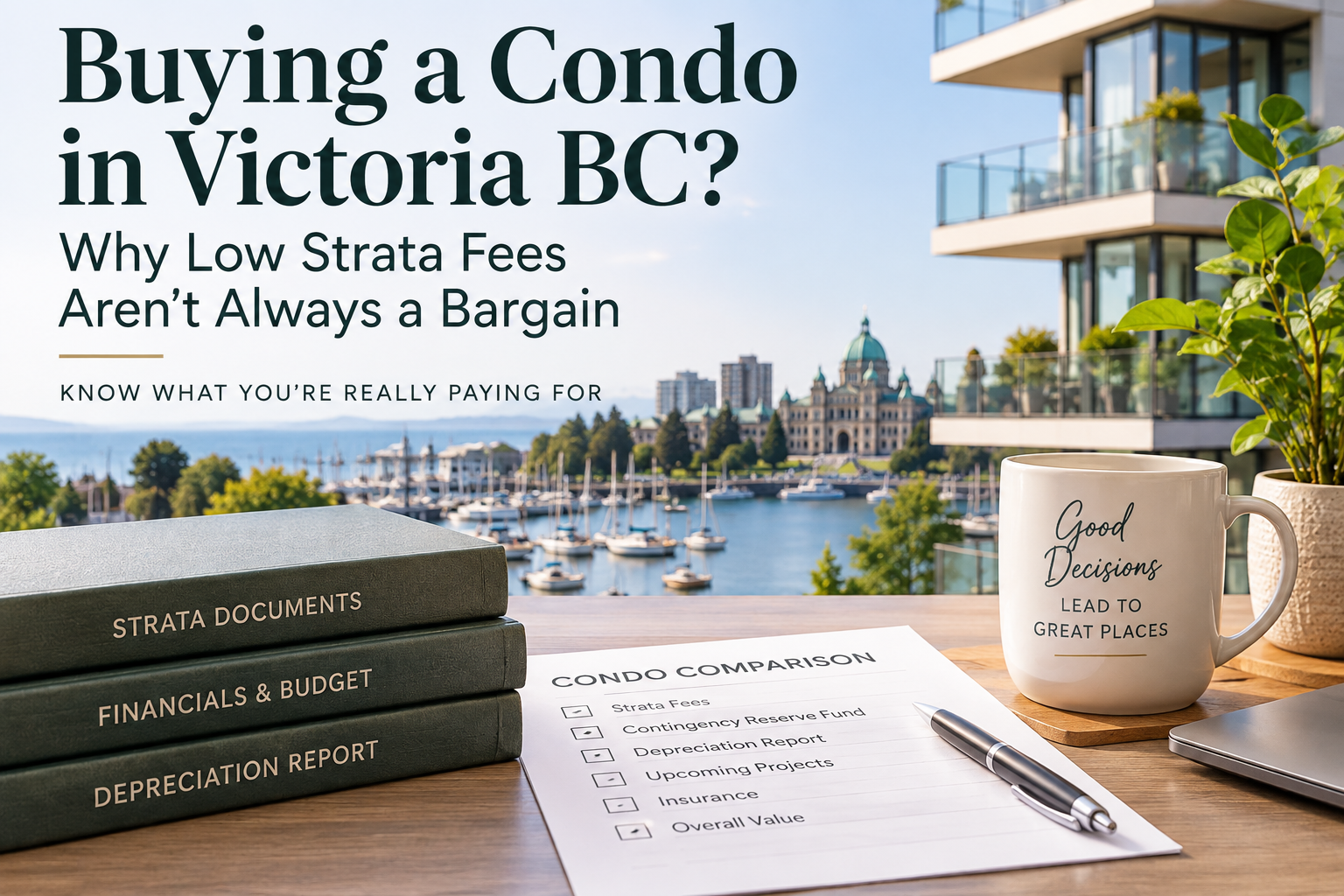
Buying a Condo in Victoria BC? Why Low Strata Fees Aren’t Always a Bargain
When buyers compare condos in Victoria, one number often gets a lot of attention: the monthly strata fee.
It makes sense. If one condo has a strata fee of $350 per month and another is $550 per month, the first property appears to be $200 a month cheaper to own.
But that isn't necessarily the whole story.
When I'm helping a buyer evaluate a strata property, I don't look at the monthly fee in isolation. I want to understand what that fee is paying for, how the strata is managing its finances, what major expenses may be coming and how well the building is preparing for them.
What Exactly Does Your Strata Fee Pay For?
In British Columbia, strata corporations establish an operating fund for regular expenses and a contingency reserve fund, commonly called the CRF, for expenses that occur less frequently.
Depending on the property, the operating budget may include expenses such as:
- building insurance
- property management
- landscaping and cleaning
- utilities for common areas
- elevator servicing
- garbage and recycling
- routine repairs and maintenance
- amenity expenses
- contributions toward the contingency reserve fund
This is one reason comparing the monthly fees of two buildings without comparing their budgets can be misleading.
A building with elevators, underground parking, extensive landscaping or other amenities may naturally cost more to operate than a small, simple strata property.
Let's Compare Two Victoria Condos
Condo A
Monthly strata fee: $365
The building has kept monthly fees relatively low, but its depreciation report identifies several significant projects ahead and its contingency reserve fund may not be sufficient to cover all of the anticipated work.
Condo B
Monthly strata fee: $525
The building has been contributing more toward its contingency reserve fund, has recently completed major maintenance and appears to be actively planning for future capital expenses.
Condo A is $160 per month cheaper on paper.
But that doesn't necessarily mean it will be the less expensive property to own over the next five or ten years.
This is why I want to look beyond the monthly number.
1. I Look at the Operating Budget
The operating budget helps show where owners' monthly strata fees are actually going.
I'm interested in whether expenses appear realistic for the type and age of the building, whether costs have been increasing significantly and how much money is being directed toward longer-term planning.
A low monthly fee isn't particularly helpful if the strata repeatedly needs additional money from owners when larger expenses arise.
2. I Look at the Contingency Reserve Fund
The contingency reserve fund is intended to help pay for expenses that don't normally occur every year, such as major repairs and replacement projects.
BC strata corporations are currently required to make a minimum annual contribution to the CRF equal to at least 10% of the amount budgeted for the operating fund.
But the legal minimum doesn't tell me whether a particular strata is adequately prepared for the work its building may require.
That's why the reserve fund needs to be considered alongside the depreciation report and the building's anticipated expenses.
3. I Compare the Depreciation Report With the Money Available
A depreciation report looks at major components of the strata property and forecasts repair and replacement needs over a long period.
Depending on the property, that can include items such as:
- roofing
- building exterior
- windows and doors
- plumbing systems
- heating and ventilation systems
- elevators
- parking structures
- roads and other common assets
Current BC rules require strata corporations with five or more strata lots to obtain depreciation reports on a five-year cycle.
For me, the important buyer question isn't simply, "Does the building have a depreciation report?"
It's:
What does the report say is coming, and how does the strata plan to pay for it?
4. I Read the Strata Minutes for Clues About Future Costs
Numbers don't always tell the entire story.
Council minutes and AGM or special general meeting minutes can help provide context about what's happening in the building.
I look for discussions about things such as recurring leaks, roof problems, plumbing issues, elevator repairs, building-envelope concerns, insurance claims, engineering investigations and proposed major projects.
One isolated repair may mean very little. A recurring issue appearing repeatedly in the minutes deserves a closer look.
5. I Look for Special Levies — Including Ones Being Discussed
Buyers often understand that they should ask whether there is an existing special levy.
I also want to know whether a levy is being discussed.
Perhaps council has received quotes for a roof replacement. Maybe an engineering report has recommended repairs. Or owners have been discussing a major project that hasn't yet reached a formal vote.
Those conversations can be very relevant to a buyer even when no levy has officially been approved.
I would never tell a buyer that a condo is a good purchase simply because its strata fees are low.
I want to know what's behind that number.
A higher fee isn't automatically bad, and a lower fee isn't automatically good. What matters is whether the fee makes sense for that particular property and whether the strata appears to be realistically planning for its ongoing and future expenses.
That's why reviewing strata documents is such an important part of buying a condo. We're not just buying the unit. We're also trying to understand the financial and physical condition of the property we're becoming an owner in.
6. I Consider What the Fee Includes
Before comparing monthly fees, buyers should also make sure they're comparing the same things.
One building's fee may include services or utilities that another building's fee does not. The size and complexity of the property can also make a significant difference.
A newer condominium tower with elevators, underground parking and extensive common areas can't necessarily be compared directly with a small walk-up building simply by looking at the monthly fee.
So, What Is a Reasonable Strata Fee in Victoria BC?
This is one of those questions where a simple dollar amount can be misleading.
There isn't one strata-fee number that tells us whether a building is well managed or whether a condo represents good value.
Instead, I compare the fee with:
- the size and type of strata
- the services and amenities provided
- the age of the building
- the operating budget
- the contingency reserve fund
- the depreciation report
- planned capital projects
- recent and proposed special levies
- the strata's maintenance history
That gives us a much more useful picture than simply asking whether $400, $500 or $600 per month is "too much."
My Strata Fee Checklist for Victoria Condo Buyers
✓ What exactly is included in the monthly fee?
✓ How much is going toward the contingency reserve fund?
✓ What is the current CRF balance?
✓ What major expenses are identified in the depreciation report?
✓ Are major projects coming soon?
✓ Have special levies recently been paid?
✓ Are new special levies being discussed?
✓ Do the minutes reveal recurring maintenance problems?
✓ Have strata fees increased significantly?
✓ Does the financial plan make sense for the building's anticipated needs?
Frequently Asked Questions
Are low strata fees good when buying a condo in Victoria BC?
Not necessarily. A lower fee can be attractive, but buyers should also examine what the fee includes, the operating budget, contingency reserve fund, depreciation report and anticipated major expenses. The monthly fee alone doesn't tell you whether a strata is financially well prepared.
Does a high strata fee mean a building is poorly managed?
No. Higher fees may reflect the services and amenities provided, insurance and operating costs, or greater contributions toward future expenses. The underlying financial documents provide much more useful information than the fee alone.
What is a contingency reserve fund in a BC strata?
The contingency reserve fund, or CRF, is used for common expenses that occur less frequently than once a year or don't usually occur annually. Examples can include major repairs and replacement projects such as roofs, elevators or roads.
Can a condo have low strata fees and still have a special levy?
Yes. A special levy can be used to fund an expense when additional money is required. This is why buyers should investigate both the monthly strata fee and the building's financial planning, upcoming projects and meeting minutes.
What strata documents should I review before buying a condo in Victoria?
The documents relevant to a particular purchase can vary, but buyers commonly review items such as the Form B Information Certificate, budget, financial statements, depreciation report, strata bylaws and rules, council and general meeting minutes, insurance information and information about special levies. Your REALTOR® can help coordinate the document-review process and identify questions that may need to be directed to the appropriate professional.
Helpful BC Strata Resources
For additional information about strata finances and depreciation reports, buyers can review:
- Government of BC — Budgeting and Strata Fees
- Government of BC — Contingency Reserve Funds
- Government of BC — Strata Depreciation Reports
Thinking About Buying a Condo in Victoria?
Finding the condo is only part of the process. I help my buyers understand the property, review the available strata information and identify the questions that should be answered before they make their purchasing decisions.
Explore Victoria Real Estate with DawnDawn Stokkeland | REALTOR®
eXp Realty
Serving Victoria, Saanich, Gordon Head, Cordova Bay, Cadboro Bay, Oak Bay, Fairfield, Fernwood, Esquimalt, Royal Oak, Sidney and Greater Victoria.
Categories
Recent Posts









REVIEWS