
Selling a Victoria Home With Deferred Property Taxes
```html
Victoria BC Seller & Downsizing Guide
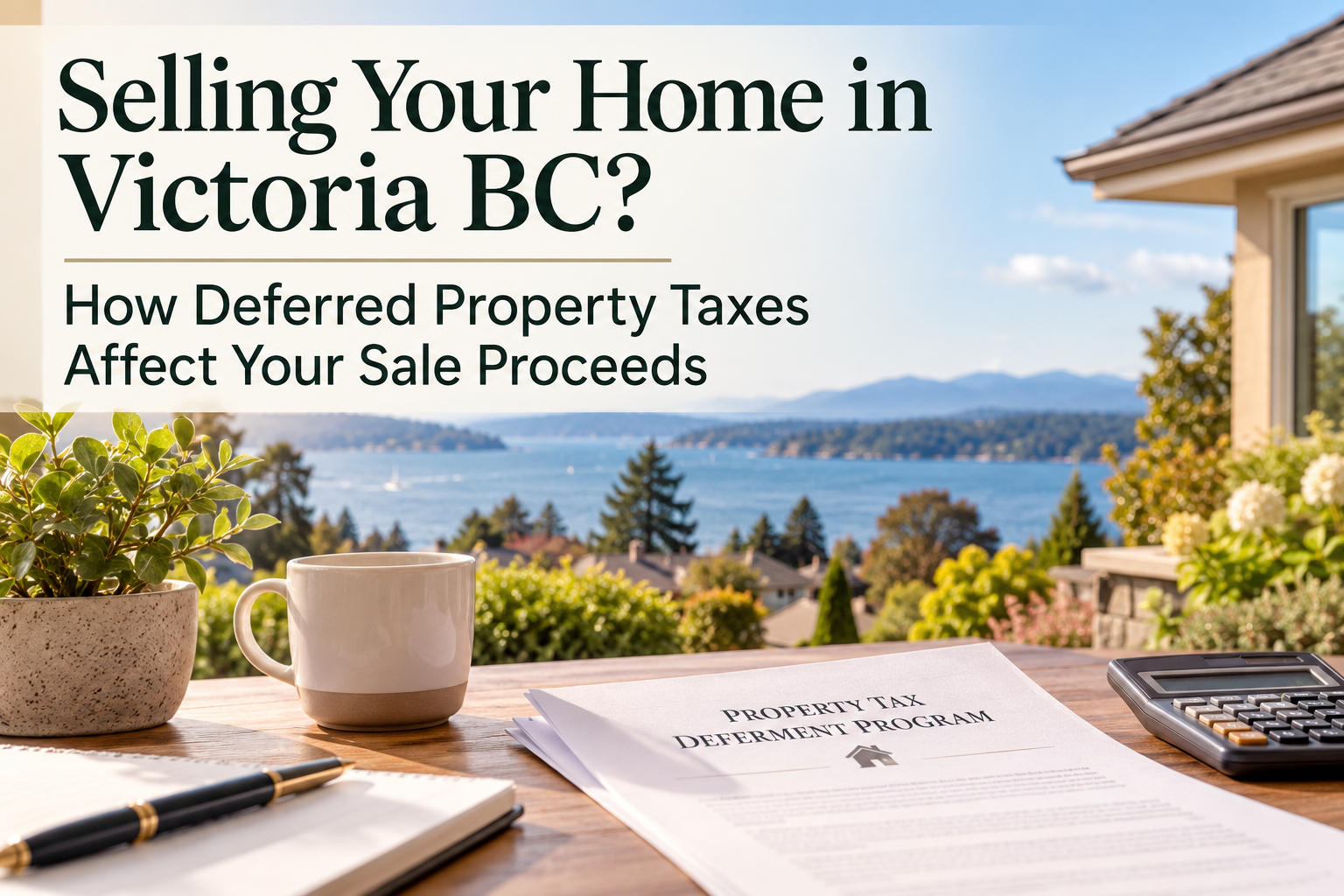
Selling Your Home in Victoria BC? How Deferred Property Taxes Affect Your Sale Proceeds
You've owned your family home for years, perhaps decades. Now you're thinking about selling and moving into something that's easier to maintain.
You've probably started thinking about what your house might sell for, how much your next home will cost, and whether you'll have some money left over for travel, retirement or simply enjoying life.
But if you've been deferring your property taxes through BC's Property Tax Deferment Program, there's another number that needs to be part of that conversation.
The amount you owe in deferred property taxes will affect how much money you actually receive when your home sells.
Your home's selling price isn't the same as the money you'll have available for your next purchase. Deferred taxes, selling expenses and other outstanding obligations all need to be considered.
What Is BC's Property Tax Deferment Program?
BC's Property Tax Deferment Program allows eligible homeowners to postpone paying their annual property taxes.
Rather than paying the property taxes directly, the provincial government pays them on the homeowner's behalf. The deferred amount becomes a loan that must eventually be repaid, along with applicable interest and fees.
The Province also registers a restrictive lien against the property to secure the loan.
The regular program is available to qualifying homeowners who are 55 or older, surviving spouses, or people with disabilities. There is also a separate program for eligible families with children.
For homeowners who prefer to preserve cash flow during retirement, tax deferment can be helpful. However, the outstanding balance remains a financial obligation attached to the property.
What Happens to Deferred Property Taxes When You Sell?
This is the most important point for homeowners considering a move:
BC requires the property tax deferment loan to be repaid in full before the sale can be finalized.
You can generally continue deferring eligible taxes while your home is on the market, but the outstanding account must be dealt with as part of the sale process.
Your lawyer or notary will typically coordinate the repayment process. The Province provides a payout letter showing the amount owing and payment instructions.
In many transactions, repayment can be arranged from the sale proceeds through the closing process, subject to the lawyer or notary's instructions and sufficient available funds.
Once the loan has been fully repaid and the payment has cleared, the Province issues the necessary notice for the lien to be released.
How Deferred Taxes Affect Your Actual Sale Proceeds
Let's use an example.
Imagine you've lived in Gordon Head for 30 years and are considering selling your detached home to purchase a townhouse in Broadmead or Sidney.
Your home sells for $1,200,000. You no longer have a mortgage, but you have $28,000 owing through the Property Tax Deferment Program.
Example: Estimated Seller Net Proceeds
| Selling price | $1,200,000 |
| Illustrative REALTOR® commission (6% on first $100,000; 3% on balance) | −$39,000 |
| GST on commission (5%) | −$1,950 |
| Illustrative legal and closing costs | −$2,000 |
| Deferred property tax payout | −$28,000 |
| Estimated proceeds before other adjustments | $1,129,050 |
Example only. Commission is negotiable and is not a prescribed rate. Actual commission, legal fees, adjustments, mortgage payouts, penalties and tax obligations will vary. The example assumes no outstanding mortgage and excludes purchase costs for the next property.
In this example, the deferred taxes reduce the amount available after the sale by $28,000.
That doesn't necessarily change whether downsizing is a good decision. But it does change the financial picture, especially if you're counting on a certain amount of money remaining after purchasing your next home.
Important: BC Changed Its Property Tax Deferment Interest Rules in 2026
This is something I would encourage homeowners who have been deferring taxes for several years to review carefully.
Beginning with property taxes deferred for the 2026 tax year and subsequent years, BC changed the interest terms for the regular and families-with-children programs.
Under the revised terms, those newer deferred amounts are subject to interest at prime plus two percentage points, compounded monthly.
Property taxes deferred for 2025 and earlier years continue under the interest terms applicable to those earlier deferment agreements, which use simple interest.
Why this matters: If you have deferred taxes both before and after the 2026 change, different portions of your outstanding loan may be subject to different interest terms. Don't estimate your balance using an old statement or assume that every year's taxes accumulate interest in the same way.
The actual interest rate can change, so it's important to obtain your current account information directly from the Province rather than relying on a rate quoted in an older article.
You can learn more through the BC Property Tax Deferment Program .
How Do You Find Out How Much You Owe?
If you're beginning to think about selling, I recommend finding out your approximate outstanding balance early.
The Province issues an annual Statement of Account, but that statement may not reflect the latest interest, payments or current-year deferred taxes.
For a current balance, homeowners can check their account through eTaxBC or contact the Property Tax Deferment Program.
When you're preparing for an actual sale, your lawyer or notary can request an official payout letter. That letter identifies the amount owing as of the date it is issued and provides instructions for repayment.
One detail worth knowing: requesting a payout letter can affect an outstanding current-year renewal application, so it's sensible to coordinate the timing with your legal professional and the Province.
Can You Pay the Deferred Taxes From the Sale Proceeds?
In many cases, yes.
A seller may not need to pay the entire deferred balance out of personal savings before listing the home.
Instead, their lawyer or notary may arrange repayment using funds received through the property sale.
However, the loan must be fully repaid and the lien properly addressed for the transaction to complete. The legal professional handling the sale should confirm the required timing and arrangements.
The Province also cautions that removing the lien can take several weeks after repayment, depending on processing and payment methods.
That's another reason not to leave this conversation until the final days before closing.
Why This Matters When You're Downsizing
Many Greater Victoria homeowners have accumulated substantial equity after owning their properties for decades.
Perhaps you're considering selling a larger home in Gordon Head, Cordova Bay, Cadboro Bay or Oak Bay and purchasing a townhouse or rancher in Broadmead, Royal Oak or Sidney.
Your goal may be to simplify maintenance, reduce monthly expenses, travel more, or free up some of the equity tied up in your current home.
But before choosing the price range for your next property, you need a realistic picture of what you'll actually have available.
That means looking at more than the estimated sale price.
Costs I Encourage Sellers to Consider
- Estimated selling price based on comparable properties
- REALTOR® commission and applicable GST
- Legal and conveyancing expenses
- Outstanding mortgage balance and possible penalties
- Deferred property taxes, interest and applicable fees
- Property tax and other closing adjustments
- Moving and property preparation expenses
- Purchase costs for the next home, including any applicable property transfer tax
Once we have a reasonable estimate of those amounts, it's much easier to discuss what you can comfortably spend on your next home and whether the move will accomplish your financial and lifestyle goals.
Should You Pay Off Deferred Taxes Before Listing?
Not necessarily.
Some homeowners prefer to repay the balance earlier. Others may arrange for repayment during the sale process.
The right approach depends on your finances, the outstanding loan, the anticipated closing date and advice from your lawyer, notary or financial professional.
What I do recommend is understanding the balance and discussing the process well before the completion date.
Dawn's Take
When I meet with homeowners who are thinking about downsizing, one of the first things I want to understand is what they hope to accomplish financially.
Some want to free up money for retirement or travel. Others simply want a home that's easier to maintain without giving up the lifestyle they enjoy.
We can estimate what their current home may sell for, but that's only part of the picture. What really matters is how much they'll have left after the sale and what their next home will cost.
If you've been deferring property taxes, I want that amount included in the conversation from the beginning. My goal is to help you make a move with a clear understanding of the numbers, rather than discover an unexpected expense at closing.
Frequently Asked Questions
Do I have to repay deferred property taxes when I sell my house in BC?
Yes. BC requires the property tax deferment loan to be repaid in full before the sale can be finalized. The Province releases the registered lien after full repayment and the required processing.
Can deferred property taxes be paid from my home sale proceeds?
Often, yes. Your lawyer or notary may arrange to repay the outstanding balance using sale proceeds, provided the transaction has sufficient funds and the repayment and lien-release requirements can be satisfied.
Can I continue deferring property taxes while my house is listed?
Generally, you can continue to defer eligible taxes while the home is on the market. However, the account must be repaid in full before the sale can be finalized. Contact the Province if you have a current-year renewal pending.
How did BC property tax deferment interest change in 2026?
Taxes deferred for 2026 and subsequent years are subject to the revised interest terms of prime plus two percentage points, compounded monthly. Amounts deferred in 2025 and earlier years continue under their applicable earlier interest terms.
How do I find my outstanding deferred property tax balance?
You can review your account through eTaxBC or contact BC's Property Tax Deferment Program. For a sale, your lawyer or notary can request an official payout letter showing the amount owing and payment instructions.
Does deferring property taxes reduce the equity in my home?
The deferment loan is an outstanding obligation secured against your property. Although it doesn't change the property's market value, it reduces the net proceeds available to you after repayment when the home is sold.
Helpful BC Government Resources
- BC Property Tax Deferment Program
- Repaying Your Property Tax Deferment Loan
- How to Repay Deferred Property Taxes
Thinking About Downsizing in Greater Victoria?
Before deciding what to buy next, let's look at what your current home could realistically sell for and the costs that may affect your proceeds.
I can help you prepare a personalized market analysis and estimated seller net-proceeds breakdown so you can plan your next move with greater confidence.
Let's Talk About Your Next MoveDawn Stokkeland, REALTOR® | eXp Realty | Victoria, BC
Helping Greater Victoria homeowners navigate selling, downsizing and buying with local market knowledge, thoughtful preparation and a calm, no-pressure approach.
homesbydawn.ca | info@homesbydawn.ca | 778-679-7686
This article is for general educational purposes only and is not legal, tax, accounting or financial advice. Property tax deferment eligibility, interest terms, balances and repayment requirements are subject to applicable provincial rules and individual circumstances. Sample calculations are illustrative. Sellers should consult their lawyer, notary, accountant or financial adviser and confirm current information with the Province of British Columbia.
```
Categories
Recent Posts




REVIEWS