
Interest Rates Explained: What Every Victoria, BC Buyer and Seller Should Know
Interest Rates Explained: What Every Victoria, BC Buyer and Seller Should Know
One of the most common questions I hear from buyers is:
"If the Bank of Canada cuts interest rates, why didn't my mortgage rate go down?"
It's a great question because the answer isn't as straightforward as many people think.
Interest rates make headlines almost every week, but there isn't just one interest rate. There are several different rates that influence mortgages, and they don't always move in the same direction.
If you're buying or selling a home in Victoria, BC, understanding how these rates work can help you make better decisions instead of reacting to the latest news headline.
The Four Interest Rates That Matter
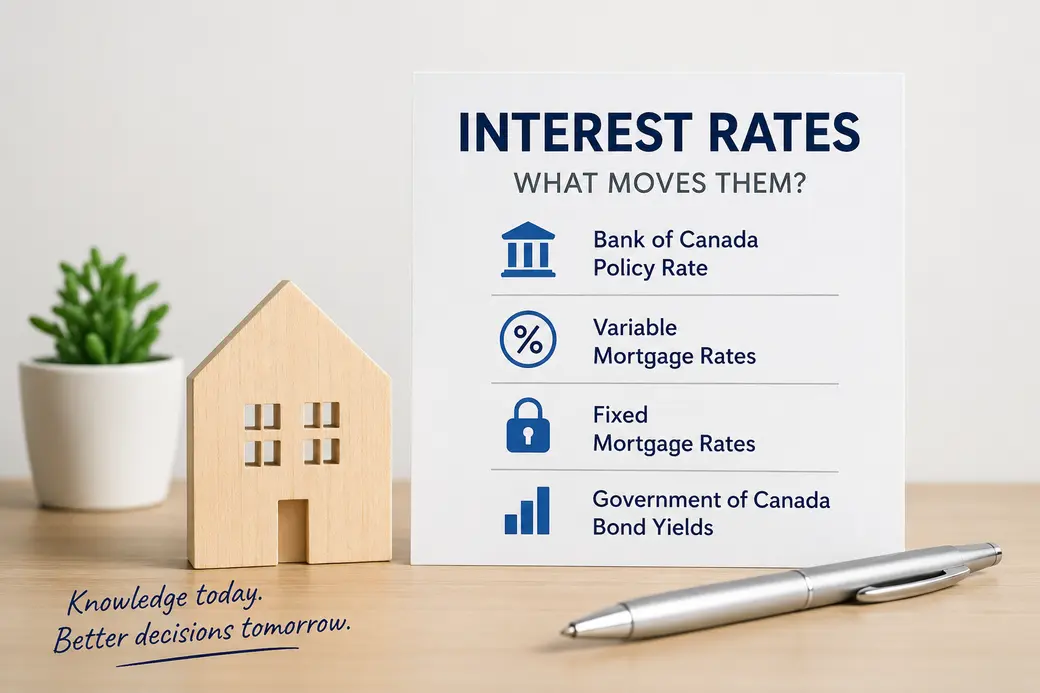
When people talk about "interest rates," they are usually referring to one of four things:
- Bank of Canada policy rate
- Variable mortgage rates
- Fixed mortgage rates
- Government bond yields
Each one affects the housing market differently.
The Bank of Canada Policy Rate
The Bank of Canada sets what's called the overnight lending rate (often called the policy rate).
This is the interest rate banks charge each other for very short-term borrowing.
The Bank of Canada adjusts this rate primarily to control inflation and support the Canadian economy.
When inflation is running too high, rates often increase.
When the economy slows, rates may be lowered to encourage borrowing and spending.
What does this mean for homebuyers?
Changes to the Bank of Canada rate mainly affect:
- Variable-rate mortgages
- Home Equity Lines of Credit (HELOCs)
- Lines of credit
- Some business loans
It does not directly determine fixed mortgage rates.
Variable Mortgage Rates
Variable mortgage rates move with a lender's Prime Rate, which is closely tied to the Bank of Canada policy rate.
If the Bank of Canada raises rates:
- Most lenders increase Prime.
- Variable mortgage payments or interest costs may rise.
If the Bank lowers rates:
- Prime usually falls.
- Borrowing costs for variable-rate mortgage holders often decrease.
This is why news about the Bank of Canada is particularly important for homeowners with variable-rate mortgages.
Fixed Mortgage Rates
Here's where many people get surprised.
Fixed mortgage rates are not set by the Bank of Canada.
Instead, they are heavily influenced by the Canadian bond market—particularly the Government of Canada five-year bond yield.
Since most Canadian fixed mortgages are for five years, lenders closely watch five-year bond yields when pricing mortgages.
If bond yields rise, fixed mortgage rates often increase.
If bond yields fall, fixed mortgage rates often decrease.
This is why fixed mortgage rates sometimes rise even when the Bank of Canada hasn't changed its policy rate.
What Are Bond Yields?
A bond is essentially a loan made to the government.
Investors buy government bonds because they are considered one of Canada's safest investments.
Bond yields move according to investor expectations.
Investors consider factors such as:
- Future inflation
- Economic growth
- Government spending
- Employment data
- Global economic uncertainty
- International events
If investors expect inflation to remain high, bond yields often increase.
Higher bond yields typically lead lenders to increase fixed mortgage rates.
Why Mortgage Rates Don't Always Move Together
Many Canadians expect all mortgage rates to move in the same direction.
In reality, they often don't.
For example:
- The Bank of Canada may lower its policy rate.
- Variable mortgage rates may decline.
- At the same time, bond yields could rise.
- Fixed mortgage rates could actually increase.
This explains why mortgage headlines can sometimes seem contradictory.
What This Means for Buyers in Victoria, BC
Trying to predict mortgage rates perfectly is extremely difficult.
The market reacts to:
- Canadian inflation reports
- Employment numbers
- Government budgets
- Global conflicts
- U.S. economic data
- Investor confidence
No one consistently predicts all of these factors accurately.
Rather than waiting for the "perfect" interest rate, it's usually more productive to focus on:
- Finding the right home
- Choosing a mortgage that fits your financial goals
- Buying when your personal circumstances are right
For many buyers in Victoria, timing their own finances is far more important than trying to time the bond market.
What Sellers Should Know
Interest rates certainly influence buyer demand, but they are only one piece of the puzzle.
Victoria's real estate market is also shaped by:
- Housing inventory
- Population growth
- Local employment
- Consumer confidence
- Seasonal market patterns
- Government housing policies
Even when interest rates are elevated, well-priced homes in desirable Victoria neighbourhoods often continue to attract strong interest.
Understanding the local market is just as important as following national economic news.
The Bottom Line
Mortgage rates are influenced by several different economic forces—not just one headline from the Bank of Canada.
Understanding the difference between policy rates, variable mortgage rates, fixed mortgage rates, and bond yields can help you make informed decisions rather than emotional ones.
Whether you're buying your first home, upsizing for a growing family, or preparing to sell in Victoria, BC, having the right information allows you to move forward with confidence.
Real estate decisions should be based on your long-term goals, not on trying to predict the next quarter-point change in interest rates.
Frequently Asked Questions
Does the Bank of Canada control fixed mortgage rates?
No. Fixed mortgage rates are primarily influenced by Government of Canada bond yields rather than the Bank of Canada policy rate.
Why did my fixed mortgage rate increase even though the Bank of Canada didn't raise rates?
Bond yields may have increased because investors expected higher inflation or stronger economic growth. Lenders often adjust fixed mortgage pricing accordingly.
Should I wait for interest rates to fall before buying a home in Victoria?
Every situation is different. Waiting for lower rates can sometimes mean facing higher home prices or more competition. It's usually better to make a decision based on your financial readiness and long-term plans rather than trying to predict future rate movements.
Are variable mortgages always cheaper?
Not necessarily. Variable mortgages have often been lower over the long term, but they can fluctuate. The right choice depends on your financial goals, risk tolerance, and comfort with changing payments or interest costs.
Thinking About Buying or Selling in Victoria, BC?
Interest rates are just one factor in today's housing market. If you're wondering how current mortgage trends could affect your buying power or the value of your home, I'd be happy to help you understand what they mean in the context of the Victoria, BC real estate market.
Every client receives clear, straightforward guidance so they can make informed decisions with confidence—regardless of what the headlines are saying.
Categories
Recent Posts







REVIEWS