
Victoria Condo Parking & Storage: What Buyers Must Check
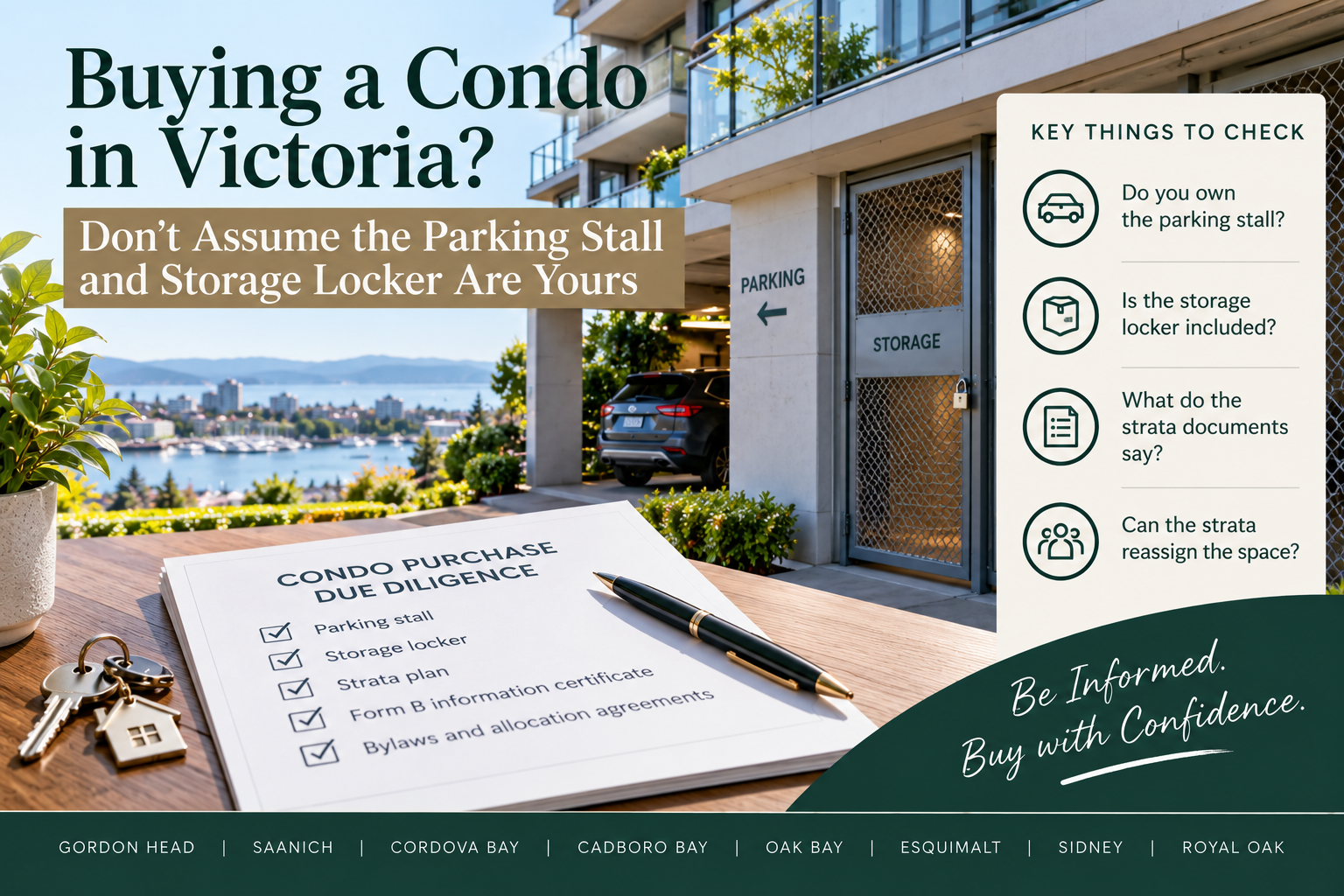
Buying a Condo in Victoria? Don't Assume the Parking Stall and Storage Locker Are Yours
You've found a condo you love. The layout works, the location is perfect, and the listing says it comes with a parking stall and storage locker.
Wonderful. Two more things to check off your list.
But before you assume those spaces are included in your purchase, there's something important you should know.
In British Columbia, having the use of a parking stall or storage locker doesn't always mean you own it or have a permanent right to use it.
And depending on how those spaces are designated, the rights enjoyed by the current owner may not automatically transfer to you when you purchase the property.
This is one of those details that can be easily overlooked when buying a condo or townhouse in Greater Victoria.
Fortunately, it's also something we can investigate during the due-diligence process.
Why Parking and Storage Rights Matter When Buying a Condo
Imagine you're downsizing from a detached home in Gordon Head to a condominium in Royal Oak.
You've spent years enjoying a double garage, plenty of storage and room for everything from gardening equipment to bicycles.
Now you're looking forward to a simpler lifestyle, with less maintenance and more freedom to travel.
You find a lovely condo with two parking spaces and a storage locker advertised in the listing.
It seems ideal.
But during your review of the strata documents, you discover that one parking stall is designated as limited common property while the second is common property allocated by strata council.
Those two spaces may look identical, but the rights associated with them can be quite different.
That's why parking and storage deserve the same careful attention as other important strata documents.
Do You Actually Own Your Condo Parking Stall?
In BC, parking stalls and storage lockers can be designated and allocated in several different ways.
The most important distinction is between property that forms part of your strata lot and common property that you're entitled or permitted to use.
Let's look at the main arrangements.
1. Parking or Storage That Is Part of Your Strata Lot
In some developments, a parking stall or storage area is legally included within the boundaries of the residential strata lot.
When you purchase that strata lot, you acquire the property included within those boundaries.
This is different from simply being assigned a space in a shared parking garage.
The registered strata plan helps establish what is actually included in the strata lot.
For residential strata developments, parking or storage included as part of a residential strata lot shares that strata lot's designation.
2. Limited Common Property (LCP)
This is an important term for condo and townhouse buyers to understand.
Limited common property is common property designated for the exclusive use of one or more particular strata lots.
For example, parking stall 24 might be designated as limited common property for strata lot 12.
The owner of strata lot 12 has the right to use that space because the designation is attached to the strata lot.
When that strata lot is sold, the right to use the designated limited common property generally passes to the new owner.
However, the individual owner does not separately own the limited common property. It remains part of the common property owned collectively by strata owners.
The designation should be established through the registered strata plan or an appropriately filed plan and resolution.
3. Common Property Allocated by Strata Council
This is where buyers need to be particularly careful.
Some parking stalls and storage lockers are designated as common property, with individual spaces allocated for use by particular owners.
The current owner may have used the same parking stall for many years.
They may even believe that the stall belongs to their unit.
However, the arrangement may be based on permission granted by the strata corporation rather than a permanent right attached to the property.
Under section 76 of BC's Strata Property Act, short-term exclusive-use permission for common property is generally limited to one year at a time, subject to conditions and statutory exceptions.
The permission may be renewed, but it may also be changed or cancelled with reasonable notice, subject to applicable law.
Most importantly, permission granted to the current owner does not necessarily transfer automatically to the next owner.
For buyers, this means a parking stall that's been used by the seller for years may not be guaranteed in the same way as a stall designated as limited common property.
4. Parking and Storage Arranged Through a Developer's Lease
Some strata developments use lease or sublease arrangements involving parking stalls and storage lockers.
For example, a developer may have arranged a lease of common property parking areas and then assigned or subleased particular spaces to purchasers.
In these situations, the buyer's rights depend on the terms of the relevant agreements.
It's important to determine whether the agreement can be assigned to a new purchaser and whether any additional steps are required.
These arrangements can be more complicated, so legal advice may be appropriate before proceeding.
Comparing the Different Parking and Storage Arrangements
| Designation | What It Generally Means | What Buyers Should Verify |
|---|---|---|
| Part of strata lot | The space is legally included within the strata lot. | Confirm the boundaries and designation on the registered strata plan. |
| Limited common property | Exclusive use is designated for one or more specific strata lots. | Confirm the registered designation and associated strata lot. |
| Common property allocation | Use may depend on strata council permission or another allocation arrangement. | Confirm the current allocation, conditions and whether it will continue after the purchase. |
| Lease or sublease | Rights depend on the applicable contractual agreement. | Review the agreement and confirm whether the rights can transfer to the purchaser. |
Can Strata Council Reassign Your Parking Stall?
The answer depends on how the stall is legally designated.
If a parking stall is designated as limited common property for your strata lot, strata council generally cannot simply treat it as an ordinary common property stall and reassign it at will.
Changing a limited common property designation involves specific legal procedures.
However, if the stall is common property allocated under a short-term exclusive-use arrangement, the strata may have authority to change the allocation, subject to the Strata Property Act, applicable bylaws and other legal requirements.
That's an important difference.
It also explains why the fact that a seller has always parked in a particular stall isn't enough to establish that the buyer will have the same right.
What About Your Storage Locker?
The same general principles apply to storage lockers.
A storage locker may be part of a strata lot, designated as limited common property, allocated as common property or governed by a lease or other agreement.
For buyers moving from a detached home into a condo, storage can be particularly important.
You may be planning to keep bicycles, seasonal decorations, sporting equipment or items that no longer fit inside your new home.
Before purchasing, it's worth checking more than whether a locker exists.
- Which specific locker is associated with the property?
- How is the locker legally designated?
- Will your right to use it continue after completion?
- Are there restrictions on what can be stored?
- Is the locker large enough for your needs?
- Are there any rental fees or other conditions?
Remember that strata bylaws and rules may restrict storage of certain items, even where you have exclusive use of a locker.
What Does the Form B Information Certificate Tell You?
One of the most important documents when purchasing a strata property in BC is the Form B Information Certificate.
The Form B contains important information about the strata corporation and the individual strata lot.
Among other things, it includes information about parking stalls and storage lockers allocated to the property.
It should identify their designations and, where applicable, provide information about how common property spaces are allocated.
For example, the Form B may indicate that a parking stall is:
- Part of the strata lot.
- Designated as limited common property.
- Common property allocated with strata council approval.
- Common property rented for a monthly fee.
- Potentially subject to a developer assignment arrangement.
This is useful information, but the Form B should not always be the end of the investigation.
Depending on the designation, additional documents may be needed to establish the buyer's rights.
These may include the registered strata plan, filed limited common property designations, council records or lease agreements.
Five Things I Would Check Before Buying a Victoria Condo
1. Compare the MLS Listing With the Form B
Does the listing advertise one parking stall, two stalls or a storage locker?
Do the details match the Form B?
If not, I would want clarification.
2. Review the Registered Strata Plan
The strata plan helps establish whether the parking or storage space forms part of the strata lot or is common property.
It may also identify limited common property designations, although additional registered documents may need to be reviewed.
3. Confirm the Actual Stall and Locker Numbers
It's important to verify the specific spaces involved.
The parking stall you saw during your showing should match the documentation establishing the right to use it.
4. Ask Whether the Allocation Can Change
If the parking stall or storage locker is common property, find out how the current arrangement works.
Is the space assigned by strata council? Is there a monthly fee? Does the buyer need approval after completion?
5. Investigate Any Discrepancies Before Removing Conditions
If there is uncertainty about ownership, allocation or transfer rights, this is the time to investigate.
Depending on the circumstances, clarification from the strata corporation, additional records or legal advice may be necessary.
What if the Listing Says Two Parking Stalls but the Form B Shows Only One?
This is exactly the type of situation that deserves attention during the purchasing process.
There may be a straightforward explanation.
Perhaps the seller rents an additional parking stall from the strata corporation or another owner.
Or perhaps the second stall is allocated under a separate agreement that hasn't been provided.
But buyers should not assume the arrangement will continue after the sale.
Before proceeding, the parties should clarify what is actually being offered and what rights will be available to the purchaser.
Where necessary, the purchase contract may need appropriately drafted terms addressing parking and storage rights.
BCFSA provides guidance and sample contract clauses for real estate professionals, but the correct approach depends on the circumstances.
Why This Is Especially Important for Downsizers
One of the biggest lifestyle changes when moving from a detached home to a condo is having less control over certain spaces.
In a detached house, you generally know where your property boundaries are and what areas belong to you.
In a strata development, the distinctions between your strata lot, limited common property and common property can be less obvious.
For someone selling a family home in Gordon Head, Cordova Bay or Oak Bay and moving into a condo in Sidney, Royal Oak or Esquimalt, these details may affect everyday convenience.
Do you need parking for two vehicles?
Will you have room for your bicycles or golf clubs?
Can you accommodate visitors?
Will the storage space be available for as long as you own the property?
These may sound like small questions, but they can make a real difference to how comfortably a new home fits your lifestyle.
What Sellers Should Know Before Listing Their Condo
This issue matters to sellers, too.
If you're preparing to sell a condo or townhouse, it's worth confirming the legal status of your parking and storage arrangements before your property goes on the market.
You may have been using the same parking stall for fifteen years.
That doesn't necessarily mean you own it or that your purchaser will automatically have the right to use it.
Obtaining and reviewing a current Form B, together with other relevant documentation, can help ensure your listing accurately represents what's included.
It can also reduce the likelihood of unexpected questions or complications after an offer has been accepted.
Accurate information helps buyers feel more confident and supports a smoother transaction.
Dawn's Take: It's the Details That Matter
When I'm showing condos or townhomes, buyers naturally focus on the things they can see.
The kitchen, the layout, the natural light and whether the property feels like somewhere they'd enjoy living.
Those things matter, of course.
But some of the most important details aren't visible during a showing.
Parking and storage are good examples.
Just because a listing advertises a parking stall or the seller has used a locker for years doesn't necessarily tell us what rights the buyer will have.
That's why I believe in taking the time to review the strata documents carefully and ask questions when something isn't clear.
My goal isn't to make the buying process complicated. It's to help clients understand what they're purchasing so they can make decisions with confidence.
Sometimes the smallest details deserve the closest attention.
Frequently Asked Questions About Condo Parking and Storage in BC
Do I automatically own the parking stall advertised with my Victoria condo?
No. The stall may form part of your strata lot, be designated as limited common property, or be common property allocated through another arrangement. The legal designation determines your rights.
What does limited common property mean for parking?
Limited common property is common property designated for the exclusive use of one or more strata lots. If a parking stall is properly designated for the strata lot you're purchasing, the right to use it generally transfers with that strata lot.
Can a BC strata corporation change my assigned parking stall?
It depends on the designation. Common property parking allocated through a short-term exclusive-use arrangement may be subject to change. Limited common property has a different legal status and cannot simply be reassigned in the same way.
Does a storage locker automatically transfer when I buy a condo?
Not always. It depends on whether the locker is part of the strata lot, limited common property, common property allocated for use or subject to a lease or other agreement. Buyers should verify the arrangement before purchasing.
Where can I check which parking stall belongs with a condo?
Start with the Form B Information Certificate and registered strata plan. Depending on the arrangement, you may also need filed limited common property documents, strata council records or lease agreements.
What should I do if the MLS listing and Form B don't match?
Ask for clarification and supporting documentation before removing your purchase conditions. If the buyer's rights remain uncertain, legal advice may be appropriate.
Thinking About Buying a Condo or Townhome in Greater Victoria?
Whether you're buying your first condo or downsizing from your family home, understanding strata documents is an important part of making a confident purchase.
There's often a lot of information to review, and it's not always obvious which details deserve closer attention.
I'm here to help you work through that process, identify the right questions and understand when additional professional advice is needed.
Be Informed. Buy With Confidence.
Looking at condos or townhomes in Victoria, Saanich, Sidney, Oak Bay or Esquimalt?
Let's talk about what matters most to you and how to evaluate your options before making a purchase.
Let's Talk About Your Next HomeHelpful Resources
- BC Government: Strata Parking Stalls and Storage Lockers
- BC Financial Services Authority: Parking Stalls and Storage Lockers
- BC Government: Exclusive Use of Common Property
- BCFSA: Understanding the Form B Information Certificate
Disclaimer: This article provides general information about strata parking and storage arrangements in British Columbia as of October 2026. Individual rights depend on registered documents, applicable legislation, bylaws and contractual arrangements. Buyers and sellers should verify property-specific information and obtain independent legal advice when appropriate.
Categories
Recent Posts






REVIEWS