
Buying a Condo in Victoria BC? The Strata Insurance Deductible Could Surprise You
Buying a Condo in Victoria BC? The Strata Insurance Deductible Could Surprise You
When you're buying a condo or townhome in Greater Victoria, there are plenty of things to consider: location, layout, strata fees, building condition and whether the property suits your lifestyle.
But there's another detail that deserves your attention, and it's one many buyers don't think to ask about.
The strata corporation's insurance deductible.
Some strata buildings have deductibles of $100,000, $150,000 or considerably more for certain types of damage.
And under certain circumstances, an individual owner could be responsible for paying a substantial portion of that amount.
That can come as a surprise, particularly to buyers moving from a detached home into strata living for the first time.
Let's look at how strata insurance works in British Columbia, when an owner might be responsible for a deductible and what I recommend checking before purchasing a condo or townhome.
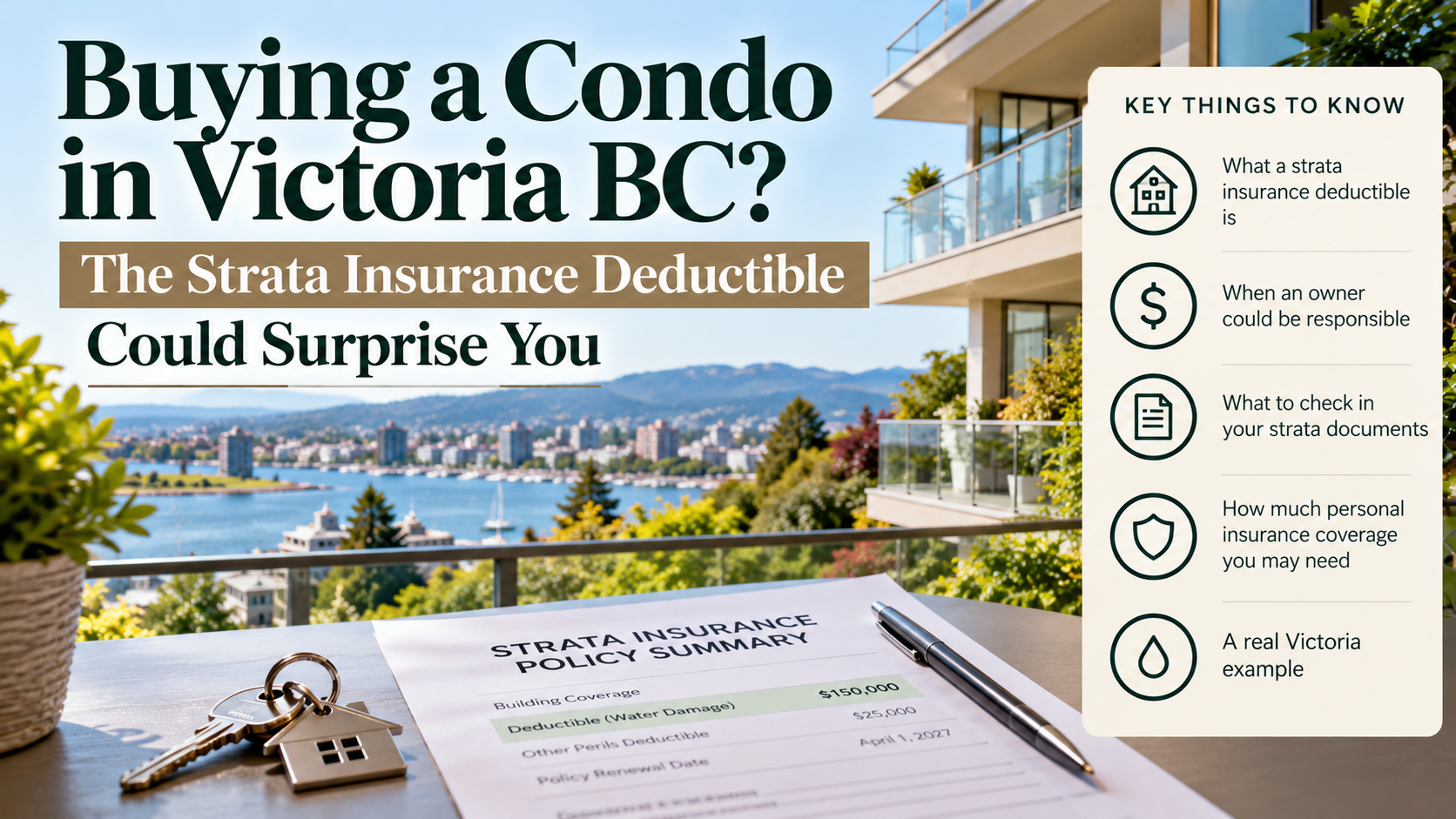
What Is a Strata Insurance Deductible?
In British Columbia, strata corporations are required to maintain insurance for specified property, including common property, common assets and buildings shown on the strata plan, subject to the applicable legal requirements.
Think of this as the building's insurance policy.
It generally covers major insured losses involving the building and common property, subject to the policy's terms, limits and exclusions.
However, just like a personal home insurance policy, the strata corporation's policy has deductibles.
A deductible is the amount that must be paid toward an insured loss before the insurer pays the covered balance.
Different types of claims can have different deductibles.
For example, a strata corporation might have one deductible for fire damage and a much higher deductible for water damage.
Water-related claims are particularly important to investigate because they can affect multiple units and common property.
How High Can Strata Insurance Deductibles Be in BC?
The Province of British Columbia advises that strata insurance deductibles can range from $100,000 to $750,000 or higher, depending on factors such as the building and its claims history.
That doesn't mean every condo building in Victoria has deductibles this high.
Some buildings have considerably lower amounts, and deductibles vary by insurer, policy and type of claim.
But the potential amounts are significant enough that buyers should always investigate.
A Simple Example
Imagine a condo building with the following insurance deductibles:
- Water damage: $150,000
- Fire damage: $25,000
- Sewer backup: $100,000
These figures are hypothetical and are used only to illustrate how deductibles can vary.
If a covered water-damage claim occurs, the strata corporation's insurance policy may require a $150,000 deductible before the insurer pays the covered balance.
Who ultimately bears that deductible depends on the circumstances, the applicable law and any available insurance coverage.
Could You Be Responsible for the Strata's Insurance Deductible?
Potentially, yes.
This is one of the most important things condo and townhome buyers should understand.
Under section 158 of British Columbia's Strata Property Act, the payment of a strata corporation's insurance deductible is generally treated as a common expense.
However, the legislation also allows a strata corporation to sue an owner to recover the deductible when that owner is responsible for the loss or damage that gave rise to the insurance claim.
Responsibility does not always require proof that the owner was negligent.
That distinction can surprise buyers.
An owner might not have intentionally caused damage or failed to maintain something, yet could still face a claim for the deductible, depending on the facts.
Recovery is not automatic, and disputes about responsibility can involve legal questions.
A Victoria Example: When a Dishwasher Hose Fails
From Gordon Head to a Condo in Royal Oak
Imagine a couple selling their longtime family home in Gordon Head and purchasing a lovely condo in Royal Oak.
They're looking forward to less exterior maintenance and a simpler lifestyle.
They carefully review the strata fees, depreciation report and recent meeting minutes.
Everything appears manageable.
What they haven't looked closely at is the strata corporation's insurance deductible.
Several months after moving in, a dishwasher hose unexpectedly fails while they're away.
Water escapes from their unit and damages the flooring, walls and neighbouring units.
The strata corporation submits a claim under its building insurance policy.
Unfortunately, the building has a $150,000 water-damage deductible.
Even though the owners did not deliberately cause the problem and may not have been negligent, the strata corporation could potentially seek recovery of the deductible if they are legally responsible for the loss.
Would their personal condo insurance cover the amount?
That depends on the coverage they purchased, their policy limits, exclusions and the circumstances of the claim.
This is why I recommend having a knowledgeable insurance broker review the strata's insurance information before removing purchase conditions.
Strata Insurance vs. Personal Condo Insurance: What's the Difference?
When you purchase a condo or strata townhome, there are generally two important insurance policies to consider.
1. The Strata Corporation's Insurance
The strata corporation's policy generally insures the building, common property and certain original fixtures, subject to the policy and applicable law.
The cost is usually part of the strata corporation's operating expenses and is funded through strata fees.
2. Your Personal Condo Insurance
Your own condo insurance can provide coverage for things the strata corporation's policy does not ordinarily cover.
Depending on the policy, this may include:
- Your furniture and personal belongings.
- Improvements or upgrades made to your unit.
- Personal liability.
- Additional living expenses if an insured loss makes your home temporarily uninhabitable.
- Certain losses or assessments that may not be fully covered by the strata corporation's insurance.
- Coverage toward the strata corporation's insurance deductible when you are legally responsible for an insured loss.
The important point is that not every personal condo insurance policy provides identical coverage.
Buyers need to understand both the amount of coverage and the circumstances under which it applies.
How Much Personal Insurance Coverage Do You Need?
There isn't one amount that's appropriate for every condo owner.
The answer depends on the strata corporation's current deductibles, the coverage available from your insurer and your individual circumstances.
For example, if the building has a $150,000 water-damage deductible, you should ask your insurance broker whether your proposed policy provides appropriate coverage for potential deductible liability.
Don't assume that a policy's general liability limit automatically covers every strata deductible claim.
Ask specifically about strata deductible assessment or loss-assessment coverage, including any limits, conditions and exclusions.
Also ask whether coverage differs for water damage, sewer backup, fire or other insured events.
Where Can You Find the Strata Insurance Deductible?
The good news is that buyers can obtain this information during their due diligence.
One of the most important documents is the Form B Information Certificate.
What Is a Form B?
A Form B is a prescribed strata information document that provides important details about the strata corporation and the particular strata lot.
It includes information about matters such as strata fees, certain amounts owing and other required disclosures.
A summary of the strata corporation's insurance coverage must also be included with the Form B.
This gives buyers an opportunity to review the building's insurance arrangements before committing to the purchase.
What Should You Look For?
I would want to review the current insurance cover note or other evidence of insurance showing:
- The insurance company and policy period.
- The types of coverage in place.
- Coverage limits.
- Deductibles for different types of claims.
- Any important exclusions or coverage restrictions.
- Whether the information is current or a renewal is approaching.
It's also worth reviewing recent strata meeting minutes for discussions about insurance premiums, deductibles, claims and renewals.
If the strata's policy is close to renewal, buyers should understand that the current deductible could change.
What Happens if the Strata Deductible Increases After You Buy?
Insurance policies are renewed periodically, and deductibles can change.
A building that previously had a $50,000 water-damage deductible could face a higher deductible at a later renewal.
That's one reason personal condo insurance shouldn't be something you arrange once and then forget about.
The Province of BC recommends reviewing your personal strata insurance annually with a knowledgeable insurance broker.
Strata corporations must also inform owners and tenants as soon as feasible about material changes to the strata corporation's insurance coverage, including increases in deductibles.
If you receive notice of a deductible increase, contact your insurance broker and ask whether your existing coverage is still appropriate.
Does a High Insurance Deductible Mean You Should Avoid the Building?
Not necessarily.
A higher deductible is something to investigate, but it shouldn't automatically determine whether a property is a good purchase.
I would want to understand the broader picture.
For example:
- Has the building experienced repeated water-damage claims?
- Have the causes of previous claims been addressed?
- Are there ongoing plumbing or building-envelope concerns?
- Has the strata corporation completed preventative maintenance?
- Are insurance premiums and deductibles increasing?
- Is appropriate personal insurance available at a reasonable cost?
These questions can help distinguish a manageable insurance issue from a pattern that deserves closer attention.
It's also important to remember that the deductible alone doesn't tell you whether a building is well maintained.
Reviewing the depreciation report, financial statements, meeting minutes and other strata documents helps provide the context.
Five Insurance Questions I Would Ask Before Buying a Condo
My Buyer's Strata Insurance Checklist
- What are the current deductibles?
Look beyond the general deductible. Check water damage, sewer backup, fire and other relevant categories. - Has the building experienced significant insurance claims?
Review available strata records and ask about recurring problems, particularly water-related damage. - Is the insurance policy approaching renewal?
A pending renewal may bring changes to premiums, deductibles or coverage. - Can I obtain appropriate personal condo insurance?
Have an insurance broker review the strata's policy and provide a quote before removing conditions. - Are there any gaps in coverage I should understand?
Ask about deductible assessments, personal liability, improvements, contents, temporary accommodation and exclusions.
My advice: Don't simply confirm that the building has insurance. Understand what that insurance covers, what it doesn't cover and what financial exposure could remain with you.
Why This Matters for Downsizers in Greater Victoria
Many homeowners in Gordon Head, Broadmead, Cordova Bay, Cadboro Bay and Oak Bay eventually reach a point where they're ready for less home maintenance.
They may be considering a condo or townhome in Royal Oak, Sidney, Fairfield, Esquimalt or another convenient neighbourhood.
Strata living can offer real advantages.
There may be fewer exterior maintenance responsibilities, more opportunities to travel and less time spent looking after a large property.
But the financial responsibilities are different from those of owning a detached home.
Instead of being responsible for the entire property yourself, you share certain expenses and obligations with other owners through the strata corporation.
At the same time, you still need personal insurance and an understanding of potential liabilities.
For someone who has owned a detached home for 25 or 30 years, these details may be unfamiliar.
That's why I believe education is such an important part of the downsizing process.
It's not just about finding a home that's easier to maintain. It's about understanding the responsibilities that come with your next home.
What Sellers Should Know About Strata Insurance
If you're selling a condo or townhome in Greater Victoria, buyers will likely want to review the strata corporation's insurance information.
Having current strata documents available can help make the process smoother.
It is also helpful to understand whether there have been recent changes to the building's deductibles or insurance coverage.
Accurate documentation allows buyers to make informed decisions and obtain appropriate insurance advice.
If a buyer has questions about a high deductible, the best approach is to provide reliable information rather than make assumptions about what their personal insurance will cover.
Dawn's Take: It's About Understanding the Details
When I'm helping clients buy a condo or townhome, I want them to feel comfortable with more than just the property itself.
Of course, the layout, location and lifestyle are important. But so are the details that aren't immediately obvious during a showing.
Insurance deductibles are a good example.
Most buyers understand that they need home insurance. What they may not realize is that the strata corporation's insurance and their personal insurance work together, and there can be gaps between the two.
I particularly think about clients who are downsizing from a detached home. They're often looking forward to having fewer responsibilities, which makes complete sense.
But I want them to understand what changes when they move into strata living.
My approach is to review the relevant documents, identify anything that deserves a closer look and encourage clients to get advice from the appropriate professionals.
A little investigation before purchasing can prevent a very expensive surprise later.
It's all part of helping buyers make informed decisions without feeling rushed or pressured.
Frequently Asked Questions About Strata Insurance Deductibles in BC
Who pays the strata insurance deductible in British Columbia?
Under section 158 of BC's Strata Property Act, the deductible is generally a common expense. However, the strata corporation may sue an owner to recover the deductible if the owner is responsible for the loss or damage that caused the claim. The outcome depends on the circumstances.
Can a strata owner be responsible for water damage without being negligent?
Yes, potentially. BC government guidance explains that an owner can be responsible for a loss even without negligence. For example, a failed dishwasher hose could cause damage to other units or common property. Responsibility depends on the facts and applicable law.
Does my personal condo insurance cover the strata deductible?
It may provide some or all of the coverage, depending on your policy. Coverage limits, conditions and exclusions vary. Ask your insurance broker to compare your personal policy with the strata corporation's current insurance deductibles.
Where can I find a condo building's insurance deductible?
Start with the Form B Information Certificate and its insurance summary. Buyers should also review the current insurance cover note or other evidence of insurance showing the policy's coverage, limits, expiry dates and deductibles.
Should I avoid buying a condo with a high water-damage deductible?
Not automatically. A high deductible should prompt further investigation into the building's insurance history, maintenance, claims and available personal insurance coverage. Consider the information alongside the other strata documents and professional advice.
Can strata insurance deductibles increase after I purchase my condo?
Yes. Deductibles can change when the strata corporation renews or modifies its insurance policy. Owners should review their personal condo insurance regularly and contact their insurance broker when the strata announces material changes.
Buying a Condo or Townhome in Victoria? Let's Make Sure You Know What You're Buying
Whether you're purchasing your first condo, moving into a townhome or downsizing from a longtime family home, strata ownership comes with important details worth understanding.
Insurance deductibles are just one part of the picture.
Reviewing the strata documents, asking the right questions and understanding your financial responsibilities can help you move forward with greater confidence.
I'm happy to guide you through the buying process, help you identify the documents that matter and connect you with qualified professionals when specialized advice is needed.
Be Informed. Buy With Confidence.
Thinking about purchasing a condo or townhome in Greater Victoria?
Let's talk about what you're looking for and what you'll want to investigate before making an offer.
Let's Talk About Your Next HomeHelpful Resources
- Province of BC: Strata Owner and Tenant Insurance
- Province of BC: Insurance for Strata Corporations
- Province of BC: Form B Information Certificate
- BC Strata Property Act: Section 158, Insurance Deductibles
Disclaimer: This article provides general educational information about strata insurance in British Columbia as of October 2026. Insurance policies, deductibles, exclusions and legal responsibility vary. Buyers and owners should consult a qualified insurance broker for coverage advice and a legal professional where questions about liability arise. Examples are hypothetical and do not represent actual insurance policies or claims at specific Greater Victoria properties.
Categories
Recent Posts





REVIEWS