
BC Assessment vs. Market Value in Victoria BC
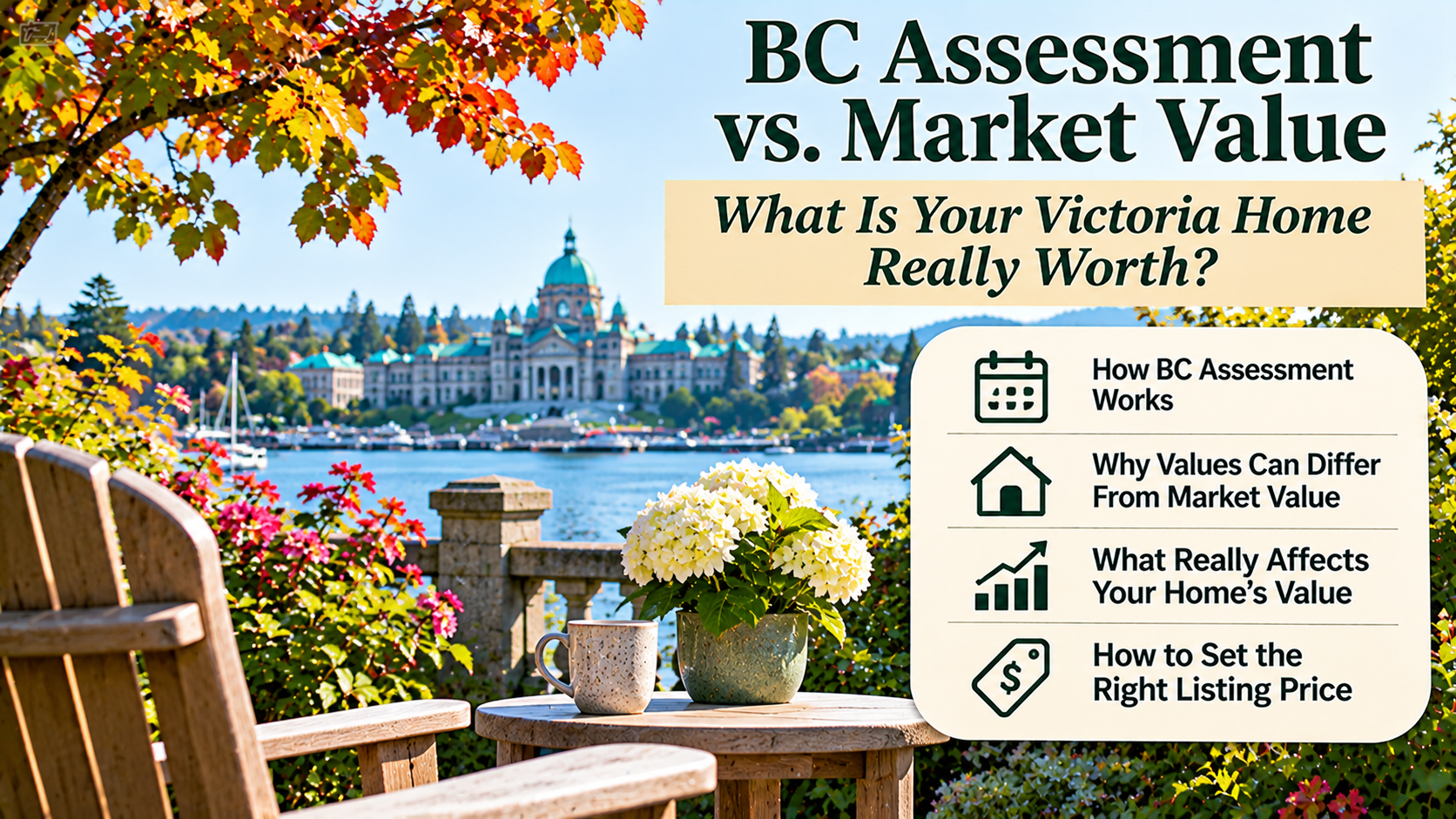
BC Assessment vs. Market Value: What Is Your Victoria Home Really Worth?
Every January, homeowners across Greater Victoria receive their annual BC property assessment. And every year, the same question comes up: Is this what my home is actually worth?
It's a reasonable question, particularly if you're considering selling your home.
You might be surprised to discover that your property assessment is higher than you expected. Or perhaps it's lower than the price similar homes have recently sold for in your neighbourhood.
So which number should you believe?
The answer is that BC Assessment and current market value serve different purposes. Understanding the difference can help you make better decisions about selling, buying or simply keeping track of your property's value.
1. What Is BC Assessment?
BC Assessment is a provincial Crown corporation responsible for assessing the value of properties throughout British Columbia.
These assessments provide the property value information used by municipalities and other taxing authorities to calculate property taxes.
Each year, BC Assessment reviews property information and market activity to determine assessed values.
For most residential properties, the assessment considers factors such as:
- Property location and neighbourhood.
- Lot size and characteristics.
- Building size and age.
- Property type and construction quality.
- Available information about renovations and improvements.
- Comparable property sales.
- Market conditions around the valuation date.
BC Assessment uses mass appraisal methods, meaning large numbers of properties are assessed using standardized valuation processes and available property data.
This differs from a REALTOR preparing an individual market analysis for a specific home.
2. Why Is the July 1 Valuation Date Important?
One of the most important things to understand about BC Assessment is that the value is based on a specific date.
For the 2027 assessment notices arriving in January, the valuation date is July 1, 2026.
This means the assessment reflects an estimate of the property's value as of that date, not necessarily its value when the notice arrives.
BC Assessment generally uses October 31 as the date for determining the property's physical condition and permitted use.
Why does this matter?
Because real estate markets change.
Between July and the following January, mortgage rates, buyer demand, inventory levels and comparable selling prices may all change.
If you're planning to sell in February or March 2027, for example, a July 2026 valuation may not accurately reflect what buyers are prepared to pay at that time.
3. What Is Market Value?
In real estate, market value generally refers to the price a property would likely achieve in an open and competitive market under normal conditions, with informed and willing buyers and sellers.
When I prepare a comparative market analysis for a homeowner, I look at what buyers have actually been paying for similar properties.
This involves reviewing:
- Recent sales of comparable properties.
- Currently listed homes competing for the same buyers.
- Properties that have expired or failed to sell.
- Differences in size, condition, layout and location.
- Renovations, upgrades and maintenance.
- Lot characteristics, views and outdoor space.
- Current inventory and buyer demand.
- How long comparable properties remained on the market.
The goal is to understand how buyers are responding to properties like yours in the current market.
A comparative market analysis is not a formal appraisal, but it is an important tool for developing a realistic listing strategy.
4. Why Can BC Assessment and Market Value Be Different?
There are several reasons your assessed value may differ from what your home could sell for.
The Market May Have Changed
The assessment is tied to July 1, while a current market analysis considers more recent activity.
If prices have risen or softened since the valuation date, the difference can be meaningful.
Your Home May Have Unique Features
Two houses on the same street can have very different appeal.
One may have a renovated kitchen, updated bathrooms, a heat pump and attractive landscaping.
Another may have an older roof, dated interiors and significant maintenance requirements.
Although BC Assessment considers available property information, its records may not fully capture every feature or condition that influences a buyer's decision.
Buyer Preferences Matter
Certain features may be particularly desirable to buyers at a given time.
A functional floor plan, a main-level primary bedroom, good natural light or a well-designed outdoor space may make one property more appealing than another.
These differences can influence offers and selling prices.
Competition Changes
The number and quality of competing listings can affect the price a buyer is willing to pay.
If several similar homes are available, buyers may have more negotiating power.
If comparable properties are scarce, a well-presented home may attract stronger interest.
5. A Gordon Head Example: Two Different Values
A Hypothetical Seller Scenario
Imagine a homeowner in Gordon Head receives a 2027 BC Assessment showing a value of $1,250,000.
The owner is thinking about downsizing and assumes that $1,250,000 would be the appropriate asking price.
However, when I prepare a market analysis, I discover that several comparable homes have sold recently.
Some have sold below their assessed values, while others have sold above them.
One comparable home had extensive renovations and a beautifully landscaped yard. Another was largely original and required considerable updating.
The homeowner's property falls somewhere between the two in terms of condition and appeal.
After considering recent sales, active competition and the home's specific features, the current market evidence may support a different price than the assessment.
That doesn't necessarily mean BC Assessment made a mistake.
It means the assessment and the current market analysis are measuring value using different dates, information and methods.
The figures in this example are illustrative, not actual Gordon Head sales data.
6. Does a Higher BC Assessment Mean Higher Property Taxes?
Not necessarily.
This is another common misunderstanding.
Property taxes are calculated using assessed values and tax rates established by the applicable taxing authorities.
A municipality determines the revenue it needs to collect and sets tax rates accordingly.
As a result, a 10% increase in your assessed value does not automatically mean your property taxes will increase by 10%.
What matters in part is how your property's assessed value changes relative to other properties in the same property class and taxing jurisdiction, along with changes to tax rates and applicable levies.
For example, if your home's assessed value rises by approximately the same percentage as comparable properties across the municipality, the assessment increase alone may have a relatively limited effect on your share of the tax burden.
However, if your assessment rises substantially more than the average, your share may increase.
Property taxes can also change because of municipal budgets, other taxing authorities and applicable exemptions.
The key point is that property assessments and property taxes are related, but they aren't the same thing.
7. Should You Use Your BC Assessment to Set Your Listing Price?
I wouldn't recommend relying on the assessment alone.
When you're selling a home, the asking price needs to reflect the market you're entering.
That means considering what buyers are currently willing to pay, what competing properties are available and how your home compares.
An assessment can be a useful reference point, but it shouldn't determine your pricing strategy.
Overpricing a property can lead to fewer showings, a longer time on the market and eventually a price reduction.
On the other hand, pricing too low without a clear strategy may not serve the seller's interests either.
A well-supported listing price should consider both the property's characteristics and the current market.
8. What If Your BC Assessment Is Higher Than Your Home's Market Value?
This can happen, particularly when the market has softened since the assessment valuation date.
For example, if comparable properties are now selling for less than they were around July 1, the current market value may be below the assessed value.
That doesn't automatically mean the assessment was incorrect for its valuation date.
If you believe your assessment is inaccurate, it's important to distinguish between a genuine assessment concern and a market change that occurred after July 1.
You can review the property details BC Assessment has on file and compare your assessment with similar properties.
If you believe the information or value is incorrect, BC Assessment provides a review and appeal process.
The usual deadline to request a Property Assessment Review Panel review is January 31, although the applicable deadline can be affected by the calendar.
Confirm the deadline and requirements for the 2027 assessment cycle directly with BC Assessment.
9. What If Your BC Assessment Is Lower Than Your Home's Market Value?
A lower assessment doesn't automatically mean your home is worth less than similar properties.
Your home may have features that are particularly attractive to today's buyers.
Or the market may have strengthened since the July 1 valuation date.
For example, a well-maintained home in Oak Bay with a desirable floor plan and attractive outdoor space may appeal strongly to buyers, even if its assessed value is lower than recent comparable selling prices.
The assessment is one piece of information, not the final word on value.
10. How Do Renovations Affect Your Home's Value?
Homeowners often ask whether the money they've spent on renovations will be reflected in their property's value.
The answer depends on the improvements.
Renovations can make a home more appealing, but the cost of an improvement doesn't always translate into an equivalent increase in market value.
For example, replacing an aging roof may be important for maintaining the property's condition and avoiding buyer concerns.
A kitchen renovation may improve both functionality and presentation.
But buyers will still compare the property with other available homes.
Some improvements may generate a stronger return than others, depending on the neighbourhood, price range and buyer expectations.
When preparing a market analysis, I consider the quality and relevance of improvements rather than simply adding renovation costs to the home's estimated value.
11. Why Neighbourhood Matters in Greater Victoria
Greater Victoria isn't one uniform real estate market.
Buyer preferences, housing styles and price ranges vary considerably between neighbourhoods.
A detached family home in Gordon Head may attract a different buyer pool than a character home in Fairfield, a waterfront property in Cordova Bay or a townhouse in Royal Oak.
Even within the same neighbourhood, factors such as lot size, street location, condition, views and proximity to amenities can influence value.
This is why I prefer to use closely comparable local sales whenever possible.
A broad Greater Victoria average may provide useful context, but it doesn't necessarily tell you what an individual property is worth.
12. Five Things I Review Before Recommending a Listing Price
When I'm preparing a comparative market analysis, I focus on five important areas.
- Recently sold properties: These show what buyers have actually paid for comparable homes.
- Active competition: I look at which homes buyers can choose from right now and how they compare with yours.
- Property condition: Maintenance, updates, renovations and presentation all influence buyer perception.
- Neighbourhood characteristics: Lot size, location, views, floor plan and proximity to amenities can affect value.
- Current market conditions: Inventory, buyer activity, financing conditions and days on market help determine an appropriate pricing strategy.
Sold properties are particularly important because they show what buyers actually paid.
Active listings tell us about current competition, but their asking prices don't establish market value.
Expired or cancelled listings can also provide useful context, although they don't always reveal why a property failed to sell.
The result is a recommended pricing range supported by evidence, rather than a number based on an assessment alone.
13. Homeowner Checklist: Understanding Your Property's Value
Before Deciding What Your Home Is Worth, Consider:
- Assessment date: Remember that the 2027 BC Assessment reflects a July 1, 2026 valuation date.
- Property details: Check that BC Assessment has accurate information about your home.
- Recent sales: Review comparable properties that have actually sold.
- Current listings: Understand which homes would compete with yours.
- Condition: Consider maintenance, repairs and improvements.
- Location: Look at neighbourhood and street-specific factors.
- Buyer demand: Consider how active buyers are in your price range.
- Days on market: Review how long comparable homes are taking to sell.
- Market changes: Consider interest rates, inventory and recent pricing trends.
- Professional guidance: Obtain a current comparative market analysis if you're considering selling.
14. When Should You Request a Market Analysis?
You don't need to be ready to list your home immediately to benefit from a market analysis.
Perhaps you're thinking about downsizing next year.
Maybe you're considering selling your family home and purchasing something smaller.
Or you may simply want to understand how your property's value has changed.
Having a realistic estimate of your home's current market value can help with financial planning and future decisions.
If you're preparing to sell, I recommend reviewing the market again closer to the listing date because conditions can change.
Dawn's Take: Your Assessment Is a Starting Point, Not a Pricing Strategy
Every year when BC Assessment notices arrive, I hear from homeowners who are curious about what the new number means for their property.
Some are pleasantly surprised by an increase. Others wonder why their assessment is lower than expected.
I always remind people that an assessed value and a current market value aren't necessarily the same thing.
When I'm helping someone prepare to sell, I want to understand what buyers are actually paying for homes similar to theirs.
I look at recent sales, competing properties, the home's condition and the features that make it attractive to buyers.
I also believe it's important to be realistic. A homeowner may have a particular number in mind, but the market ultimately determines what a buyer is willing to pay.
My role is to provide the information and guidance needed to make a thoughtful pricing decision.
If you're wondering what your home is worth, I'd be happy to prepare a market analysis for you. There's no obligation to sell. Sometimes it's simply helpful to know where you stand.
Frequently Asked Questions About BC Assessment and Market Value
Is BC Assessment the same as market value?
No. BC Assessment estimates a property's market value as of a specific valuation date, while current market value reflects what a property would likely sell for under present market conditions. The two figures can differ because of timing, property characteristics and market changes.
What date is the 2027 BC property assessment based on?
The 2027 assessment uses July 1, 2026 as its valuation date. Property condition and permitted use are generally considered as of October 31, 2026. The assessment therefore may not reflect market changes occurring after July.
Can I sell my home for more than its BC Assessment?
Yes. A property may sell above or below its assessed value depending on current market conditions, location, condition, buyer demand and comparable sales. The assessed value does not set a maximum or minimum selling price.
Does a higher property assessment mean higher taxes?
Not automatically. Property taxes depend on applicable tax rates and levies, as well as the property's assessed value relative to other properties. An assessment increase does not necessarily produce an equivalent percentage increase in property taxes.
Should I use my BC Assessment to price my home for sale?
Your assessment can provide background information, but a listing price should be based primarily on recent comparable sales, current competition, property condition and buyer demand. A current comparative market analysis is more useful for developing a selling strategy.
How can I find out what my Victoria BC home is worth today?
A local REALTOR can prepare a comparative market analysis using recent sales, active listings and the specific characteristics of your property. A qualified appraiser can provide a formal appraisal when one is required.
Thinking About Selling Your Home in Greater Victoria?
Whether you own a family home in Gordon Head, a townhouse in Royal Oak, a character home in Fairfield or a property in Oak Bay, understanding its current market value can help you plan your next move.
I work with homeowners throughout Greater Victoria, including Saanich, Cordova Bay, Cadboro Bay, Sidney, Esquimalt and surrounding neighbourhoods.
My approach is to provide a thoughtful, property-specific analysis and explain the information in a way that's easy to understand.
You don't have to be ready to sell to start the conversation.
Curious What Your Home Is Worth?
If you've received your BC Assessment and are wondering how it compares with today's market, I'd be happy to help.
I can prepare a comparative market analysis based on recent Greater Victoria sales and your property's individual features.
No pressure and no obligation. Just useful information to help you plan.
Connect With DawnHelpful Resources
- BC Assessment — Valuation Date vs. Physical Condition Date
- BC Assessment — Understanding the Property Tax Equation
- BC Assessment — Important Assessment Dates
- BC Assessment — Official Property Search
- Victoria Real Estate Board — Greater Victoria Market Information
Disclaimer: This article provides general real estate information as of November 2026. Property assessments, tax rates, market conditions and property values can change. A comparative market analysis is not a formal appraisal or tax assessment. Homeowners should consult BC Assessment, their municipality, a qualified appraiser or another appropriate professional for property-specific assessment, tax or valuation questions.
Categories
Recent Posts








REVIEWS