
Buying a Home With a Shared Driveway in Victoria BC
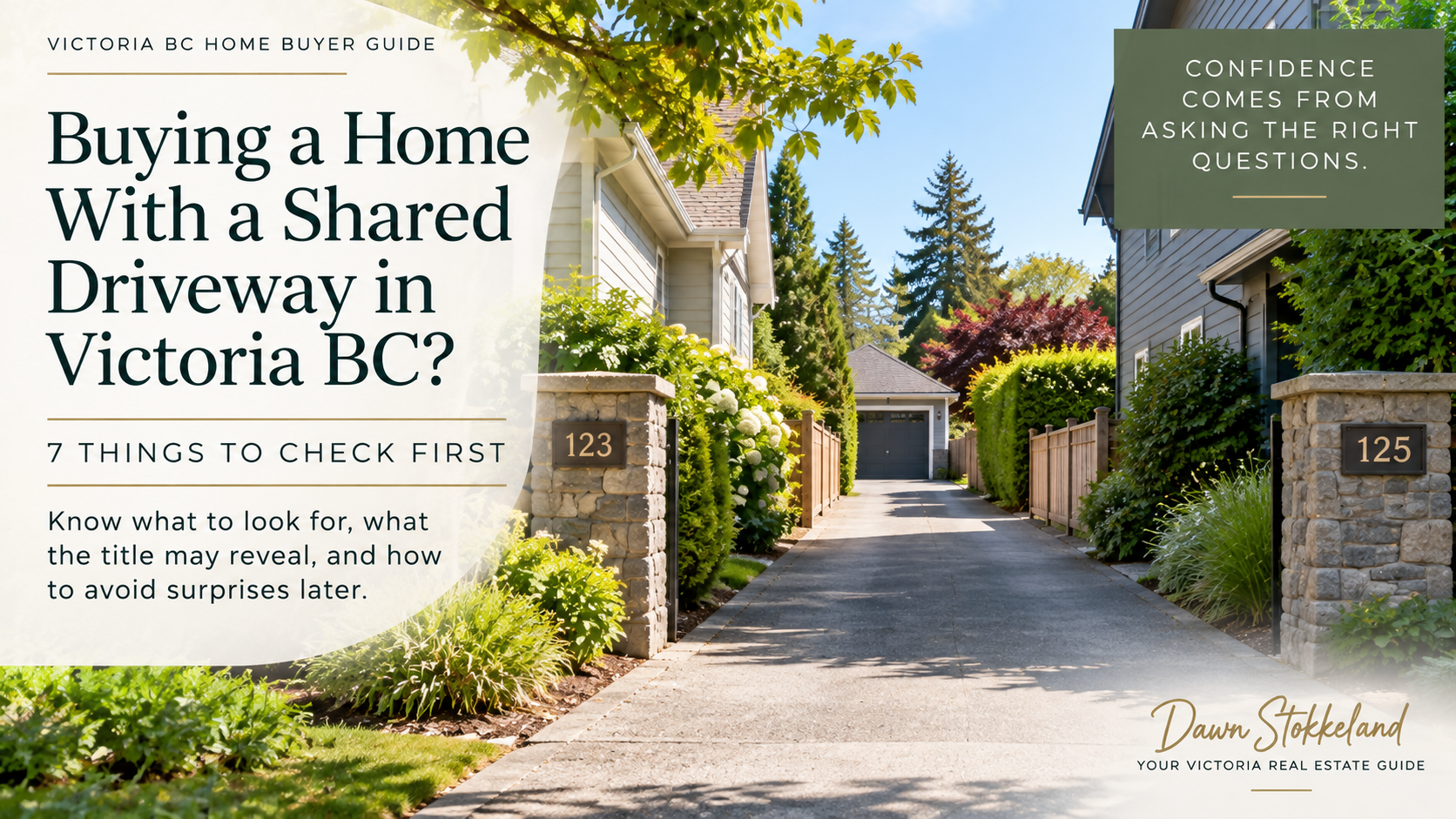
Shared driveway arrangements vary from property to property. Always review the specific title and registered documents for the home you are considering.
Victoria BC Home Buyer Guide
Buying a Home With a Shared Driveway in Victoria BC? 7 Things to Check First
A shared driveway might not seem like a big deal when you are viewing a home. You pull in, see where the cars park and assume the neighbours simply share the space.
But what you see on the ground doesn't necessarily tell you who owns the driveway, who has the legal right to use it, or what each property owner is responsible for. Those details may be contained in the property's title and registered documents.
A good question to ask
Does the way everyone is currently using this driveway actually match the legal rights registered to the properties?
This doesn't mean a shared driveway is a problem. Many work perfectly well for decades. It simply means that, as a buyer, you should understand the arrangement you're purchasing before you remove your conditions.
What Is a Shared Driveway?
A shared driveway generally means that two or more properties use some portion of the same access to reach their homes, garages or parking areas.
But two driveways that look almost identical can have very different legal arrangements.
One property may own the land while a neighbouring property has a registered easement allowing access over it. In another situation, there may be reciprocal easements. In some developments, the driveway or roadway may instead form part of a strata arrangement.
That's why I don't recommend making assumptions based solely on what we see during a showing.
1. Who Actually Owns the Driveway?
Start with the property itself. Where are the property boundaries, and where does the driveway sit in relation to them?
A driveway may appear to sit neatly between two houses while actually being located largely or entirely on one property.
This is where the title, registered plans and, when appropriate, professional surveying information can become important.
A REALTOR® can help identify the documents that should be investigated, but questions about the legal interpretation of an easement should be referred to a lawyer or notary, and questions about the precise location of property boundaries should be addressed by a qualified land surveyor.
2. Is There a Registered Easement or Right of Way?
This is one of the most important questions.
An easement is a legal right that can allow someone to use a portion of another person's land for a particular purpose. With a shared driveway, that purpose may be vehicle or pedestrian access.
The BC Financial Services Authority specifically advises home buyers to pay attention to whether a property's title contains easements or restrictive covenants.
The important part isn't simply seeing the word easement on a title. The registered document itself may need to be obtained and reviewed so that you understand which property benefits, which property is burdened, where the easement is located and what rights were actually granted.
3. Who Is Responsible for Maintenance and Repairs?
Imagine that five years after buying the home, the driveway needs to be resurfaced.
Who pays?
Is the cost split equally? Is responsibility based on ownership? Is there a written agreement? Or have the neighbours simply been handling repairs informally?
These are worthwhile questions to investigate before purchasing rather than discovering the answers when a major repair is needed.
Buyer tip: Ask whether there is a written maintenance agreement and whether the seller can provide information about how driveway repairs and maintenance have historically been handled.
4. Can Someone Park in the Shared Portion?
Everyday use matters just as much as the legal paperwork.
Look at whether vehicles parked on the driveway could prevent another owner from getting to a garage, carport or parking area.
Don't assume that because the current neighbours have developed an informal parking routine, a future neighbour will necessarily use the space the same way.
If uninterrupted access is important to you, the registered rights governing the driveway deserve careful review.
5. Does the Driveway Affect What You Can Do With the Property?
This is especially important if you're buying with future plans in mind.
Perhaps you're considering an addition, a garage, a garden suite, additional parking or a substantial renovation.
A registered easement or right of way may affect how a portion of the property can be developed.
The District of Saanich, for example, notes that easements and rights-of-way can affect development and the issuance of building permits.
So if future development potential is one of the reasons you're purchasing the property, investigate the title and municipal requirements before assuming your plans will work.
6. Where Does the Private Driveway End and Municipal Access Begin?
There is another boundary buyers don't always think about: the point where the private property meets the municipal boulevard or road allowance.
In Saanich, for example, the municipality defines driveway access as the portion of the municipal boulevard between the road and the property line. A permit is required to construct a new driveway access or widen an existing one.
This can become particularly relevant if you're thinking about changing the driveway, adding parking or altering access to the property after you buy.
Rules differ by municipality, so buyers should check the requirements for the specific property rather than assuming the same rules apply throughout Greater Victoria.
7. Does What You See Match the Documents?
This may be the most important point of all.
A driveway might have been used in the same informal way for years. A neighbour may park in a particular spot. Landscaping may have gradually changed the apparent edge of the driveway. A fence or hedge may make a boundary seem obvious.
None of those things, by themselves, establish the legal arrangement.
If something doesn't make sense, that's the time to investigate further—not after you've purchased the home.
Shared Driveways Around Greater Victoria
Shared access isn't limited to one particular style or age of home. You can encounter it in established neighbourhoods, on subdivided properties, on infill lots and in some strata developments.
It's something worth watching for when buying in areas such as Gordon Head, Saanich, Cordova Bay, Cadboro Bay, Oak Bay, Fairfield, Fernwood, Esquimalt, Royal Oak and Sidney.
In established neighbourhoods, the physical use of a property may also have evolved over many years. That's another reason I prefer to verify rather than assume.
Dawn's Take
A shared driveway isn't automatically a reason not to buy a home.
What matters is understanding exactly what you're buying.
If we're looking at a property together and I notice shared access, I don't want you making assumptions based on how the neighbours happen to be using the driveway today. I want us to understand the title, the registered documents and any practical issues that could affect you as the future owner.
Good due diligence isn't about finding reasons to be afraid of a property. It's about getting enough information to make a confident decision.
Frequently Asked Questions
Is a shared driveway a problem when buying a house?
Not necessarily. Many shared driveways function without difficulty. The important thing is to understand ownership, access rights, registered easements and any maintenance arrangements before purchasing.
How do I know if my neighbour has a legal right to use the driveway?
The property's title and relevant registered documents are an important starting point. A lawyer or notary can provide legal advice about the meaning and effect of those documents.
Who pays to repair a shared driveway?
There isn't one answer that applies to every property. Responsibility may depend on the ownership structure and the specific agreement or registered documents. Ask for any available maintenance agreement and information about how costs have historically been handled.
Can a shared driveway affect future renovations?
Potentially. Easements and rights-of-way can affect how land is developed. If you're purchasing with plans for an addition, garage, garden suite or other project, investigate the relevant title documents, zoning and municipal requirements before relying on that future use.
Does a fence show where the property line is?
Don't assume it does. Fences, hedges, driveways and landscaping don't necessarily correspond with legal property boundaries. If the exact boundary is important, professional surveying advice may be appropriate.
Helpful Resources
BC Financial Services Authority:
What buyers should investigate when searching for a home
BCFSA – Land Title and Survey Authority Information:
Understanding information found on a property title
District of Saanich:
Easements, rights-of-way and building permit documents
District of Saanich – Driveway Access:
Driveway access permits and municipal requirements
Buying a Home in Greater Victoria?
The house itself is only part of what you're buying. I help my clients look beyond the finishes and understand the property, documents and details that can affect their decision—so they can move forward with confidence.
Let's Talk About Your Home Search
Dawn Stokkeland, REALTOR®
eXp Realty | Victoria, British Columbia
Phone: 778.679.7686
Email: info@homesbydawn.ca
Website: www.homesbydawn.ca
Disclaimer: This article is provided for general educational purposes and is not legal, surveying, engineering or municipal planning advice. Easements, rights-of-way, driveway ownership, maintenance obligations and development restrictions vary by property and by the wording of the applicable registered documents. Buyers should obtain appropriate legal, surveying or other professional advice when necessary and verify current municipal requirements for the specific property.
Categories
Recent Posts



REVIEWS