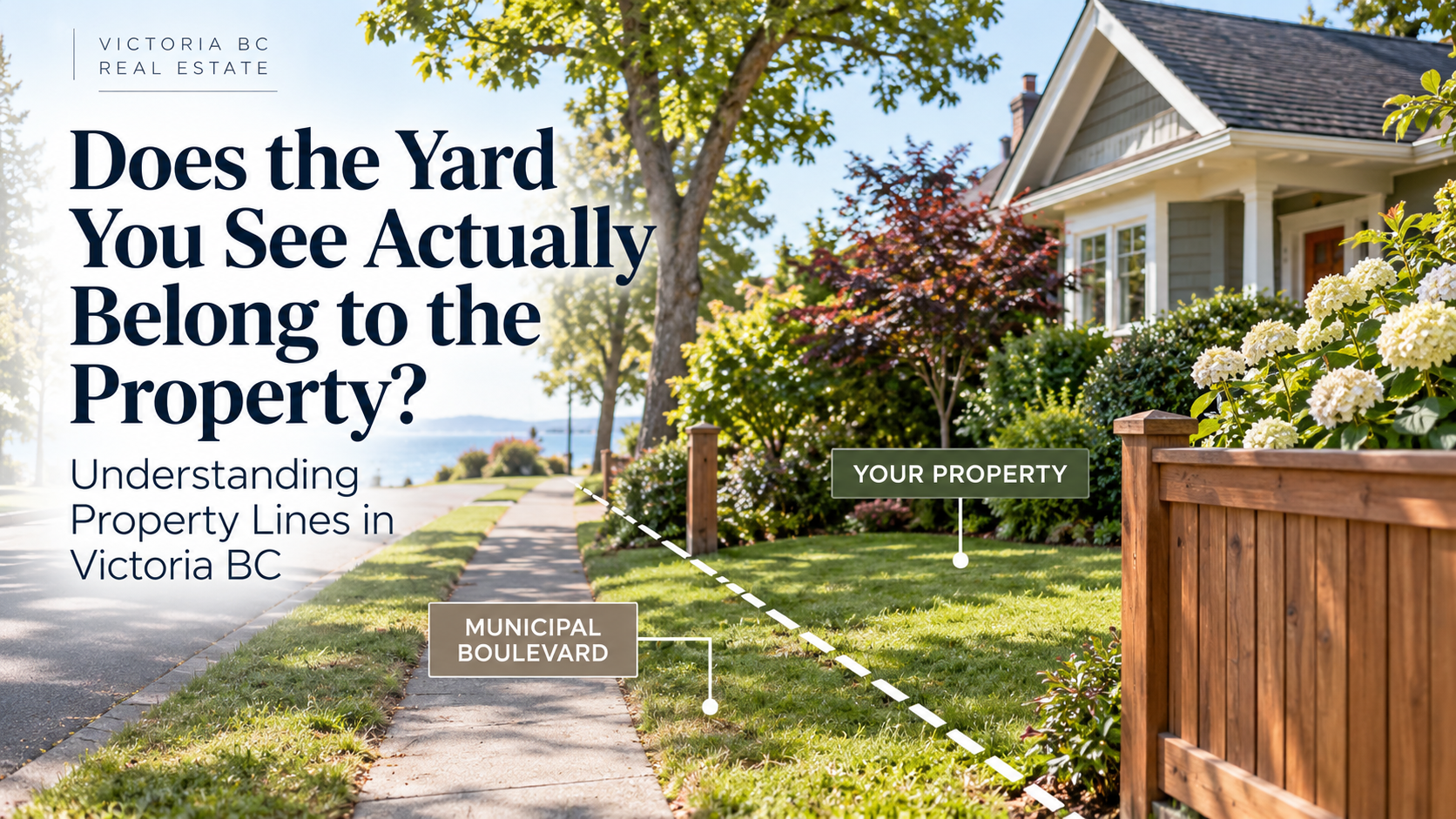
Does the Yard You See Actually Belong to the Property?
Buying a Home in Victoria BC? Don’t Assume the Fence Marks the Property Line
When you walk through a property, it is natural to assume that the fence, hedge, driveway or landscaping shows you where the property begins and ends.
But in Greater Victoria, what appears to be the edge of a property may not match the legal boundary at all.
That matters because buyers often attach real value to things like a large backyard, mature trees, a wide driveway, privacy from neighbouring homes, room for an addition or potential space for a garden suite.
“Where does the yard look like it ends?”
The better question is:
“Where does the property legally end?”
Why Property Lines Matter When Buying a Home
Property boundaries affect much more than the size of the yard. They can influence what you own, what you are responsible for maintaining and what you may eventually be able to build.
Property lines can affect:
- Where fences may legally be located
- Whether a driveway is entirely on the property
- Whether a shed, garage or other structure is close to a boundary
- Whether a retaining wall belongs to the property
- Who owns a tree near the road or side yard
- Whether part of the landscaped frontage is actually municipal boulevard
- Where future additions or garden suites may potentially be located
A buyer may love a property because of a particular feature, only to discover later that part of what appeared to belong to the home is outside the legal lot boundary.
1. Fences Do Not Always Mark the Legal Property Line
A fence creates a very convincing visual boundary. But it should not automatically be treated as the legal boundary.
A fence may have been built for privacy, convenience or landscaping rather than directly on the surveyed property line. It may sit slightly inside one property, or its location may simply reflect decisions made by previous owners many years ago.
If the exact location of a boundary matters to your purchase, the fence itself is not proof of where that boundary is.
2. Hedges and Landscaping Can Be Misleading
Mature hedges, garden beds and landscaped areas can create an equally strong impression of where one property stops and another begins.
But landscaping may have been installed decades ago without any connection to the surveyed boundary.
This can be particularly relevant in established Greater Victoria neighbourhoods such as Oak Bay, Fairfield, Gordon Head, Cadboro Bay and Cordova Bay, where homes and gardens may have a long history.
3. Part of the “Front Yard” May Actually Be Municipal Boulevard
One of the easiest areas for buyers to misunderstand is the land between the private property boundary and the road.
In Saanich, for example, the municipality describes the boulevard as the land between the property line and the curb or road shoulder.
A homeowner may maintain the grass and landscaping in this area, making it look like a seamless extension of the front yard.
But maintaining an area of land does not necessarily mean you own it.
A Useful Buyer Takeaway
A beautifully landscaped front yard may include municipal boulevard land. Before attaching value to frontage, trees, parking or future landscaping plans, understand where the private property actually begins.
4. A Driveway Can Cross Land You Do Not Own
A driveway may appear to belong entirely to the property, but buyers should not automatically assume that is the case.
Depending on the property, part of a driveway may cross municipal land or access may be affected by an easement or shared arrangement with a neighbouring property.
If parking or driveway access is important to your decision to purchase the home, understanding how that access is legally established is worth investigating.
5. Who Actually Owns That Mature Tree?
Mature trees are part of the character of many Greater Victoria neighbourhoods and can contribute enormously to the appeal of a property.
But a tree that visually appears to be inside a front or side yard may actually be on municipal land or close enough to a boundary that ownership is not obvious.
That distinction can matter when questions arise about pruning, maintenance, removal or future construction.
If a particular tree is important to the property—or could potentially interfere with future plans—it is worth determining whose property it is actually on rather than relying on appearances.
6. Sheds, Garages and Retaining Walls Deserve a Closer Look
Older properties often contain structures that were added by previous owners over many years.
These might include:
- Sheds
- Detached garages
- Retaining walls
- Decks
- Fences
- Garden structures
Buyers planning future renovations should understand where these structures sit in relation to the property boundaries.
If something appears unusually close to a neighbouring property, further investigation may be appropriate.
7. Property Lines Matter Even More If You Want to Build
This is where property boundaries become especially important for buyers purchasing a home because of its future potential.
Imagine buying a Gordon Head property because the backyard appears to provide room for a future garden suite.
Or perhaps you are considering a Cordova Bay property because the lot seems to offer room for an addition.
Maybe you are purchasing an Oak Bay or Fairfield home and envision building a new garage or substantially renovating the existing house.
Before relying on those assumptions, you need to understand the actual property boundary.
Lot boundaries are only one part of determining whether something can be built. Zoning, setbacks, tree protection, title restrictions, servicing, permits and other municipal requirements may also affect what is possible.
Can You Use Online Municipal Property Maps?
Yes—but understand their limitations.
Municipal mapping and property-information tools can be extremely useful during preliminary research.
For example, Saanich provides online property information that can help buyers investigate parcel information, zoning and other details about a property.
These tools can help you understand the general shape and location of a lot, but online mapping should not be treated as a substitute for a legal survey when the exact location of a boundary matters.
When Might a Buyer Consider a Land Survey?
Not every home purchase requires a new survey.
However, further investigation may be worthwhile when:
- The fence location appears unusual
- A structure is very close to the apparent edge of the lot
- You are buying specifically because of future building potential
- There is uncertainty about a driveway or access
- A retaining wall appears to sit on or near a boundary
- The ownership of an important mature tree is unclear
- You are relying heavily on the apparent size of the yard
- Available property information raises questions about the boundary
Where the precise legal boundary needs to be established, a qualified BC land surveyor is the appropriate professional to provide that information.
Where Your REALTOR® Adds Value
Your REALTOR® is not a land surveyor and should not attempt to determine a legal property boundary.
But an experienced buyer's agent can help identify situations where a boundary issue deserves more attention.
That may include:
- Reviewing available property information
- Looking for an existing survey or site plan
- Identifying unusual fence, driveway or access arrangements
- Investigating available permit information for existing structures
- Asking questions about the buyer's future plans for the property
- Helping determine what additional due diligence may be appropriate
- Recommending a qualified surveyor when precision is important
The goal isn't to make every property complicated.
It is to avoid assuming that something belongs to the property simply because it looks like it does.
Why Property Lines Are Worth Thinking About in Greater Victoria
Greater Victoria has a wide mix of older homes, mature landscaping, established fences and properties that have evolved over many decades.
Property-boundary questions can therefore be particularly relevant in:
- Gordon Head — larger yards, mature landscaping and buyers interested in future suites or additions
- Cadboro Bay — established properties, mature trees and varied lot configurations
- Cordova Bay — larger lots and properties where buyers may be considering future development
- Oak Bay — older homes, long-established fences and mature gardens
- Fairfield — character homes and established landscaping
- Fernwood — older urban properties and varied lot layouts
- Esquimalt — established residential properties with a range of lot configurations
- Royal Oak — detached homes where future improvements may be part of the purchase decision
- Sidney — established residential areas where smaller lots can make boundary locations particularly relevant
Two homes that look almost identical from the street can have very different legal boundaries and property considerations.
Questions Victoria Home Buyers Should Ask
If a property's boundaries are important to your purchasing decision, useful questions can include:
- Is there an existing survey or site plan for the property?
- Do the fences appear to follow the property boundaries?
- Is part of the landscaped front yard municipal boulevard?
- Does the driveway involve municipal land, an easement or shared access?
- Are any structures located unusually close to a boundary?
- Who owns significant trees near the edge of the property?
- Am I relying on the apparent yard size when deciding what this property is worth to me?
- Should I obtain professional advice before relying on future building potential?
Frequently Asked Questions About Property Lines in Victoria BC
Does a fence show the legal property line?
Not necessarily. A fence may be located on, inside or near a property boundary. Its physical location should not automatically be treated as proof of the legal property line.
Is the boulevard in front of a house part of the property?
Not necessarily. In municipalities such as Saanich, the boulevard is generally the land between the private property line and the curb or road shoulder. A homeowner may maintain this land without owning it.
Can I rely on an online property map to determine the boundary?
Online municipal maps are valuable research tools, but they should not be relied upon when the exact legal location of a property boundary needs to be established.
Who can determine the legal property line in British Columbia?
Where precise legal boundaries need to be established, buyers should consult an appropriately qualified BC land surveyor.
Should every Victoria home buyer get a land survey?
Not necessarily. Whether additional surveying is worthwhile depends on the property, the information already available, the buyer's future plans and whether there is uncertainty about boundaries, structures or access.
Why do property lines matter if I want to build a garden suite or addition?
Building opportunities can depend partly on lot dimensions, setbacks and the location of existing structures. Understanding the actual property boundary is therefore an important starting point before relying on future development potential.
The Yard You See May Not Be the Yard You Own
When buying a home in Victoria, it is easy to judge a property by what you can see during the showing.
But fences, hedges, driveways and landscaping can create a very convincing—and sometimes misleading—impression of where a property actually begins and ends.
Good due diligence isn't about looking for reasons not to buy a home. It's about understanding what you are buying before you rely on assumptions about lot size, access, privacy or future building potential.
Thinking About Buying a Home in Greater Victoria?
I help buyers look beyond the obvious features of a property and understand the questions worth asking before making a major real estate decision.
Explore Victoria Real EstateHelpful Local Resources
- District of Saanich — Boulevards
- District of Saanich — Property Information
- Land Title and Survey Authority of British Columbia
This article is provided for general educational purposes only and is not legal, surveying or development advice. Property boundaries, municipal requirements and individual circumstances vary. Buyers should obtain advice from a qualified BC land surveyor, lawyer, municipality or other appropriate professional when required.
Categories
Recent Posts




REVIEWS