
Buying a Home in Victoria BC With Mature Trees? What Buyers Need to Know Before Planning Renovations or Development
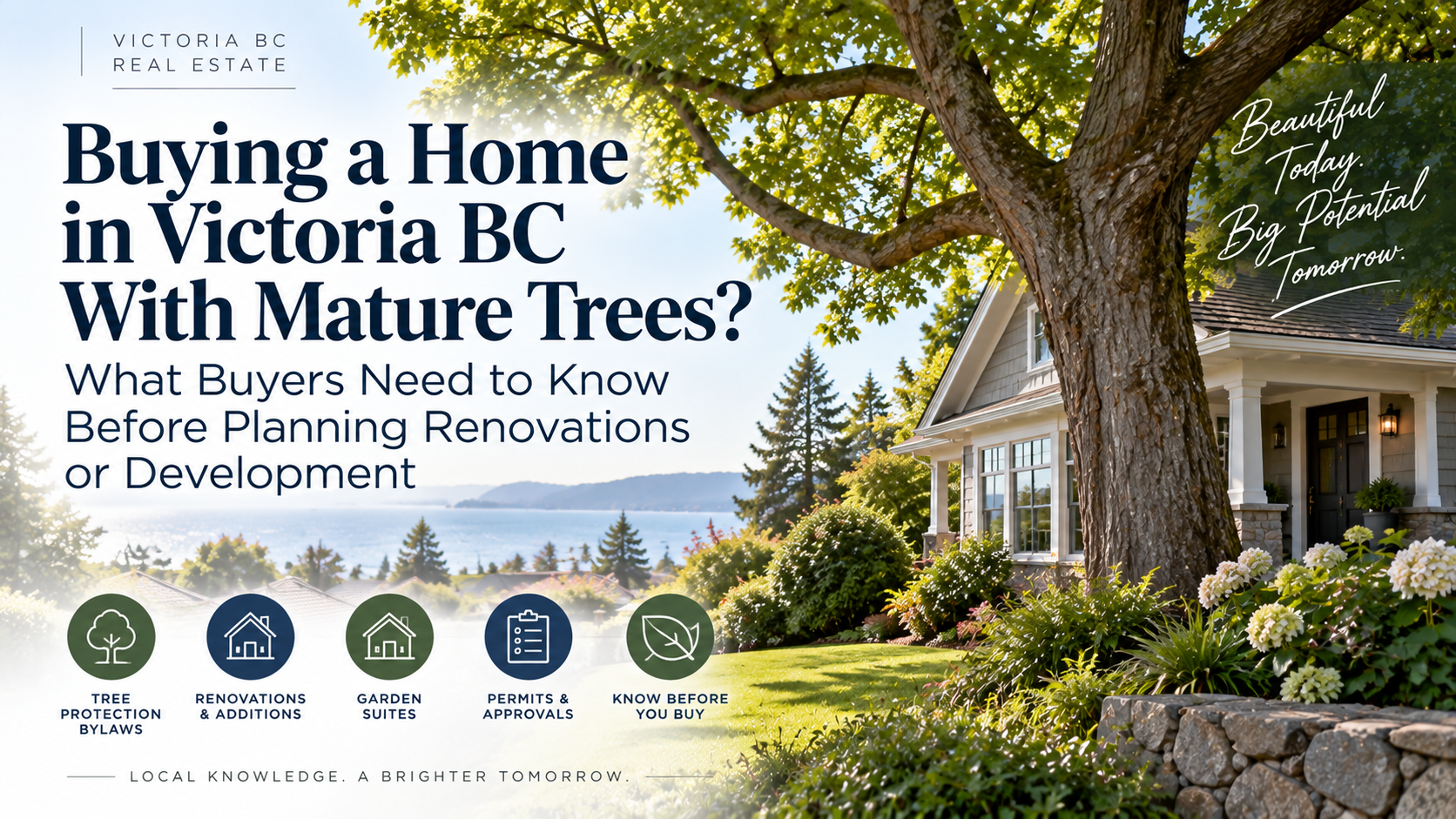
Buying a Home in Victoria BC With Mature Trees? What Buyers Need to Know Before Planning Renovations or Development
A beautiful mature tree can be one of the features that makes you fall in love with a property. But if you are buying because you hope to add a garden suite, expand the house, change the driveway or substantially redesign the yard, that same tree may need to become part of your due diligence.
Greater Victoria is known for its mature urban forest, including Garry oaks, Douglas firs, arbutus and many other established trees. Municipal tree-protection rules can affect what homeowners are permitted to remove, alter or build around.
That does not mean a property with large trees is a problem. Quite the opposite—mature trees can add privacy, character and considerable appeal.
The key is understanding how the trees may affect the plans you have for the property before you rely on those plans when deciding what the home is worth to you.
“Is that tree on my property?”
The better question may be:
“Is it protected, and could it affect what I want to do with this property?”
Why Mature Trees Matter When Buying a Home
Buyers often think about trees mainly in terms of appearance, shade and maintenance.
But trees can also affect:
- Home additions
- Garden suites
- Detached garages
- Driveway changes
- Excavation
- Retaining walls
- Patios and landscaping
- Demolition and redevelopment
- Construction access
In some cases, it is not only the tree trunk that matters. Work around a protected tree's root zone can also be regulated.
1. A Tree Does Not Have to Look Extraordinary to Be Protected
One of the first things buyers should understand is that municipal tree-protection rules vary across Greater Victoria.
Depending on the municipality, protection may relate to the tree's species, size, location, significance or other criteria.
In Saanich, for example, the Tree Protection Bylaw defines categories of protected trees, and the municipality advises homeowners to consider a tree's type, size and location when determining whether the bylaw applies.
The practical takeaway is simple: don't assume a tree can be removed merely because it is located on private property.
2. The Root Zone Can Matter Just as Much as the Tree
This is where buyers planning renovations can easily underestimate the issue.
A tree can remain standing while construction activity still affects its root system.
Excavation, trenching, changes to grade, driveways, foundations, retaining walls and heavy equipment can all potentially affect the area around tree roots.
Saanich specifically notes that permits can be required to remove or alter protected trees or to work within their protected root zones during development. The City of Victoria also regulates work within the protected root zone of bylaw-protected trees.
The Buyer Takeaway
If your future building plan sits beside a mature tree, the relevant question may not be whether the tree itself must be removed. The roots and construction zone may also need to be considered.
3. Trees Can Affect Garden-Suite Potential
Garden-suite potential is increasingly important to Greater Victoria buyers.
Some buyers want space for aging parents. Others are thinking about rental income, adult children or simply creating long-term flexibility.
A large backyard may appear to provide plenty of space for a suite, but the usable building area can be affected by more than the dimensions of the lot.
Setbacks, zoning, servicing, access, protected trees and tree-root zones may all need to be considered.
If garden-suite potential is one of the reasons you are buying the property, it is worth investigating these issues before assuming that a visually open section of yard is automatically buildable.
4. That Addition May Need to Work Around the Tree
The same principle applies to house additions.
Buyers often walk through an older home and immediately see possibilities:
- Extend the kitchen
- Add a family room
- Build a larger primary suite
- Add another level
- Construct a deck or patio
Those ideas may be entirely possible—but the presence and location of protected trees should form part of the early investigation when construction is contemplated.
5. Development Applications Can Trigger Tree Requirements
The City of Victoria specifically connects tree protection with property development.
Its current guidance says tree information may be required for development-related applications such as rezoning, subdivision, development permits and certain building permits, including demolition, construction of a principal building, larger additions and accessory buildings such as garden suites.
Protected trees on neighbouring properties can also become relevant if their protected root zones may be affected by the proposed work.
This is an important reminder that the trees affecting a project are not always limited to the ones physically growing inside the property's boundaries.
6. Oak Bay Buyers Should Pay Particular Attention
Oak Bay's mature trees are a defining part of the area's character.
The District of Oak Bay has its own Tree Protection Bylaw, and protected trees cannot simply be cut down or damaged without the required municipal authorization.
This becomes particularly important when a buyer is purchasing an older Oak Bay property specifically because of renovation or redevelopment potential.
Before paying a premium for what you believe the property could become, it is sensible to understand how the trees fit into that vision.
7. Saanich Buyers Have Similar Considerations
Saanich's Tree Protection Bylaw regulates the cutting, removal and damaging of protected trees and includes rules around work within protected root zones.
For development-related projects, Saanich advises applicants that tree considerations are incorporated into the development-review process.
That makes this especially relevant to buyers considering properties in:
- Gordon Head
- Cadboro Bay
- Cordova Bay
- Broadmead
- Royal Oak
- Other established Saanich neighbourhoods with mature trees
5 Situations Where I Would Investigate the Trees Before Relying on Future Potential
1. A Large Tree Is Close to the House
If your plan is to enlarge the home in the direction of a mature tree, I would want to understand whether that tree or its root zone could affect the project.
2. Mature Trees Occupy the Area You Envision for a Garden Suite
Don't assume they can simply be removed later. The trees should form part of the feasibility investigation.
3. You Want to Widen or Relocate the Driveway
Driveway construction often involves excavation, grading and hard surfaces—all of which can become relevant when mature trees are nearby.
4. You Are Buying Primarily for Redevelopment
If much of the property's value to you comes from what could eventually be built, tree constraints should be investigated alongside zoning, setbacks, servicing and other development considerations.
5. A Significant Tree Is Near a Property Line
A neighbouring tree can matter if its roots or canopy extend toward the proposed construction area. This is another reason not to look at future development potential in isolation.
Can You Remove a Protected Tree If You Own the Property?
Ownership alone does not necessarily give a homeowner unrestricted ability to remove a protected tree.
Municipal bylaws determine when permits are required and the circumstances under which removal may be approved.
Depending on the municipality and project, replacement trees, professional arborist involvement, tree-protection measures or other requirements may also apply.
This is why buyers should verify the rules for the specific property and municipality rather than relying on general assumptions.
When Might an Arborist Be Helpful?
A certified arborist can help identify tree species, assess tree condition and explain how proposed work may affect a tree.
For a buyer who has major future plans for a property, bringing in the appropriate professional before making irreversible decisions can be extremely useful.
The goal is not to turn every showing into a development study. It is to identify when the future potential of the property is important enough that additional investigation makes sense.
Where Your REALTOR® Adds Value
Your REALTOR® is not an arborist, planner or municipal permit expert.
The value of an experienced buyer's agent is recognizing when those professionals or municipal departments should become part of the conversation.
When I am helping a buyer evaluate a property, I want to understand not only what they like about the home today, but also what they hope to do with it tomorrow.
That helps us identify the right questions before the buyer makes assumptions about the property's future potential.
Depending on the property, that may mean investigating:
- Tree-protection requirements
- Property lines
- Zoning and setbacks
- Garden-suite regulations
- Building-permit history
- Easements or title restrictions
- Drainage and retaining walls
- Municipal servicing
Good representation is not about telling you whether you should or shouldn't buy the home.
It is about helping you gather the information you need to make that decision confidently.
Where This Is Especially Relevant Around Victoria
Mature trees are found throughout Greater Victoria, but this topic is particularly worth considering in established neighbourhoods where large trees and older homes are common.
- Gordon Head — mature lots and strong interest in additions and garden suites
- Cadboro Bay — established properties, coastal character and mature trees
- Cordova Bay — larger lots and buyers interested in future potential
- Oak Bay — mature urban forest and older homes frequently considered for renovation
- Fairfield — character properties, mature landscaping and redevelopment considerations
- Fernwood — older housing stock and urban infill opportunities
- Royal Oak — established Saanich neighbourhoods with detached homes and mature landscaping
- Esquimalt — redevelopment and renovation opportunities on established residential lots
- Sidney — mature residential neighbourhoods where lot size and future use can be important to buyers
Questions Buyers Should Ask Before Relying on Development Potential
- Are there protected trees on the property?
- Are any large trees close to the proposed building area?
- Could a neighbouring tree's root zone affect the project?
- Would a tree permit or arborist report be required?
- Could the trees affect a garden suite, addition or driveway?
- Are replacement trees likely to be required if removal is permitted?
- Should I speak with the municipality before relying on my plans?
- Is future development important enough to make this part of my due diligence before removing conditions?
Frequently Asked Questions About Protected Trees in Victoria BC
Can I remove a large tree because it is on my property?
Not automatically. Municipal tree-protection bylaws may apply to trees on private property, and a permit may be required before certain protected trees can be removed or altered.
Can a protected tree prevent me from building a garden suite?
A tree does not necessarily prevent a garden suite from being built, but its location and protected root zone may affect the design or placement of a project. Zoning, setbacks, servicing and other requirements must also be considered.
Do tree bylaws apply to renovations?
They can. If construction, excavation, grading or other work could affect a protected tree or its root zone, municipal tree requirements may become relevant.
What if the tree is on my neighbour's property?
A neighbouring tree can still be relevant if proposed work could affect its protected root area or otherwise damage the tree. This is something to investigate before construction plans are finalized.
Should every buyer hire an arborist?
No. Most buyers will not need a specialized tree assessment. It becomes more relevant when mature trees are central to a buyer's renovation, construction or redevelopment plans or when a specific tree raises questions.
Buy the Property You Understand—not the Potential You Assume
Mature trees are one of the things that make Greater Victoria neighbourhoods so beautiful.
They should not automatically discourage a buyer from purchasing a property.
But when your decision is based partly on a future addition, garden suite, new driveway or redevelopment plan, the trees deserve to be included in your due diligence.
The best time to discover a limitation is while you still have the opportunity to investigate it—not after you own the property.
Thinking About Buying a Home in Greater Victoria?
I help buyers look beyond the obvious features of a property and understand the questions worth asking before they make a major real estate decision.
Explore Victoria Real EstateHelpful Local Tree-Protection Resources
- District of Saanich — Tree Protection Bylaw
- District of Saanich — Trees & Development
- City of Victoria — Tree Protection Bylaw
- District of Oak Bay — Trees & Tree Protection
This article is provided for general educational purposes only and is not legal, arboricultural, planning, engineering or municipal advice. Tree-protection rules and development requirements vary by municipality and may change. Buyers should verify requirements for the specific property with the municipality and consult qualified arborists, planners, surveyors, lawyers or other appropriate professionals where required.
Categories
Recent Posts



REVIEWS