
2-5-10 Home Warranty Victoria BC
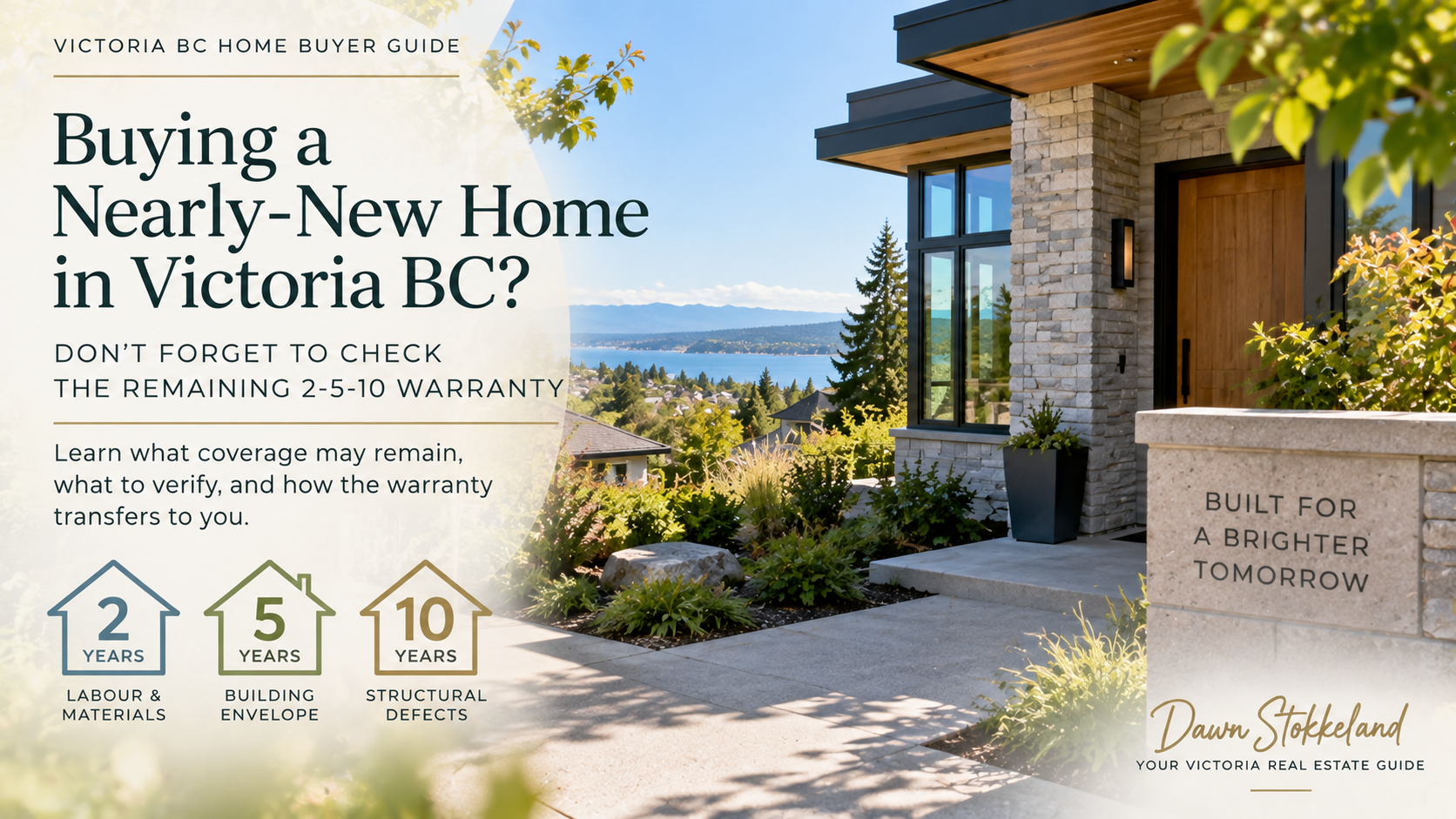
Victoria BC Home Buyer Guide
Buying a Nearly-New Home in Victoria BC? Don’t Forget to Check the Remaining 2-5-10 Warranty
When buyers hear “2-5-10 home warranty,” they often associate it with buying a brand-new home directly from a builder.
But what if you’re buying a home that is already two, three, five or even eight years old?
There may still be valuable warranty coverage attached to the property. In British Columbia, qualifying new homes are generally protected by home warranty insurance, and that coverage is attached to the home rather than the original owner. That means remaining coverage can continue when the property is sold.
The important buyer question
If this home was originally covered by a 2-5-10 warranty, what coverage is still in effect today?
What Is the 2-5-10 Home Warranty in BC?
British Columbia’s mandatory home warranty insurance for applicable new residential construction is commonly referred to as the 2-5-10 warranty.
In general, the minimum coverage includes:
2 Years
Coverage for specified defects in labour and materials, including certain building systems. Different components within this portion of the warranty can have different coverage periods.
5 Years
Coverage for defects in the building envelope, including defects that result in unintended water penetration.
10 Years
Coverage for certain structural defects.
Those are useful headline numbers, but buyers should not assume that every component of a home is covered for a full two, five or ten years. The actual warranty policy, commencement dates and coverage provisions need to be reviewed for the particular property.
Does the Warranty Transfer When the Home Is Sold?
This is one of the most useful things for buyers of newer resale properties to know.
BC Housing explains that home warranty insurance is attached to the home, not to the homeowner. Therefore, if you purchase a qualifying resale home while portions of the original warranty remain in effect, that remaining coverage generally stays with the property.
So a three-year-old townhouse, for example, may no longer have all of its original short-term coverage, but portions of the five-year building-envelope protection and ten-year structural coverage may still remain.
The key word is may. I would want to verify the actual warranty information rather than simply calculating coverage from the year shown on the MLS® listing.
What I Want to Know When My Buyer Is Considering a Nearly-New Home
If you’re considering a newer resale property in Greater Victoria, there are several questions worth investigating before you remove your conditions.
1. When Did the Warranty Coverage Actually Begin?
Don't rely solely on the home's apparent age.
BC Housing has specific rules governing when warranty coverage begins, and the commencement date can depend on the type of property and circumstances of the original sale or occupancy.
That's the date that matters when determining how much warranty coverage may remain.
2. Who Is the Warranty Provider?
I would want to identify the warranty provider and obtain the available warranty documents for the property.
BC Housing's New Homes Registry can be an excellent starting point because buyers can search for information about registered new homes, including the builder or developer and home warranty provider where applicable.
3. Has the Current or Previous Owner Made Warranty Claims?
This is an excellent question to ask.
If warranty work has previously been requested or completed, I would want to understand what the issue was, what repairs were performed and whether there are any outstanding concerns.
Available seller documentation, warranty correspondence and property disclosure information may help form part of that investigation.
4. Are There Outstanding Deficiencies?
A newer home isn't automatically a problem-free home.
Settlement cracks, water intrusion, drainage issues, flooring problems, window concerns or other deficiencies may still need investigation.
If something appears unusual during a showing or inspection, the next question is whether it could fall within remaining warranty coverage—and what steps would be required to address it.
Buying a Nearly-New Condo or Townhouse? There’s Another Layer to Check
Strata buyers should pay particular attention to warranty information because there can be coverage associated with both the individual strata lot and the common property.
That means I don't want to look only at what has happened inside the unit.
I also want to review the strata documents for evidence of building-envelope concerns, water intrusion, common-property deficiencies, warranty claims, engineering investigations or correspondence involving the developer or warranty provider.
Buyer tip: When purchasing a newer strata property, warranty information should be considered alongside the depreciation report, financial statements, meeting minutes and other strata documents—not reviewed in isolation.
Does a 2-5-10 Warranty Mean I Can Skip the Home Inspection?
I wouldn't treat warranty coverage as a substitute for understanding the current condition of the property.
A home inspection and a home warranty serve different purposes.
An inspector can help identify visible conditions and concerns with the home at the time you're considering the purchase. The warranty determines whether certain qualifying defects may be covered under the applicable policy.
In fact, discovering an issue during your due diligence can give you an opportunity to investigate whether warranty coverage might apply before you commit to the purchase.
A Nearly-New Home Is Different From Both a New Build and an Older Resale
This is why I think nearly-new homes deserve their own due-diligence approach.
With a brand-new home, you're starting at or near the beginning of the warranty period.
With an older resale, the original new-home warranty has generally long since expired.
A home that's only a few years old sits somewhere in between. Some coverage may have expired while other potentially important protection may still be in place.
Understanding exactly where the property sits within that timeline can be valuable information when deciding whether to buy.
Nearly-New Homes Around Greater Victoria
This issue can arise anywhere newer construction or redevelopment has occurred throughout Greater Victoria.
Buyers may encounter newer detached homes, townhouses, condos and infill developments in areas such as Royal Oak, Saanich, Gordon Head, Cordova Bay, Cadboro Bay, Sidney, Oak Bay, Fairfield, Fernwood and Esquimalt.
Even in established neighbourhoods dominated by older homes, a newer infill property may have warranty considerations that are very different from the house next door.
Dawn's Take
Don't assume the warranty disappeared when the first owner sold the home.
When I'm helping a buyer purchase a newer resale property, I want to understand more than simply when the home was built.
I want to know when the warranty began, who provided it, what coverage remains and whether there have been previous claims or deficiencies that we should investigate.
It's another example of why good buyer representation goes beyond finding the house. My job is to help you ask the questions you may not have known to ask so that you can make an informed decision.
Frequently Asked Questions
Does the BC 2-5-10 home warranty transfer to a new owner?
Yes, remaining qualifying home warranty insurance is attached to the home rather than the original homeowner. If the property is resold while coverage remains in effect, that remaining coverage generally continues with the home.
What does the 2-5-10 warranty cover in BC?
In general, BC's mandatory new-home warranty provides specified coverage for labour and materials, five years for qualifying building-envelope defects and ten years for certain structural defects. Coverage details, exclusions and commencement dates should be confirmed in the actual policy.
How can I find out if a Victoria home has a new-home warranty?
BC Housing's New Homes Registry is a useful starting point. Buyers can also request available warranty documentation from the seller and review relevant property and strata records.
Should I still get a home inspection if the property has warranty coverage?
A warranty and a home inspection perform different functions. Warranty coverage should not be assumed to mean that there are no current defects or maintenance concerns. An independent home inspection can still be an important part of a buyer's due diligence.
What should I check when buying a newer strata property?
In addition to the individual unit, buyers should review strata records for information about common-property deficiencies, warranty claims, building-envelope concerns, engineering reports and correspondence with the developer or warranty provider.
Helpful BC Home Warranty Resources
BC Housing – Home Warranty Insurance:
Learn about home warranty insurance in British Columbia
BC Housing – New Homes Registry:
Search the BC New Homes Registry
Considering a Newer Home in Greater Victoria?
Whether you're considering a brand-new property or a home that's already a few years old, I'll help you understand the documents, warranty information and due-diligence questions that should be investigated before you buy.
Let's Talk About Your Home Search
Dawn Stokkeland, REALTOR®
eXp Realty | Victoria, British Columbia
Phone: 778.679.7686
Email: info@homesbydawn.ca
Website: www.homesbydawn.ca
Disclaimer: This article is provided for general educational purposes only. Home warranty coverage varies by property, policy, commencement date and circumstances. Buyers should review the actual home warranty insurance documents and confirm current coverage directly with the applicable warranty provider and BC Housing. A REALTOR® can assist with gathering and reviewing relevant real estate documentation but does not determine warranty coverage or provide legal, engineering or building-envelope advice.
Categories
Recent Posts








REVIEWS