
Buyer’s Remorse and Seller Hesitation: How to Make Confident Real Estate Decisions in Victoria, BC
Buyer’s Remorse and Seller Hesitation: How to Make Confident Real Estate Decisions in Victoria, BC
Buying or selling a home is rarely just a financial transaction. It is a decision about security, identity, lifat is why even a well-informed choice can bring an unexpected wave of doubt.
For buyers, that doubt may appear after an accepted offer as buyer’s remorse: Did I pay too much? Did I choose the right neighbourhood? What if a better home comes on the market next week?
For sellers, uncertainty often arrives before the decision is made: What if I sell too soon? What if I cannot find my next home? What if I regret leaving a place filled with memories?
These reactions are normal. They do not necessarily mean that something has gone wrong. More often, they reflect the emotional weight of a major life transition.
As a Victoria Realtor, I believe the best way to reduce anxiety is through clear communication, careful preparation, and education at every stage of the real estate journey. When you understand the process, the local market, your options, and the reasons behind your decision, uncertainty becomes much easier to manage.
Why Real Estate Decisions Feel So Emotional
A home carries meaning that goes far beyond its square footage or assessed value. It may represent independence, stability, achievement, family history, community, or the beginning of a new chapter.
Real estate decisions also involve significant financial commitments and incomplete information. No buyer can tour every property that may come to market. No seller can know with certainty what prices will do in the months ahead. The mind naturally tries to close those information gaps by imagining alternative outcomes.
That is where overthinking begins.
Several common psychological patterns can influence both Victoria homebuyers and sellers:
Loss aversion: People often feel the possibility of losing something more strongly than the possibility of gaining something. A buyer may fear losing financial flexibility, while a seller may fear giving up a home, neighbourhood, or future increase in value.
Choice overload: More options can feel empowering at first, but too many choices may make it harder to commit. Buyers can begin comparing every home with an imaginary “perfect” property that may not exist.
Confirmation bias: Once anxiety takes hold, people may focus on information that supports their fears while overlooking facts that support the decision.
The need for certainty: Real estate rarely provides a completely risk-free moment. Waiting for perfect certainty can lead to prolonged indecision because market conditions, interest rates, inventory, and personal circumstances continue to change.
Recognizing these patterns does not eliminate emotion. It helps separate a valid concern that requires action from a normal emotional response to change.
Understanding Buyer’s Remorse in Victoria Real Estate
Buyer’s remorse is the uneasiness that may arise after making a significant purchase. In real estate, it can begin after an offer is accepted, after subject conditions are removed, or even after possession day.
The feeling may be stronger when a buyer has made several rapid decisions, stretched beyond an initial comfort zone, compromised on part of a wish list, or listened to too many conflicting opinions.
In Greater Victoria, buyers also compare very different property types and communities. A downtown Victoria condo offers a different lifestyle from a home in Saanich, a townhouse in Langford, a character property in Esquimalt, or a quieter option on the Saanich Peninsula. When every choice offers different advantages, second-guessing can become easy.
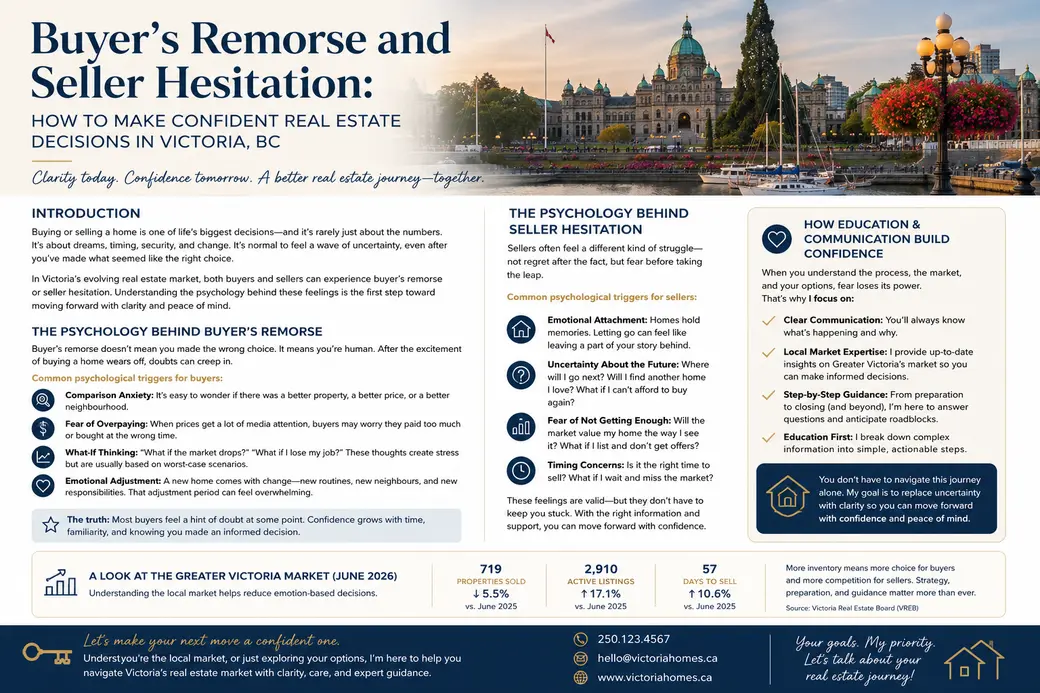
Current market conditions add another layer. In June 2026, 719 properties sold through the Victoria Real Estate Board region, 5.5% fewer than in June 2025. Active listings reached 4,054, up 7.3% year over year. More inventory can give buyers valuable choice and negotiating room, but it may also increase comparison anxiety and the fear that another option could have been better. rn371929search9
Common Causes of Buyer’s Remorse
Fear of overpaying: A buyer may continue watching new listings and recent sales after committing to a home, then interpret every lower asking price as evidence of a mistake. However, asking prices, property condition, location, strata health, renovation quality, and sale terms all affect value.
The “better home” fear: A new listing may appear more attractive online, but photographs and marketing rarely tell the whole story. The home may have drawbacks that are not obvious until it is viewed and investigated.
Emotional fatigue: Mortgage approval, property tours, offer preparation, inspections, documents, insurance, legal arrangements, and moving can create decision fatigue. Exhaustion can make a sound decision feel less secure.
Adjustment stress: Even a positive move disrupts routines. A new commute, unfamiliar sounds, different neighbours, or an unpacked home can temporarily feel uncomfortable.
Outside opinions: Friends and relatives may mean well, but they may not understand the buyer’s finances, priorities, due diligence, or the specific Victoria property involved.
How Buyers Can Reduce Regret
The goal is not to remove all emotion. It is to build a decision that remains understandable after the excitement fades.
Before writing an offer, define the difference between your essential needs, strong preferences, and optional features. Review the total cost of ownership, including mortgage payments, property taxes, insurance, utilities, maintenance, and applicable strata costs. Discuss comparable sales and current competition. Investigate the property carefully and use appropriate professional advice.
After making the decision, return to the facts that supported it. Ask:
- Does this home meet my most important needs?
- Is it affordable within a realistic budget?
- Did I complete appropriate due diligence?
- Does the location support the life I want to live?
- Am I identifying a genuine new problem, or reacting to the normal discomfort of commitment?
British Columbia’s Home Buyer Rescission Period generally gives purchasers of qualifying residential real estate three business days to rescind after acceptance, subject to exclusions and a rescission fee of 0.25% of the purchase price. Buyers should obtain advice about how the rules apply to their specific transaction; for example, the provincial government states that leasehold properties are excluded. ission period is a consumer-protection measure, but it is not a substitute for preparation. A calm, informed process should begin before an offer is written.
Understanding Seller Hesitation in Greater Victoria
Seller hesitation usually occurs before a home is listed. It may look like procrastination, repeated changes to the timeline, resistance to pricing discussions, or a desire to wait for a perfect market signal.
Sometimes hesitation is practical. A seller may need clarity about financing, tax implications, tenancy rules, estate matters, downsizing, or the purchase of a replacement property. Those issues deserve careful professional guidance.
At other times, hesitation is rooted in emotion.
Common Psychological Reasons Sellers Delay
Emotional attachment: A home may hold years of memories. Selling can feel like letting go of part of one’s identity or family story.
Fear of making an irreversible choice: Sellers may worry that once the home is sold, they will never be able to return to the same neighbourhood or property type.
Uncertainty about what comes next: A homeowner may be ready to sell but unclear about where to move, whether to buy first, or how to coordinate possession dates.
Fear of leaving money on the table: Sellers may postpone listing because they worry the market could rise immediately after the sale.
Fear of rejection: A listing that takes time to sell or receives lower offers can feel personal, even though market response is about price, presentation, competition, property type, and buyer demand—not the seller’s worth or the value of their memories.
Overwhelm: Preparing a home, decluttering, arranging repairs, reviewing documents, showing the property, negotiating, and moving can feel like one enormous task.
The June 2026 Greater Victoria figures show why generalized headlines can be misleading. While overall sales were lower year over year, single-family home sales declined 3.5%, condominium sales declined 26.9%, and townhouse sales increased 25.3%. The right strategy therefore depends on the property, price range, condition, neighbourhood, and competing inventory—not merely on whether someone describes the market as “good” or “bad.” ellers Can Move from Hesitation to Clarity
A seller does not need to begin with a commitment to list. The first step can simply be gathering information.
A useful planning conversation should address:
- Your reason for considering a move
- Your ideal and acceptable timelines
- The likely market position of your property
- Preparation that may improve presentation or value
- Expected selling costs and estimated net proceeds
- Your housing plan after the sale
- Risks associated with selling first or buying first
- The emotional concerns that are making the decision difficult
It is also helpful to distinguish between strategic waiting and fear-based waiting.
Strategic waiting has a clear purpose, such as completing a necessary repair, aligning the move with a job change, organizing financing, or waiting for a specific life event.
Fear-based waiting has no defined milestone. It often sounds like, “I will decide when the market feels certain.” Because certainty rarely arrives, the decision continues to be postponed.
A professional real estate plan does not pressure a seller into moving. It gives the seller enough information to make a deliberate choice—even when the best choice is not to list yet.
The Role of Communication and Education
Anxiety grows in information gaps. When buyers and sellers do not know what happens next, they often imagine the worst.
That is why communication is central to my approach as a Victoria Realtor. My role is not simply to arrange showings, place a sign on a lawn, or prepare an offer. It is to help clients understand each stage of the process, the choices available, the consequences of those choices, and the market evidence behind a recommendation.
For buyers, that may include:
- Creating a realistic property and neighbourhood strategy
- Explaining current Greater Victoria market conditions
- Reviewing comparable sales
- Discussing offer terms and subject conditions
- Coordinating appropriate due diligence
- Preparing for closing and possession
For sellers, it may include:
- Reviewing local sales and competing listings
- Developing a pricing and positioning strategy
- Creating a manageable preparation plan
- Explaining showing, feedback, and negotiation processes
- Planning the transition to the next property
- Communicating consistently from consultation through completion
Good communication does not guarantee that every moment will feel easy. It prevents clients from feeling alone, uninformed, or rushed.
Questions Victoria Buyers and Sellers Frequently Ask
Is buyer’s remorse normal after purchasing a home?
Yes. A period of doubt can be a normal response to a large financial commitment and major life change. The important step is to determine whether the concern reveals a material issue or reflects temporary stress, fatigue, or adjustment.
How can I tell whether I am ready to buy in Victoria?
Readiness is not based only on the market. It includes stable financing, a realistic budget, clarity about your needs, an appropriate time horizon, and comfort with the responsibilities of ownership.
Is now a good time to sell a home in Victoria, BC?
There is no universal answer. Results vary by neighbourhood, property type, condition, price range, and competition. A property-specific market analysis is more useful than a broad headline.
Should I wait until I feel completely certain?
Complete certainty is uncommon in real estate. A better standard is informed confidence: you understand the benefits, costs, risks, alternatives, and reasons for your decision.
How does a Realtor help with real estate anxiety?
A strong Realtor turns a complex process into a series of understandable decisions. Clear explanations, current local data, realistic expectations, and consistent updates can reduce uncertainty and help clients remain focused on their goals.
Confidence Comes from a Process, Not a Prediction
Neither buyers nor sellers can control every market movement. The most confident decisions are not based on perfectly predicting the future. They are based on understanding your priorities, examining current evidence, preparing for realistic scenarios, and choosing a path that fits your life.
Buyer’s remorse and seller hesitation are not signs of weakness. They are reminders that real estate decisions matter.
Whether you are considering a condo in Victoria, a family home in Saanich, a townhouse in Langford, a character home in Esquimalt, or a move elsewhere in Greater Victoria, you deserve a process that feels informed, organized, and supported.
If you are thinking about buying or selling and uncertainty is keeping you stuck, let’s begin with a conversation. I will answer your questions, explain the market, and educate you through every step so you can make your next real estate decision with greater clarity and confidence.
Categories
Recent Posts









REVIEWS